

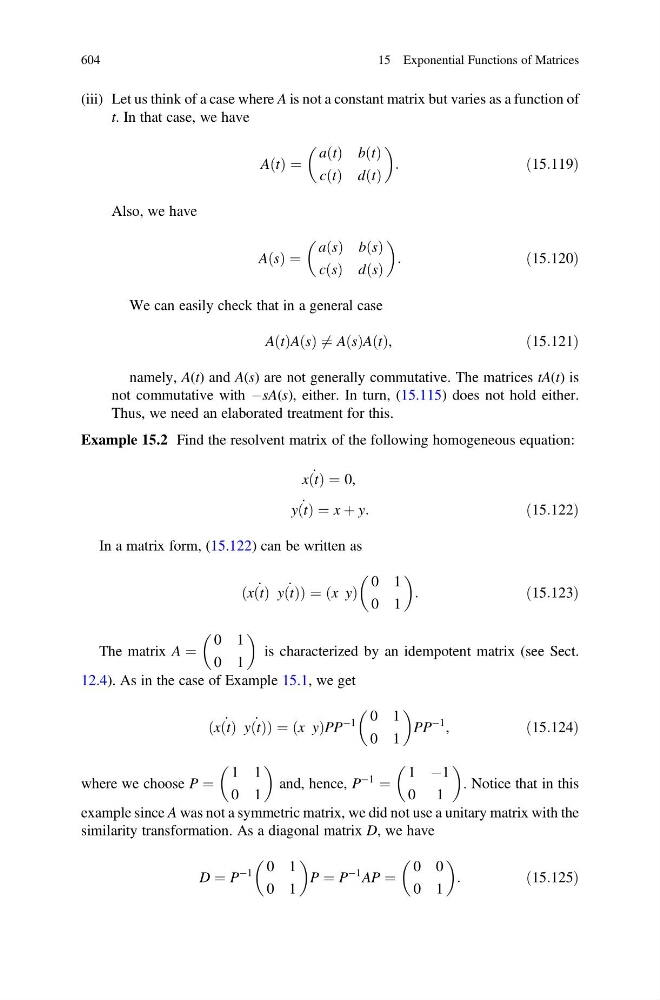
(iii) Let us think of a case where A is not a constant matrix but varies as a function of
t. In that case, we have
A t
ð Þ ¼
a t
ð Þ b t
ð Þ
c t
ð Þ d t
ð Þ
:
ð15:119Þ
Also, we have
A s
ð Þ ¼
a s
ð Þ b s
ð Þ
c s
ð Þ d s
ð Þ
:
ð15:120Þ
We can easily check that in a general case
A t
ð ÞA s
ð Þ 6 ¼ A s
ð ÞA t
ð Þ,
ð15:121Þ
namely, A(t) and A(s) are not generally commutative. The matrices tA(t) is
not commutative with ÀsA(s), either. In turn, (15.115) does not hold either.
Thus, we need an elaborated treatment for this.
Example 15.2 Find the resolvent matrix of the following homogeneous equation:
_
x t
ð Þ ¼ 0,
_
y t
ð Þ ¼ x þ y:
ð15:122Þ
In a matrix form, (15.122) can be written as
ð _
x t
ð Þ _
y t
ð ÞÞ ¼ x y
ð Þ
0 1
0 1
:
ð15:123Þ
The matrix A ¼
0 1
0 1
is characterized by an idempotent matrix (see Sect.
12.4). As in the case of Example 15.1, we get
ð _
x t
ð Þ _
y t
ð ÞÞ ¼ x y
ð ÞPP
À1 0 1
0 1
PP
À1 ,
ð15:124Þ
where we choose P ¼
1 1
0 1
and, hence, P
À1
¼
1 À1
0 1
. Notice that in this
example since A was not a symmetric matrix, we did not use a unitary matrix with the
similarity transformation. As a diagonal matrix D, we have
D ¼ P
À1 0 1
0 1
P ¼ P
À1 AP ¼
0 0
0 1
:
ð15:125Þ
604
15 Exponential Functions of Matrices