

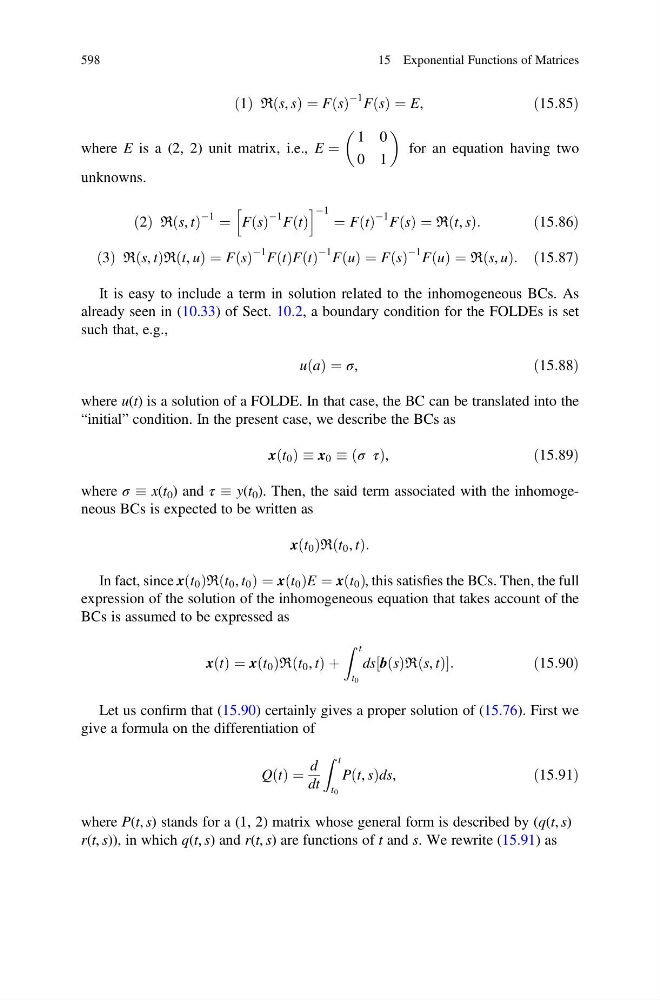
1
ð Þ R s, s
ð Þ ¼ F s
ð Þ
À1 F s
ð Þ ¼ E,
ð15:85Þ
where E is a (2, 2) unit matrix, i.e., E ¼
1 0
0 1
for an equation having two
unknowns.
2
ð Þ R s, t
ð Þ
À1 ¼ F s
ð Þ
À1 F t
ð Þ
h
i À1 ¼ F t
ð Þ
À1 F s
ð Þ ¼ R t, s
ð Þ:
ð15:86Þ
3
ð Þ R s, t
ð ÞR t, u
ð Þ ¼ F s
ð Þ
À1 F t
ð ÞF t
ð Þ
À1 F u
ð Þ ¼ F s
ð Þ
À1 F u
ð Þ ¼ R s, u
ð Þ: ð15:87Þ
It is easy to include a term in solution related to the inhomogeneous BCs. As
already seen in (10.33) of Sect. 10.2, a boundary condition for the FOLDEs is set
such that, e.g.,
u a
ð Þ ¼ σ,
ð15:88Þ
where u(t) is a solution of a FOLDE. In that case, the BC can be translated into the
“initial” condition. In the present case, we describe the BCs as
x t 0
ð Þ x 0 σ τ
ð Þ,
ð15:89Þ
where σ x(t 0 ) and τ y(t 0 ). Then, the said term associated with the inhomogeneous BCs is expected to be written as
x t 0
ð ÞR t 0 , t
ð Þ:
In fact, since x t 0
ð ÞR t 0 , t 0
ð
Þ¼x t 0
ð ÞE ¼ x t 0
ð Þ, this satisfies the BCs. Then, the full
expression of the solution of the inhomogeneous equation that takes account of the
BCs is assumed to be expressed as
x t
ð Þ ¼ x t 0
ð Þℜ t 0 , t
ð Þþ
Z t
t 0
ds b s
ð Þℜ s, t
ð Þ
½
:
ð15:90Þ
Let us confirm that (15.90) certainly gives a proper solution of (15.76). First we
give a formula on the differentiation of
Q t
ð Þ ¼
d
dt
Z t
t 0
P t, s
ð Þds,
ð15:91Þ
where P(t, s) stands for a (1, 2) matrix whose general form is described by (q(t, s)
r(t, s)), in which q(t, s) and r(t, s) are functions of t and s. We rewrite (15.91) as
598
15 Exponential Functions of Matrices