

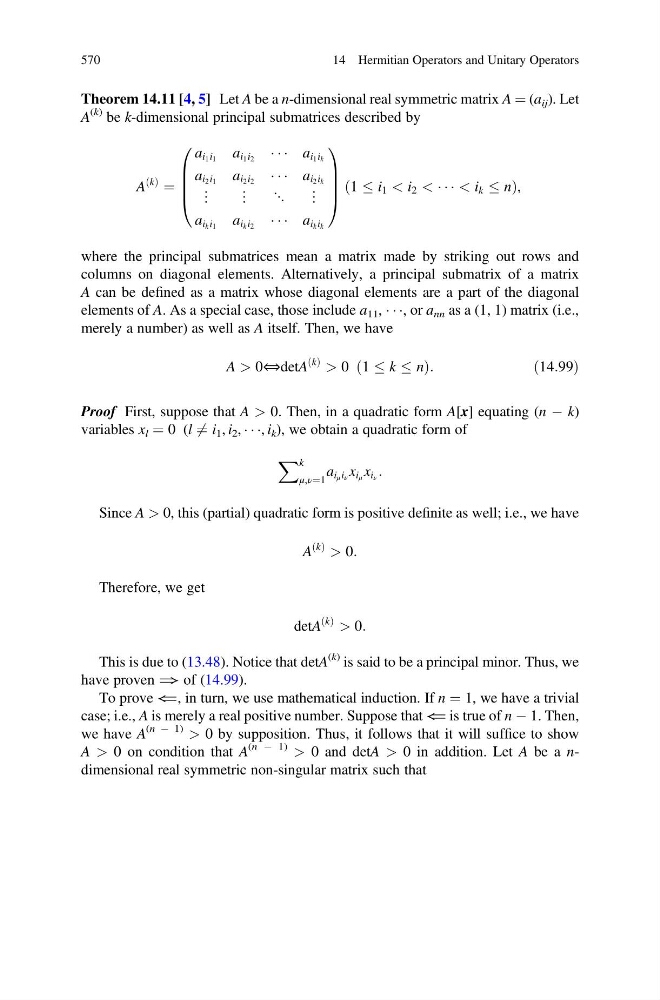
Theorem 14.11 [4, 5] Let A be a n-dimensional real symmetric matrix A ¼ (a ij ). Let
A
(k) be k-dimensional principal submatrices described by
A
k
ð Þ
¼
a i 1 i 1 a i 1 i 2 Á Á Á a i 1 i k
a i 2 i 1 a i 2 i 2 Á Á Á a i 2 i k
⋮
⋮ ⋱ ⋮
a i k i 1 a i k i 2 Á Á Á a i k i k
0
B
B
B
@
1
C
C
C
A
1 i 1 < i 2 < Á Á Á < i k n
ð
Þ ,
where the principal submatrices mean a matrix made by striking out rows and
columns on diagonal elements. Alternatively, a principal submatrix of a matrix
A can be defined as a matrix whose diagonal elements are a part of the diagonal
elements of A. As a special case, those include a 11 , Á Á Á, or a nn as a (1, 1) matrix (i.e.,
merely a number) as well as A itself. Then, we have
A > 0⟺detA
k
ð Þ
> 0 1 k n
ð
Þ :
ð14:99Þ
Proof First, suppose that A > 0. Then, in a quadratic form A[x] equating (n À k)
variables x l ¼ 0 (l 6 ¼ i 1 , i 2 , Á Á Á, i k ), we obtain a quadratic form of
X k
μ,ν¼1
a i μ i ν x i μ x i ν :
Since A > 0, this (partial) quadratic form is positive definite as well; i.e., we have
A
k
ð Þ
> 0:
Therefore, we get
detA
k
ð Þ
> 0:
This is due to (13.48). Notice that detA
(k) is said to be a principal minor. Thus, we
have proven ⟹ of (14.99).
To prove ⟸, in turn, we use mathematical induction. If n ¼ 1, we have a trivial
case; i.e., A is merely a real positive number. Suppose that ⟸ is true of n À 1. Then,
we have A
(n À 1)
> 0 by supposition. Thus, it follows that it will suffice to show
A > 0 on condition that A
(n À 1)
> 0 and detA > 0 in addition. Let A be a ndimensional real symmetric non-singular matrix such that
570
14 Hermitian Operators and Unitary Operators
A
(k) be k-dimensional principal submatrices described by
A
k
ð Þ
¼
a i 1 i 1 a i 1 i 2 Á Á Á a i 1 i k
a i 2 i 1 a i 2 i 2 Á Á Á a i 2 i k
⋮
⋮ ⋱ ⋮
a i k i 1 a i k i 2 Á Á Á a i k i k
0
B
B
B
@
1
C
C
C
A
1 i 1 < i 2 < Á Á Á < i k n
ð
Þ ,
where the principal submatrices mean a matrix made by striking out rows and
columns on diagonal elements. Alternatively, a principal submatrix of a matrix
A can be defined as a matrix whose diagonal elements are a part of the diagonal
elements of A. As a special case, those include a 11 , Á Á Á, or a nn as a (1, 1) matrix (i.e.,
merely a number) as well as A itself. Then, we have
A > 0⟺detA
k
ð Þ
> 0 1 k n
ð
Þ :
ð14:99Þ
Proof First, suppose that A > 0. Then, in a quadratic form A[x] equating (n À k)
variables x l ¼ 0 (l 6 ¼ i 1 , i 2 , Á Á Á, i k ), we obtain a quadratic form of
X k
μ,ν¼1
a i μ i ν x i μ x i ν :
Since A > 0, this (partial) quadratic form is positive definite as well; i.e., we have
A
k
ð Þ
> 0:
Therefore, we get
detA
k
ð Þ
> 0:
This is due to (13.48). Notice that detA
(k) is said to be a principal minor. Thus, we
have proven ⟹ of (14.99).
To prove ⟸, in turn, we use mathematical induction. If n ¼ 1, we have a trivial
case; i.e., A is merely a real positive number. Suppose that ⟸ is true of n À 1. Then,
we have A
(n À 1)
> 0 by supposition. Thus, it follows that it will suffice to show
A > 0 on condition that A
(n À 1)
> 0 and detA > 0 in addition. Let A be a ndimensional real symmetric non-singular matrix such that
570
14 Hermitian Operators and Unitary Operators