

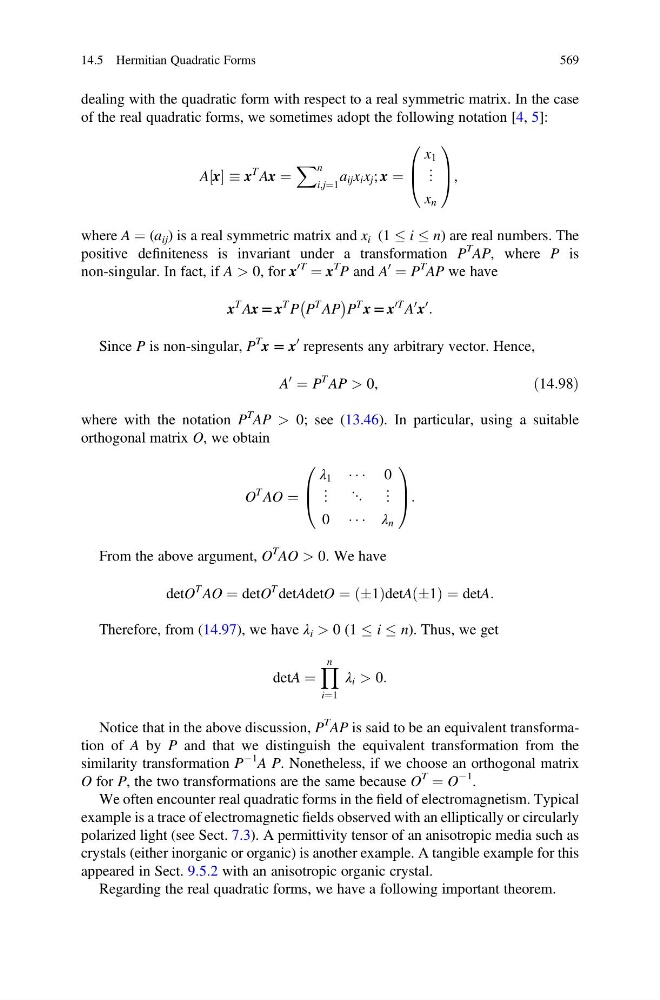
dealing with the quadratic form with respect to a real symmetric matrix. In the case
of the real quadratic forms, we sometimes adopt the following notation [4, 5]:
A x
½ x
T Ax ¼
X n
i,j¼1
a ij x i x j ; x ¼
x 1
⋮
x n
0
B
@
1
C
A,
where A ¼ (a ij ) is a real symmetric matrix and x i (1 i n) are real numbers. The
positive definiteness is invariant under a transformation P
T AP, where P is
non-singular. In fact, if A > 0, for x
0T
¼ x
T
P and A
0
¼ P
T AP we have
x
T Ax = x
T P P
T AP
À
Á
P
T
x = x
0T A
0
x
0
:
Since P is non-singular, P
T
x = x
0 represents any arbitrary vector. Hence,
A
0
¼ P
T AP > 0,
ð14:98Þ
where with the notation P
T AP > 0; see (13.46). In particular, using a suitable
orthogonal matrix O, we obtain
O
T AO ¼
λ 1 Á Á Á 0
⋮ ⋱ ⋮
0 Á Á Á λ n
0
B
@
1
C
A:
From the above argument, O
T AO > 0. We have
detO
T AO ¼ detO
T detAdetO ¼ Æ1
ð ÞdetA Æ1
ð Þ ¼ detA:
Therefore, from (14.97), we have λ i > 0 (1 i n). Thus, we get
detA ¼
Y n
i¼1
λ i > 0:
Notice that in the above discussion, P
T AP is said to be an equivalent transformation of A by P and that we distinguish the equivalent transformation from the
similarity transformation P
À1 A P. Nonetheless, if we choose an orthogonal matrix
O for P, the two transformations are the same because O
T
¼ O
À1 .
We often encounter real quadratic forms in the field of electromagnetism. Typical
example is a trace of electromagnetic fields observed with an elliptically or circularly
polarized light (see Sect. 7.3). A permittivity tensor of an anisotropic media such as
crystals (either inorganic or organic) is another example. A tangible example for this
appeared in Sect. 9.5.2 with an anisotropic organic crystal.
Regarding the real quadratic forms, we have a following important theorem.
14.5 Hermitian Quadratic Forms
569
of the real quadratic forms, we sometimes adopt the following notation [4, 5]:
A x
½ x
T Ax ¼
X n
i,j¼1
a ij x i x j ; x ¼
x 1
⋮
x n
0
B
@
1
C
A,
where A ¼ (a ij ) is a real symmetric matrix and x i (1 i n) are real numbers. The
positive definiteness is invariant under a transformation P
T AP, where P is
non-singular. In fact, if A > 0, for x
0T
¼ x
T
P and A
0
¼ P
T AP we have
x
T Ax = x
T P P
T AP
À
Á
P
T
x = x
0T A
0
x
0
:
Since P is non-singular, P
T
x = x
0 represents any arbitrary vector. Hence,
A
0
¼ P
T AP > 0,
ð14:98Þ
where with the notation P
T AP > 0; see (13.46). In particular, using a suitable
orthogonal matrix O, we obtain
O
T AO ¼
λ 1 Á Á Á 0
⋮ ⋱ ⋮
0 Á Á Á λ n
0
B
@
1
C
A:
From the above argument, O
T AO > 0. We have
detO
T AO ¼ detO
T detAdetO ¼ Æ1
ð ÞdetA Æ1
ð Þ ¼ detA:
Therefore, from (14.97), we have λ i > 0 (1 i n). Thus, we get
detA ¼
Y n
i¼1
λ i > 0:
Notice that in the above discussion, P
T AP is said to be an equivalent transformation of A by P and that we distinguish the equivalent transformation from the
similarity transformation P
À1 A P. Nonetheless, if we choose an orthogonal matrix
O for P, the two transformations are the same because O
T
¼ O
À1 .
We often encounter real quadratic forms in the field of electromagnetism. Typical
example is a trace of electromagnetic fields observed with an elliptically or circularly
polarized light (see Sect. 7.3). A permittivity tensor of an anisotropic media such as
crystals (either inorganic or organic) is another example. A tangible example for this
appeared in Sect. 9.5.2 with an anisotropic organic crystal.
Regarding the real quadratic forms, we have a following important theorem.
14.5 Hermitian Quadratic Forms
569