

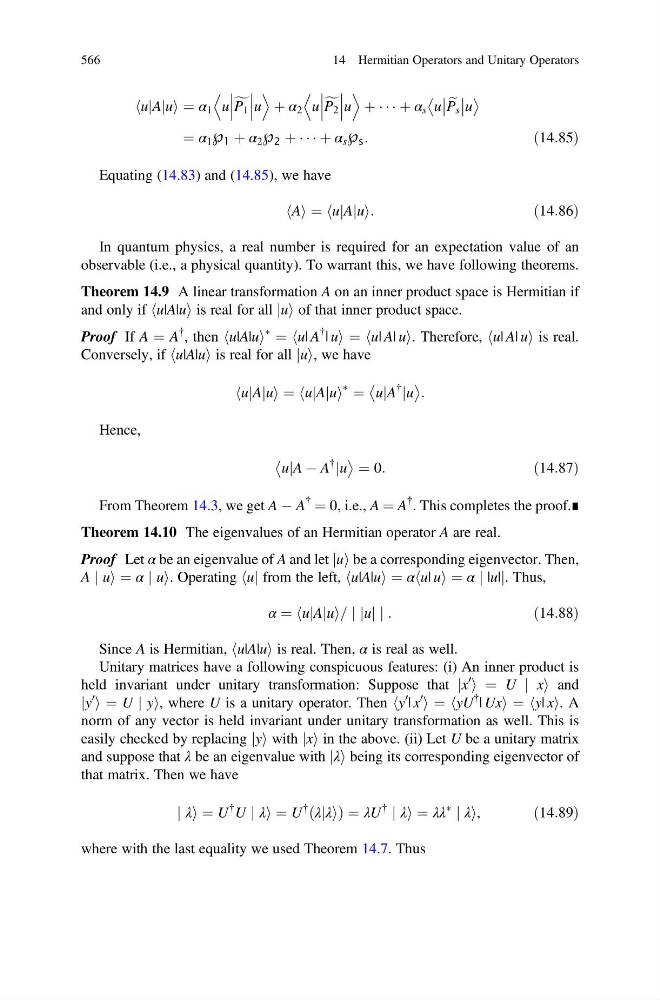
u A
j ju
h
i¼ α 1 u f
P 1
u
D
E
þ α 2 u f
P 2
u
D
E
þ Á Á Á þ α s u e
P s
u
¼ α 1 ℘ 1 þ α 2 ℘ 2 þ Á Á Á þ α s ℘ s :
ð14:85Þ
Equating (14.83) and (14.85), we have
A
h i ¼ u A
j ju
h
i:
ð14:86Þ
In quantum physics, a real number is required for an expectation value of an
observable (i.e., a physical quantity). To warrant this, we have following theorems.
Theorem 14.9 A linear transformation A on an inner product space is Hermitian if
and only if hu|A|ui is real for all jui of that inner product space.
Proof If A ¼ A
{ , then hu|A|ui
Ã
¼ hu| A
{ | ui ¼ hu| A| ui. Therefore, hu| A| ui is real.
Conversely, if hu|A|ui is real for all jui, we have
u A
j ju
h
i¼ u A
j ju
h
i
à ¼ ujA
{
ju
:
Hence,
ujA À A
{
ju
¼ 0:
ð14:87Þ
From Theorem 14.3, we get A À A
{ ¼ 0, i.e., A ¼ A
{ . This completes the proof.∎
Theorem 14.10 The eigenvalues of an Hermitian operator A are real.
Proof Let α be an eigenvalue of A and let jui be a corresponding eigenvector. Then,
A j ui ¼ α j ui. Operating huj from the left, hu|A|ui ¼ αhu| ui ¼ α j |u|j. Thus,
α ¼ u A
j ju
h
i= j u
j j j :
ð14:88Þ
Since A is Hermitian, hu|A|ui is real. Then, α is real as well.
Unitary matrices have a following conspicuous features: (i) An inner product is
held invariant under unitary transformation: Suppose that jx
0
i ¼ U j xi and
jy
0
i ¼ U j yi, where U is a unitary operator. Then hy
0 | x
0
i ¼ hyU
{ | Uxi ¼ hy| xi. A
norm of any vector is held invariant under unitary transformation as well. This is
easily checked by replacing jyi with jxi in the above. (ii) Let U be a unitary matrix
and suppose that λ be an eigenvalue with jλi being its corresponding eigenvector of
that matrix. Then we have
j λi ¼ U
{ U j λi ¼ U
{
λjλi
ð
Þ ¼ λU
{
j λi ¼ λλ
Ã
j λi,
ð14:89Þ
where with the last equality we used Theorem 14.7. Thus
566
14 Hermitian Operators and Unitary Operators
j ju
h
i¼ α 1 u f
P 1
u
D
E
þ α 2 u f
P 2
u
D
E
þ Á Á Á þ α s u e
P s
u
¼ α 1 ℘ 1 þ α 2 ℘ 2 þ Á Á Á þ α s ℘ s :
ð14:85Þ
Equating (14.83) and (14.85), we have
A
h i ¼ u A
j ju
h
i:
ð14:86Þ
In quantum physics, a real number is required for an expectation value of an
observable (i.e., a physical quantity). To warrant this, we have following theorems.
Theorem 14.9 A linear transformation A on an inner product space is Hermitian if
and only if hu|A|ui is real for all jui of that inner product space.
Proof If A ¼ A
{ , then hu|A|ui
Ã
¼ hu| A
{ | ui ¼ hu| A| ui. Therefore, hu| A| ui is real.
Conversely, if hu|A|ui is real for all jui, we have
u A
j ju
h
i¼ u A
j ju
h
i
à ¼ ujA
{
ju
:
Hence,
ujA À A
{
ju
¼ 0:
ð14:87Þ
From Theorem 14.3, we get A À A
{ ¼ 0, i.e., A ¼ A
{ . This completes the proof.∎
Theorem 14.10 The eigenvalues of an Hermitian operator A are real.
Proof Let α be an eigenvalue of A and let jui be a corresponding eigenvector. Then,
A j ui ¼ α j ui. Operating huj from the left, hu|A|ui ¼ αhu| ui ¼ α j |u|j. Thus,
α ¼ u A
j ju
h
i= j u
j j j :
ð14:88Þ
Since A is Hermitian, hu|A|ui is real. Then, α is real as well.
Unitary matrices have a following conspicuous features: (i) An inner product is
held invariant under unitary transformation: Suppose that jx
0
i ¼ U j xi and
jy
0
i ¼ U j yi, where U is a unitary operator. Then hy
0 | x
0
i ¼ hyU
{ | Uxi ¼ hy| xi. A
norm of any vector is held invariant under unitary transformation as well. This is
easily checked by replacing jyi with jxi in the above. (ii) Let U be a unitary matrix
and suppose that λ be an eigenvalue with jλi being its corresponding eigenvector of
that matrix. Then we have
j λi ¼ U
{ U j λi ¼ U
{
λjλi
ð
Þ ¼ λU
{
j λi ¼ λλ
Ã
j λi,
ð14:89Þ
where with the last equality we used Theorem 14.7. Thus
566
14 Hermitian Operators and Unitary Operators