

In quantum physics, one frequently treats expectation value of an operator. In
general, such an operator is Hermitian, more strictly an observable. Moreover, a
vector on an inner product space is interpreted as a state on a Hilbert space. Suppose
that there is a linear operator (or observable that represents a physical quantity)
O that has discrete (or countable) eigenvalues α 1 , α 2 , Á Á Á. The number of the
eigenvalues may be a finite number or an infinite number, but here we assume the
finite number; i.e., let us suppose that we have eigenvalues α 1 , α 2 , Á Á Á, and α s , in
consistent with our previous discussion.
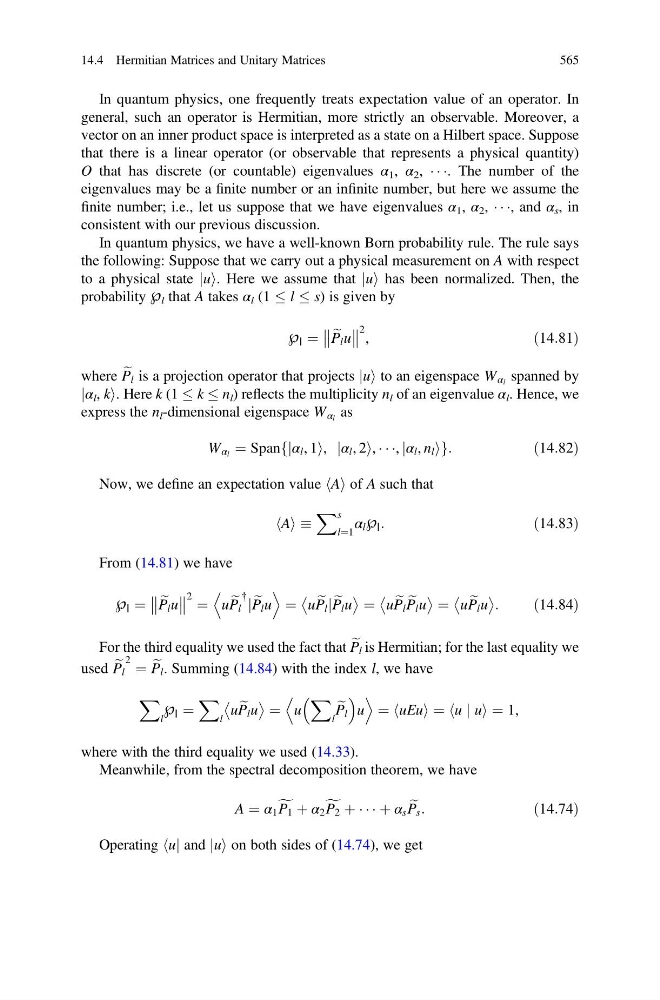
In quantum physics, we have a well-known Born probability rule. The rule says
the following: Suppose that we carry out a physical measurement on A with respect
to a physical state jui. Here we assume that jui has been normalized. Then, the
probability ℘ l that A takes α l (1 l s) is given by
℘ l ¼ e
P l u
2 ,
ð14:81Þ
where e
P l is a projection operator that projects jui to an eigenspace W α l spanned by
jα l , ki. Here k (1 k n l ) reflects the multiplicity n l of an eigenvalue α l . Hence, we
express the n l -dimensional eigenspace W α l as
W α l ¼ Span jα l , 1i, jα l , 2i, Á Á Á, jα l , n l i
f
g :
ð14:82Þ
Now, we define an expectation value hAi of A such that
A
h i
X s
l¼1
α l ℘ l :
ð14:83Þ
From (14.81) we have
℘ l ¼ e
P l u
2 ¼ u e
P l
{ j e
P l u
D
E
¼ u e
P l j e
P l u
¼ u e
P l e
P l u
¼ u e
P l u
:
ð14:84Þ
For the third equality we used the fact that e
P l is Hermitian; for the last equality we
used e
P l
2 ¼ e
P l . Summing (14.84) with the index l, we have
X
l
℘ l ¼
X
l
u e
P l u
¼ u
X
l
e
P l
u
D
E
¼ uEu
h
i ¼ u j u
h
i¼ 1,
where with the third equality we used (14.33).
Meanwhile, from the spectral decomposition theorem, we have
A ¼ α 1 f P 1 þ α 2 f P 2 þ Á Á Á þ α s e
P s :
ð14:74Þ
Operating huj and jui on both sides of (14.74), we get
14.4 Hermitian Matrices and Unitary Matrices
565
general, such an operator is Hermitian, more strictly an observable. Moreover, a
vector on an inner product space is interpreted as a state on a Hilbert space. Suppose
that there is a linear operator (or observable that represents a physical quantity)
O that has discrete (or countable) eigenvalues α 1 , α 2 , Á Á Á. The number of the
eigenvalues may be a finite number or an infinite number, but here we assume the
finite number; i.e., let us suppose that we have eigenvalues α 1 , α 2 , Á Á Á, and α s , in
consistent with our previous discussion.
In quantum physics, we have a well-known Born probability rule. The rule says
the following: Suppose that we carry out a physical measurement on A with respect
to a physical state jui. Here we assume that jui has been normalized. Then, the
probability ℘ l that A takes α l (1 l s) is given by
℘ l ¼ e
P l u
2 ,
ð14:81Þ
where e
P l is a projection operator that projects jui to an eigenspace W α l spanned by
jα l , ki. Here k (1 k n l ) reflects the multiplicity n l of an eigenvalue α l . Hence, we
express the n l -dimensional eigenspace W α l as
W α l ¼ Span jα l , 1i, jα l , 2i, Á Á Á, jα l , n l i
f
g :
ð14:82Þ
Now, we define an expectation value hAi of A such that
A
h i
X s
l¼1
α l ℘ l :
ð14:83Þ
From (14.81) we have
℘ l ¼ e
P l u
2 ¼ u e
P l
{ j e
P l u
D
E
¼ u e
P l j e
P l u
¼ u e
P l e
P l u
¼ u e
P l u
:
ð14:84Þ
For the third equality we used the fact that e
P l is Hermitian; for the last equality we
used e
P l
2 ¼ e
P l . Summing (14.84) with the index l, we have
X
l
℘ l ¼
X
l
u e
P l u
¼ u
X
l
e
P l
u
D
E
¼ uEu
h
i ¼ u j u
h
i¼ 1,
where with the third equality we used (14.33).
Meanwhile, from the spectral decomposition theorem, we have
A ¼ α 1 f P 1 þ α 2 f P 2 þ Á Á Á þ α s e
P s :
ð14:74Þ
Operating huj and jui on both sides of (14.74), we get
14.4 Hermitian Matrices and Unitary Matrices
565