

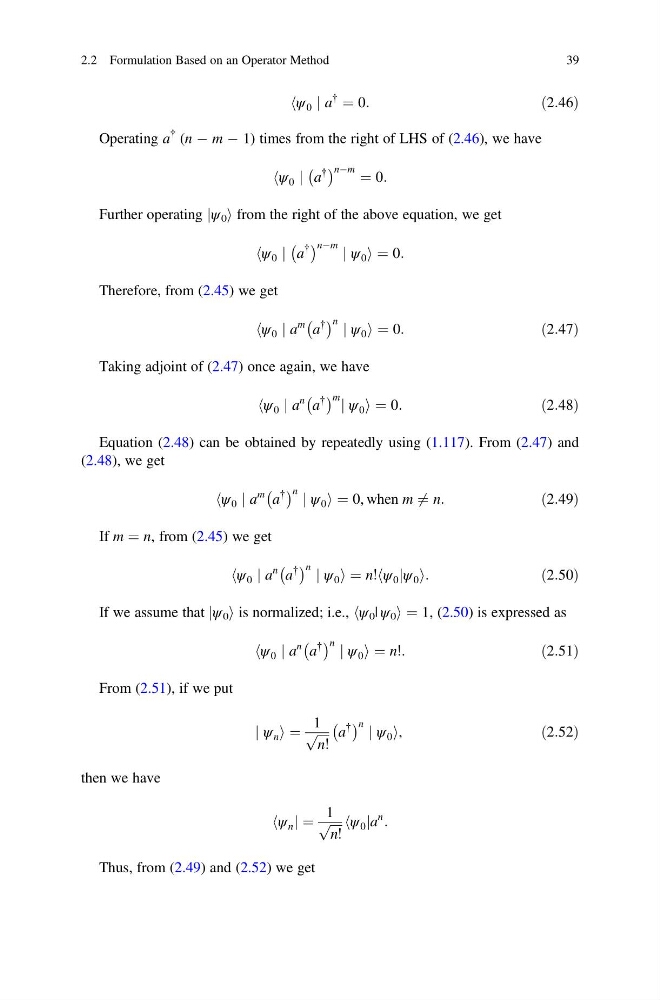
ψ 0
h j a
{
¼ 0:
ð2:46Þ
Operating a
{ (n À m À 1) times from the right of LHS of (2.46), we have
ψ 0
h j a
{
À Á nÀm ¼ 0:
Further operating jψ 0 i from the right of the above equation, we get
hψ 0 j a
{
À Á nÀm j ψ 0 i ¼ 0:
Therefore, from (2.45) we get
hψ 0 j a
m a
{
À Á n j ψ 0 i ¼ 0:
ð2:47Þ
Taking adjoint of (2.47) once again, we have
hψ 0 j a
n a
{
À Á m j ψ 0 i ¼ 0:
ð2:48Þ
Equation (2.48) can be obtained by repeatedly using (1.117). From (2.47) and
(2.48), we get
hψ 0 j a
m a
{
À Á n j ψ 0 i ¼ 0, when m 6 ¼ n:
ð2:49Þ
If m ¼ n, from (2.45) we get
hψ 0 j a
n a
{
À Á n j ψ 0 i ¼ n! ψ 0 jψ 0 i
h
:
ð2:50Þ
If we assume that jψ 0 i is normalized; i.e., hψ 0 | ψ 0 i ¼ 1, (2.50) is expressed as
hψ 0 j a
n a
{
À Á n j ψ 0 i ¼ n!:
ð2:51Þ
From (2.51), if we put
j ψ n i ¼
1
ffiffiffiffi
n!
p a
{
À Á n j ψ 0 i,
ð2:52Þ
then we have
ψ n j
h
¼
1
ffiffiffiffi
n!
p ψ 0 j
h a
n
:
Thus, from (2.49) and (2.52) we get
2.2 Formulation Based on an Operator Method
39
h j a
{
¼ 0:
ð2:46Þ
Operating a
{ (n À m À 1) times from the right of LHS of (2.46), we have
ψ 0
h j a
{
À Á nÀm ¼ 0:
Further operating jψ 0 i from the right of the above equation, we get
hψ 0 j a
{
À Á nÀm j ψ 0 i ¼ 0:
Therefore, from (2.45) we get
hψ 0 j a
m a
{
À Á n j ψ 0 i ¼ 0:
ð2:47Þ
Taking adjoint of (2.47) once again, we have
hψ 0 j a
n a
{
À Á m j ψ 0 i ¼ 0:
ð2:48Þ
Equation (2.48) can be obtained by repeatedly using (1.117). From (2.47) and
(2.48), we get
hψ 0 j a
m a
{
À Á n j ψ 0 i ¼ 0, when m 6 ¼ n:
ð2:49Þ
If m ¼ n, from (2.45) we get
hψ 0 j a
n a
{
À Á n j ψ 0 i ¼ n! ψ 0 jψ 0 i
h
:
ð2:50Þ
If we assume that jψ 0 i is normalized; i.e., hψ 0 | ψ 0 i ¼ 1, (2.50) is expressed as
hψ 0 j a
n a
{
À Á n j ψ 0 i ¼ n!:
ð2:51Þ
From (2.51), if we put
j ψ n i ¼
1
ffiffiffiffi
n!
p a
{
À Á n j ψ 0 i,
ð2:52Þ
then we have
ψ n j
h
¼
1
ffiffiffiffi
n!
p ψ 0 j
h a
n
:
Thus, from (2.49) and (2.52) we get
2.2 Formulation Based on an Operator Method
39