

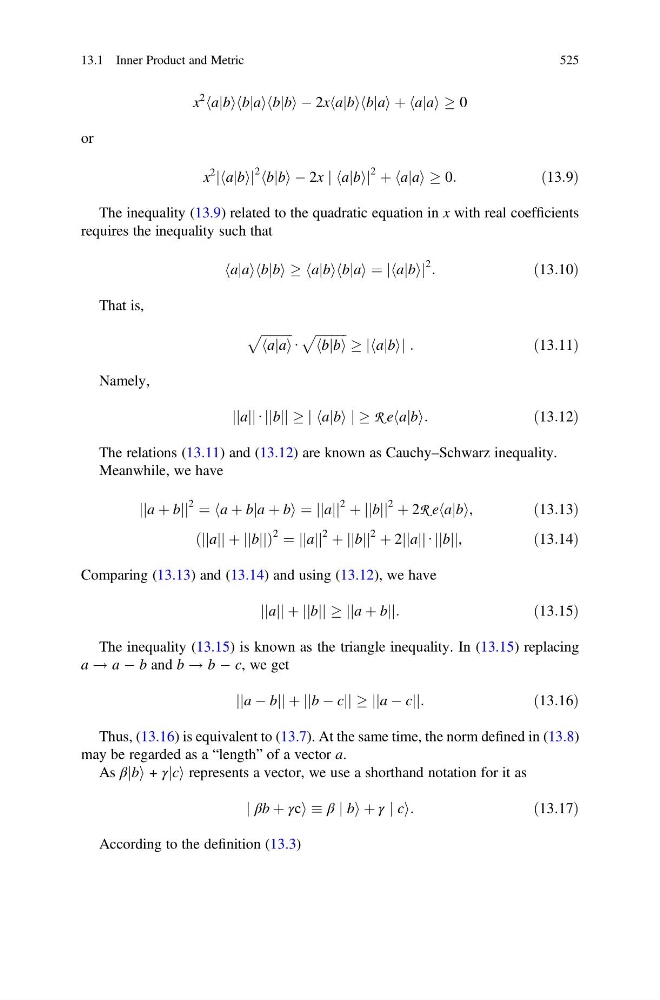
x
2 ajb
h i bja
h i bjb
h iÀ2x ajb
h i bja
h iþ aja
h i ! 0
or
x
2 ajb
h i
j
j
2 bjb
h iÀ2x j ha bi
j j
2 þ aja
h i ! 0:
ð13:9Þ
The inequality (13.9) related to the quadratic equation in x with real coefficients
requires the inequality such that
aja
h i bjb
h i ! ajb
h i bja
h i ¼ jha bi
j j
2 :
ð13:10Þ
That is,
ffiffiffiffiffiffiffiffiffiffi
aja
h i
p
∙
ffiffiffiffiffiffiffiffiffiffi
bjb
h i
p
! j ajb
h ij :
ð13:11Þ
Namely,
ja
j jj∙ jb
j jj ! j ajb
h i j ! R e ajb
h i:
ð13:12Þ
The relations (13.11) and (13.12) are known as Cauchy–Schwarz inequality.
Meanwhile, we have
a þ b
j
j
j
j
2 ¼ a þ bja þ b
h
i¼ a
j j
j j
2 þ b
j j
j j
2 þ 2R e ajb
h i,
ð13:13Þ
j a
j jj þ j b
j jj
ð
Þ
2 ¼ a
j j
j j
2 þ b
j j
j j
2 þ 2 ja
j jj∙ jb
j jj,
ð13:14Þ
Comparing (13.13) and (13.14) and using (13.12), we have
ja
j jj þ jb
j jj ! ja þ b
j
jj:
ð13:15Þ
The inequality (13.15) is known as the triangle inequality. In (13.15) replacing
a ! a À b and b ! b À c, we get
ja À b
j
jjþ jb À c
j
jj! ja À c
j
jj:
ð13:16Þ
Thus, (13.16) is equivalent to (13.7). At the same time, the norm defined in (13.8)
may be regarded as a “length” of a vector a.
As βjbi + γjci represents a vector, we use a shorthand notation for it as
j βb þ γci β j bi þ γ j ci:
ð13:17Þ
According to the definition (13.3)
13.1 Inner Product and Metric
525
2 ajb
h i bja
h i bjb
h iÀ2x ajb
h i bja
h iþ aja
h i ! 0
or
x
2 ajb
h i
j
j
2 bjb
h iÀ2x j ha bi
j j
2 þ aja
h i ! 0:
ð13:9Þ
The inequality (13.9) related to the quadratic equation in x with real coefficients
requires the inequality such that
aja
h i bjb
h i ! ajb
h i bja
h i ¼ jha bi
j j
2 :
ð13:10Þ
That is,
ffiffiffiffiffiffiffiffiffiffi
aja
h i
p
∙
ffiffiffiffiffiffiffiffiffiffi
bjb
h i
p
! j ajb
h ij :
ð13:11Þ
Namely,
ja
j jj∙ jb
j jj ! j ajb
h i j ! R e ajb
h i:
ð13:12Þ
The relations (13.11) and (13.12) are known as Cauchy–Schwarz inequality.
Meanwhile, we have
a þ b
j
j
j
j
2 ¼ a þ bja þ b
h
i¼ a
j j
j j
2 þ b
j j
j j
2 þ 2R e ajb
h i,
ð13:13Þ
j a
j jj þ j b
j jj
ð
Þ
2 ¼ a
j j
j j
2 þ b
j j
j j
2 þ 2 ja
j jj∙ jb
j jj,
ð13:14Þ
Comparing (13.13) and (13.14) and using (13.12), we have
ja
j jj þ jb
j jj ! ja þ b
j
jj:
ð13:15Þ
The inequality (13.15) is known as the triangle inequality. In (13.15) replacing
a ! a À b and b ! b À c, we get
ja À b
j
jjþ jb À c
j
jj! ja À c
j
jj:
ð13:16Þ
Thus, (13.16) is equivalent to (13.7). At the same time, the norm defined in (13.8)
may be regarded as a “length” of a vector a.
As βjbi + γjci represents a vector, we use a shorthand notation for it as
j βb þ γci β j bi þ γ j ci:
ð13:17Þ
According to the definition (13.3)
13.1 Inner Product and Metric
525