

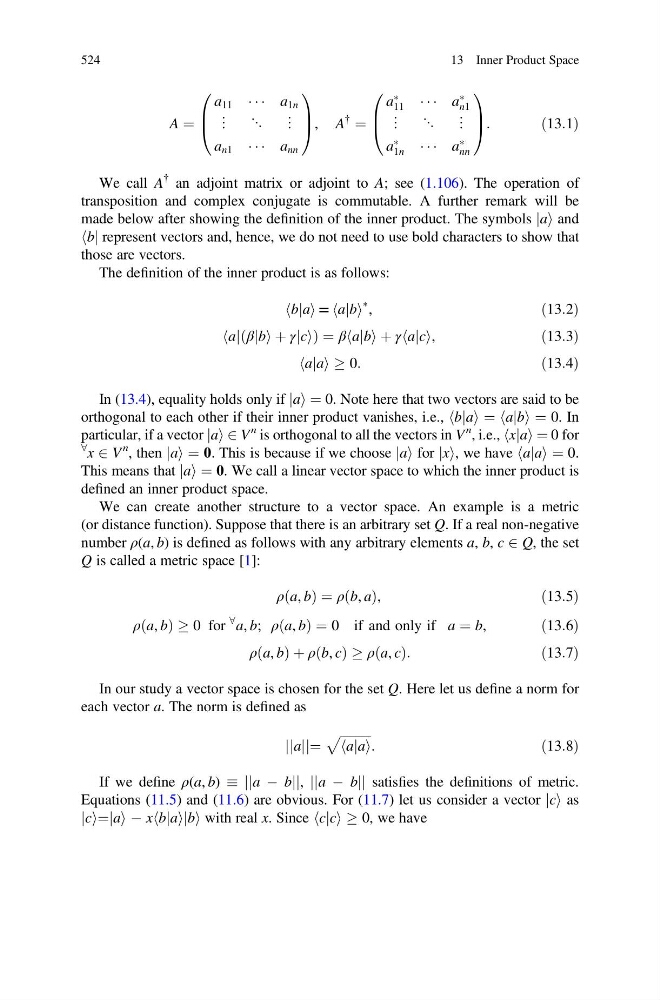
A ¼
a 11 Á Á Á a 1n
⋮ ⋱ ⋮
a n1 Á Á Á a nn
0
B
@
1
C
A, A
{
¼
a
Ã
11
Á Á Á a
Ã
n1
⋮ ⋱ ⋮
a
Ã
1n Á Á Á a
Ã
nn
0
B
@
1
C
A:
ð13:1Þ
We call A
{ an adjoint matrix or adjoint to A; see (1.106). The operation of
transposition and complex conjugate is commutable. A further remark will be
made below after showing the definition of the inner product. The symbols jai and
hbj represent vectors and, hence, we do not need to use bold characters to show that
those are vectors.
The definition of the inner product is as follows:
bja
h i= ajb
h i
à ,
ð13:2Þ
haj βjbi þ γjci
ð
Þ¼β ajb
h iþ γ ajc
h i,
ð13:3Þ
aja
h i ! 0:
ð13:4Þ
In (13.4), equality holds only if jai ¼ 0. Note here that two vectors are said to be
orthogonal to each other if their inner product vanishes, i.e., hbjai ¼ hajbi ¼ 0. In
particular, if a vector jai 2 V
n is orthogonal to all the vectors in V
n , i.e., hxjai ¼ 0 for
8 x 2 V
n , then jai ¼ 0. This is because if we choose jai for jxi, we have hajai ¼ 0.
This means that jai ¼ 0. We call a linear vector space to which the inner product is
defined an inner product space.
We can create another structure to a vector space. An example is a metric
(or distance function). Suppose that there is an arbitrary set Q. If a real non-negative
number ρ(a, b) is defined as follows with any arbitrary elements a, b, c 2 Q, the set
Q is called a metric space [1]:
ρ a, b
ð Þ ¼ ρ b, a
ð Þ,
ð13:5Þ
ρ a, b
ð Þ ! 0 for
8 a, b; ρ a, b
ð Þ ¼ 0 if and only if a ¼ b,
ð13:6Þ
ρ a, b
ð Þþρ b, c
ð Þ ! ρ a, c
ð Þ:
ð13:7Þ
In our study a vector space is chosen for the set Q. Here let us define a norm for
each vector a. The norm is defined as
j a
j jj¼
ffiffiffiffiffiffiffiffiffiffi
aja
h i
p
:
ð13:8Þ
If we define ρ(a, b) jja À bjj, jja À bjj satisfies the definitions of metric.
Equations (11.5) and (11.6) are obvious. For (11.7) let us consider a vector jci as
jci¼jai À xhbjaijbi with real x. Since hcjci ! 0, we have
524
13 Inner Product Space
a 11 Á Á Á a 1n
⋮ ⋱ ⋮
a n1 Á Á Á a nn
0
B
@
1
C
A, A
{
¼
a
Ã
11
Á Á Á a
Ã
n1
⋮ ⋱ ⋮
a
Ã
1n Á Á Á a
Ã
nn
0
B
@
1
C
A:
ð13:1Þ
We call A
{ an adjoint matrix or adjoint to A; see (1.106). The operation of
transposition and complex conjugate is commutable. A further remark will be
made below after showing the definition of the inner product. The symbols jai and
hbj represent vectors and, hence, we do not need to use bold characters to show that
those are vectors.
The definition of the inner product is as follows:
bja
h i= ajb
h i
à ,
ð13:2Þ
haj βjbi þ γjci
ð
Þ¼β ajb
h iþ γ ajc
h i,
ð13:3Þ
aja
h i ! 0:
ð13:4Þ
In (13.4), equality holds only if jai ¼ 0. Note here that two vectors are said to be
orthogonal to each other if their inner product vanishes, i.e., hbjai ¼ hajbi ¼ 0. In
particular, if a vector jai 2 V
n is orthogonal to all the vectors in V
n , i.e., hxjai ¼ 0 for
8 x 2 V
n , then jai ¼ 0. This is because if we choose jai for jxi, we have hajai ¼ 0.
This means that jai ¼ 0. We call a linear vector space to which the inner product is
defined an inner product space.
We can create another structure to a vector space. An example is a metric
(or distance function). Suppose that there is an arbitrary set Q. If a real non-negative
number ρ(a, b) is defined as follows with any arbitrary elements a, b, c 2 Q, the set
Q is called a metric space [1]:
ρ a, b
ð Þ ¼ ρ b, a
ð Þ,
ð13:5Þ
ρ a, b
ð Þ ! 0 for
8 a, b; ρ a, b
ð Þ ¼ 0 if and only if a ¼ b,
ð13:6Þ
ρ a, b
ð Þþρ b, c
ð Þ ! ρ a, c
ð Þ:
ð13:7Þ
In our study a vector space is chosen for the set Q. Here let us define a norm for
each vector a. The norm is defined as
j a
j jj¼
ffiffiffiffiffiffiffiffiffiffi
aja
h i
p
:
ð13:8Þ
If we define ρ(a, b) jja À bjj, jja À bjj satisfies the definitions of metric.
Equations (11.5) and (11.6) are obvious. For (11.7) let us consider a vector jci as
jci¼jai À xhbjaijbi with real x. Since hcjci ! 0, we have
524
13 Inner Product Space