

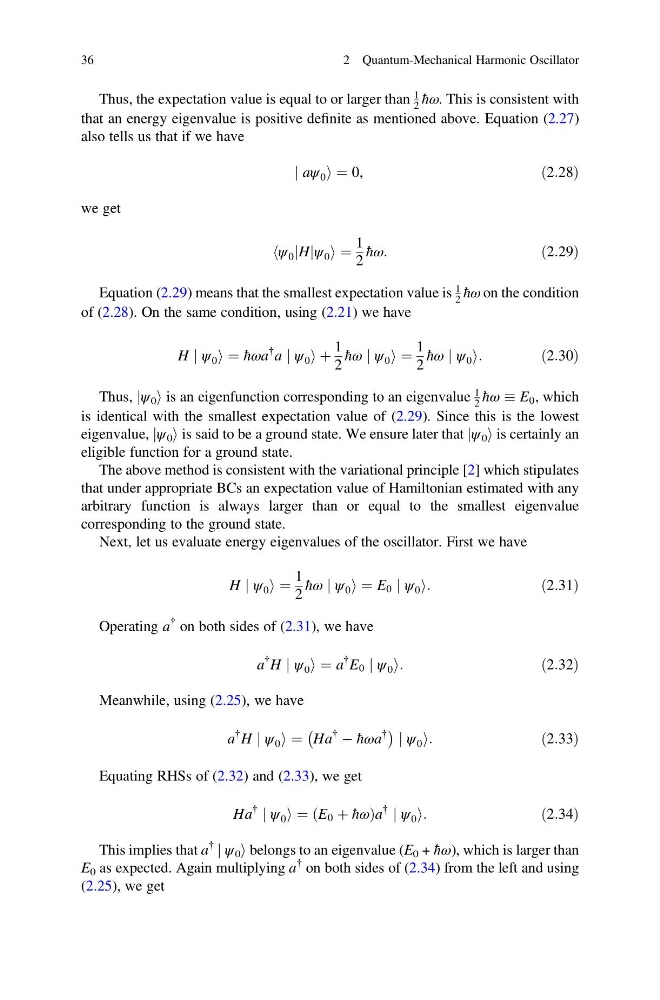
Thus, the expectation value is equal to or larger than
1
2 ħω. This is consistent with
that an energy eigenvalue is positive definite as mentioned above. Equation (2.27)
also tells us that if we have
j aψ 0 i ¼ 0,
ð2:28Þ
we get
ψ 0 jHjψ 0 i
h
¼
1
2
ħω:
ð2:29Þ
Equation (2.29) means that the smallest expectation value is
1
2 ħω on the condition
of (2.28). On the same condition, using (2.21) we have
H j ψ 0 i ¼ ħωa
{ a j ψ 0 i þ
1
2
ħω j ψ 0 i ¼
1
2
ħω j ψ 0 i:
ð2:30Þ
Thus, jψ 0 i is an eigenfunction corresponding to an eigenvalue
1
2 ħω E 0 , which
is identical with the smallest expectation value of (2.29). Since this is the lowest
eigenvalue, jψ 0 i is said to be a ground state. We ensure later that jψ 0 i is certainly an
eligible function for a ground state.
The above method is consistent with the variational principle [2] which stipulates
that under appropriate BCs an expectation value of Hamiltonian estimated with any
arbitrary function is always larger than or equal to the smallest eigenvalue
corresponding to the ground state.
Next, let us evaluate energy eigenvalues of the oscillator. First we have
H j ψ 0 i ¼
1
2
ħω j ψ 0 i ¼ E 0 j ψ 0 i:
ð2:31Þ
Operating a
{ on both sides of (2.31), we have
a
{ H j ψ 0 i ¼ a
{ E 0 j ψ 0 i:
ð2:32Þ
Meanwhile, using (2.25), we have
a
{ H j ψ 0 i ¼ Ha
{
À ħωa
{
À
Á j ψ 0 i:
ð2:33Þ
Equating RHSs of (2.32) and (2.33), we get
Ha
{
j ψ 0 i ¼ E 0 þ ħω
ð
Þ a
{
j ψ 0 i:
ð2:34Þ
This implies that a
{
j ψ 0 i belongs to an eigenvalue (E 0 + ħω), which is larger than
E 0 as expected. Again multiplying a
{ on both sides of (2.34) from the left and using
(2.25), we get
36
2 Quantum-Mechanical Harmonic Oscillator
1
2 ħω. This is consistent with
that an energy eigenvalue is positive definite as mentioned above. Equation (2.27)
also tells us that if we have
j aψ 0 i ¼ 0,
ð2:28Þ
we get
ψ 0 jHjψ 0 i
h
¼
1
2
ħω:
ð2:29Þ
Equation (2.29) means that the smallest expectation value is
1
2 ħω on the condition
of (2.28). On the same condition, using (2.21) we have
H j ψ 0 i ¼ ħωa
{ a j ψ 0 i þ
1
2
ħω j ψ 0 i ¼
1
2
ħω j ψ 0 i:
ð2:30Þ
Thus, jψ 0 i is an eigenfunction corresponding to an eigenvalue
1
2 ħω E 0 , which
is identical with the smallest expectation value of (2.29). Since this is the lowest
eigenvalue, jψ 0 i is said to be a ground state. We ensure later that jψ 0 i is certainly an
eligible function for a ground state.
The above method is consistent with the variational principle [2] which stipulates
that under appropriate BCs an expectation value of Hamiltonian estimated with any
arbitrary function is always larger than or equal to the smallest eigenvalue
corresponding to the ground state.
Next, let us evaluate energy eigenvalues of the oscillator. First we have
H j ψ 0 i ¼
1
2
ħω j ψ 0 i ¼ E 0 j ψ 0 i:
ð2:31Þ
Operating a
{ on both sides of (2.31), we have
a
{ H j ψ 0 i ¼ a
{ E 0 j ψ 0 i:
ð2:32Þ
Meanwhile, using (2.25), we have
a
{ H j ψ 0 i ¼ Ha
{
À ħωa
{
À
Á j ψ 0 i:
ð2:33Þ
Equating RHSs of (2.32) and (2.33), we get
Ha
{
j ψ 0 i ¼ E 0 þ ħω
ð
Þ a
{
j ψ 0 i:
ð2:34Þ
This implies that a
{
j ψ 0 i belongs to an eigenvalue (E 0 + ħω), which is larger than
E 0 as expected. Again multiplying a
{ on both sides of (2.34) from the left and using
(2.25), we get
36
2 Quantum-Mechanical Harmonic Oscillator