

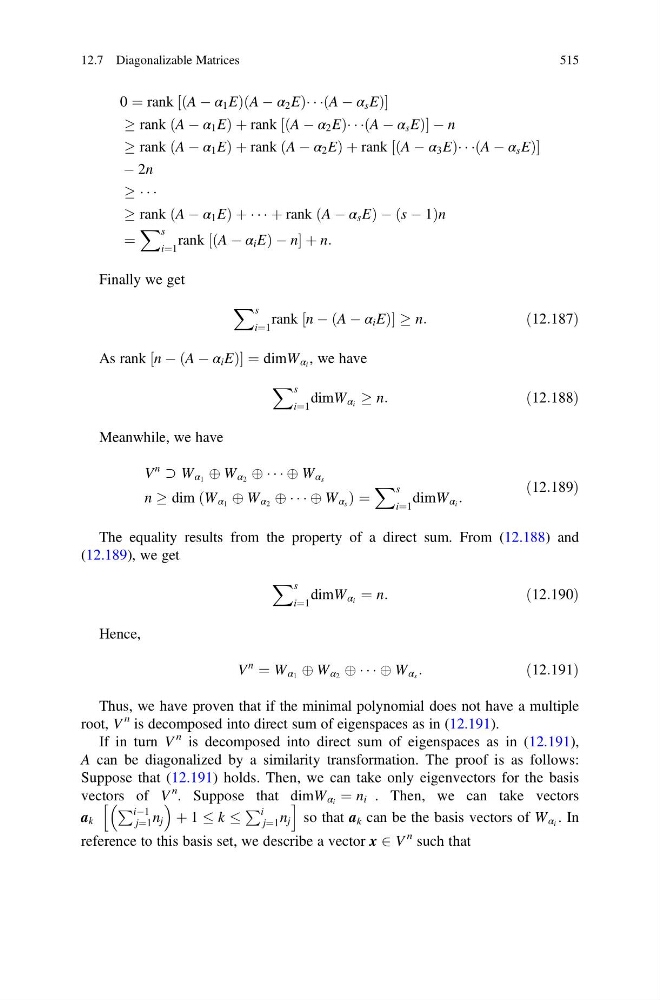
0 ¼ rank A À α 1 E
ð
ÞA À α 2 E
ð
Þ ÁÁÁA À α s E
ð
Þ
½
! rank A À α 1 E
ð
Þþrank A À α 2 E
ð
Þ ÁÁÁA À α s E
ð
Þ
½
À n
! rank A À α 1 E
ð
Þþrank A À α 2 E
ð
Þþrank A À α 3 E
ð
Þ ÁÁÁA À α s E
ð
Þ
½
À 2n
! Á Á Á
! rank A À α 1 E
ð
Þ þ Á Á Á þ rank A À α s E
ð
ÞÀ s À 1
ð
Þn
¼
X s
i¼1
rank A À α i E
ð
ÞÀn
½
þ n:
Finally we get
X s
i¼1
rank n À A À α i E
ð
Þ
½
!n:
ð12:187Þ
As rank n À A À α i E
ð
Þ
½
¼dimW α i , we have
X s
i¼1
dimW α i ! n:
ð12:188Þ
Meanwhile, we have
V
n
⊃ W α 1 È W α 2 È Á Á Á È W α s
n ! dim W α 1 È W α 2 È Á Á Á È W α s
ð
Þ ¼
X s
i¼1
dimW α i :
ð12:189Þ
The equality results from the property of a direct sum. From (12.188) and
(12.189), we get
X s
i¼1
dimW α i ¼ n:
ð12:190Þ
Hence,
V
n
¼ W α 1 È W α 2 È Á Á Á È W α s :
ð12:191Þ
Thus, we have proven that if the minimal polynomial does not have a multiple
root, V
n is decomposed into direct sum of eigenspaces as in (12.191).
If in turn V
n is decomposed into direct sum of eigenspaces as in (12.191),
A can be diagonalized by a similarity transformation. The proof is as follows:
Suppose that (12.191) holds. Then, we can take only eigenvectors for the basis
vectors of V
n . Suppose that dimW α i ¼ n i . Then, we can take vectors
a k
P iÀ1
j¼1 n j
þ 1 k
P i
j¼1 n j
h
i
so that a k can be the basis vectors of W α i . In
reference to this basis set, we describe a vector x 2 V
n such that
12.7 Diagonalizable Matrices
515
ð
ÞA À α 2 E
ð
Þ ÁÁÁA À α s E
ð
Þ
½
! rank A À α 1 E
ð
Þþrank A À α 2 E
ð
Þ ÁÁÁA À α s E
ð
Þ
½
À n
! rank A À α 1 E
ð
Þþrank A À α 2 E
ð
Þþrank A À α 3 E
ð
Þ ÁÁÁA À α s E
ð
Þ
½
À 2n
! Á Á Á
! rank A À α 1 E
ð
Þ þ Á Á Á þ rank A À α s E
ð
ÞÀ s À 1
ð
Þn
¼
X s
i¼1
rank A À α i E
ð
ÞÀn
½
þ n:
Finally we get
X s
i¼1
rank n À A À α i E
ð
Þ
½
!n:
ð12:187Þ
As rank n À A À α i E
ð
Þ
½
¼dimW α i , we have
X s
i¼1
dimW α i ! n:
ð12:188Þ
Meanwhile, we have
V
n
⊃ W α 1 È W α 2 È Á Á Á È W α s
n ! dim W α 1 È W α 2 È Á Á Á È W α s
ð
Þ ¼
X s
i¼1
dimW α i :
ð12:189Þ
The equality results from the property of a direct sum. From (12.188) and
(12.189), we get
X s
i¼1
dimW α i ¼ n:
ð12:190Þ
Hence,
V
n
¼ W α 1 È W α 2 È Á Á Á È W α s :
ð12:191Þ
Thus, we have proven that if the minimal polynomial does not have a multiple
root, V
n is decomposed into direct sum of eigenspaces as in (12.191).
If in turn V
n is decomposed into direct sum of eigenspaces as in (12.191),
A can be diagonalized by a similarity transformation. The proof is as follows:
Suppose that (12.191) holds. Then, we can take only eigenvectors for the basis
vectors of V
n . Suppose that dimW α i ¼ n i . Then, we can take vectors
a k
P iÀ1
j¼1 n j
þ 1 k
P i
j¼1 n j
h
i
so that a k can be the basis vectors of W α i . In
reference to this basis set, we describe a vector x 2 V
n such that
12.7 Diagonalizable Matrices
515