

A À α 1 E
ð
ÞA À α 2 E
ð
Þ ÁÁÁA À α s E
ð
Þ¼0:
ð12:183Þ
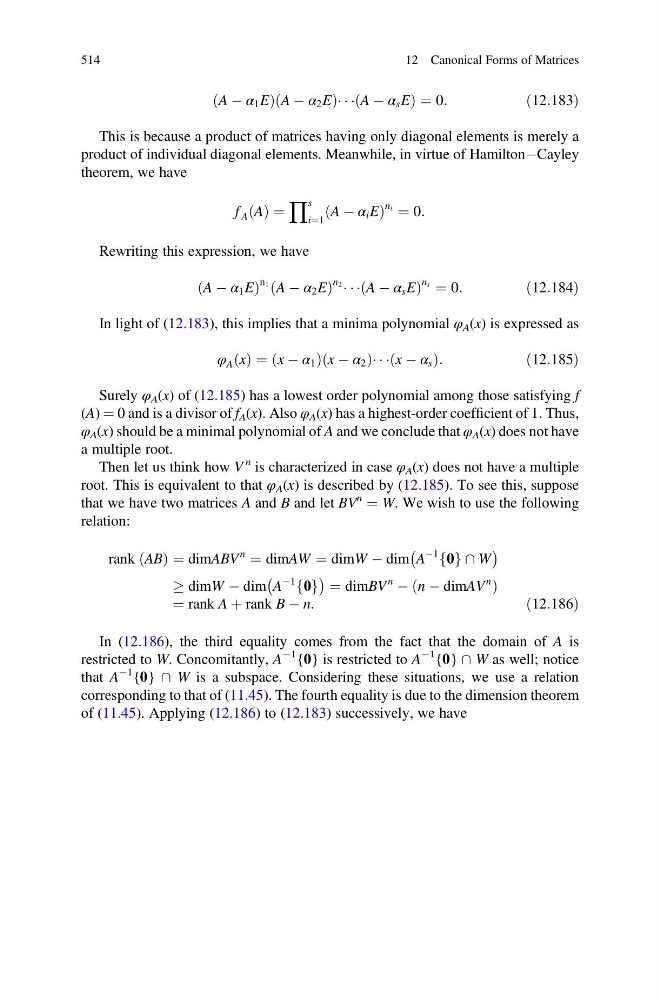
This is because a product of matrices having only diagonal elements is merely a
product of individual diagonal elements. Meanwhile, in virtue of HamiltonÀCayley
theorem, we have
f A A
ð Þ ¼
Y s
i¼1
A À α i E
ð
Þ
n i
¼ 0:
Rewriting this expression, we have
A À α 1 E
ð
Þ
n 1 A À α 2 E
ð
Þ
n 2
Á Á Á A À α s E
ð
Þ
n s
¼ 0:
ð12:184Þ
In light of (12.183), this implies that a minima polynomial φ A (x) is expressed as
φ A x
ð Þ ¼ x À α 1
ð
Þ x À α 2
ð
ÞÁÁÁ x À α s
ð
Þ:
ð12:185Þ
Surely φ A (x) of (12.185) has a lowest order polynomial among those satisfying f
(A) ¼ 0 and is a divisor of f A (x). Also φ A (x) has a highest-order coefficient of 1. Thus,
φ A (x) should be a minimal polynomial of A and we conclude that φ A (x) does not have
a multiple root.
Then let us think how V
n is characterized in case φ A (x) does not have a multiple
root. This is equivalent to that φ A (x) is described by (12.185). To see this, suppose
that we have two matrices A and B and let BV
n
¼ W. We wish to use the following
relation:
rank AB
ð Þ ¼ dimABV
n
¼ dimAW ¼ dimW À dim A
À1 0
f g \ W
À
Á
! dimW À dim A
À1 0
f g
À
Á ¼ dimBV
n
À n À dimAV
n
ð
Þ
¼ rank A þ rank B À n:
ð12:186Þ
In (12.186), the third equality comes from the fact that the domain of A is
restricted to W. Concomitantly, A
À1 {0} is restricted to A
À1 {0} \ W as well; notice
that A
À1 {0} \ W is a subspace. Considering these situations, we use a relation
corresponding to that of (11.45). The fourth equality is due to the dimension theorem
of (11.45). Applying (12.186) to (12.183) successively, we have
514
12 Canonical Forms of Matrices
ð
ÞA À α 2 E
ð
Þ ÁÁÁA À α s E
ð
Þ¼0:
ð12:183Þ
This is because a product of matrices having only diagonal elements is merely a
product of individual diagonal elements. Meanwhile, in virtue of HamiltonÀCayley
theorem, we have
f A A
ð Þ ¼
Y s
i¼1
A À α i E
ð
Þ
n i
¼ 0:
Rewriting this expression, we have
A À α 1 E
ð
Þ
n 1 A À α 2 E
ð
Þ
n 2
Á Á Á A À α s E
ð
Þ
n s
¼ 0:
ð12:184Þ
In light of (12.183), this implies that a minima polynomial φ A (x) is expressed as
φ A x
ð Þ ¼ x À α 1
ð
Þ x À α 2
ð
ÞÁÁÁ x À α s
ð
Þ:
ð12:185Þ
Surely φ A (x) of (12.185) has a lowest order polynomial among those satisfying f
(A) ¼ 0 and is a divisor of f A (x). Also φ A (x) has a highest-order coefficient of 1. Thus,
φ A (x) should be a minimal polynomial of A and we conclude that φ A (x) does not have
a multiple root.
Then let us think how V
n is characterized in case φ A (x) does not have a multiple
root. This is equivalent to that φ A (x) is described by (12.185). To see this, suppose
that we have two matrices A and B and let BV
n
¼ W. We wish to use the following
relation:
rank AB
ð Þ ¼ dimABV
n
¼ dimAW ¼ dimW À dim A
À1 0
f g \ W
À
Á
! dimW À dim A
À1 0
f g
À
Á ¼ dimBV
n
À n À dimAV
n
ð
Þ
¼ rank A þ rank B À n:
ð12:186Þ
In (12.186), the third equality comes from the fact that the domain of A is
restricted to W. Concomitantly, A
À1 {0} is restricted to A
À1 {0} \ W as well; notice
that A
À1 {0} \ W is a subspace. Considering these situations, we use a relation
corresponding to that of (11.45). The fourth equality is due to the dimension theorem
of (11.45). Applying (12.186) to (12.183) successively, we have
514
12 Canonical Forms of Matrices