

A ¼ A
1
ð Þ
È A
2
ð Þ
È Á Á Á È A
i
ð Þ
È Á Á Á È A
s
ð Þ
:
ð12:141Þ
In (12.141), A
(1) is a (1, 1) matrix (i.e., simply a number); A
(2) is a (3, 3) matrix;
Á Á Á A
(i) is a (4, 4) matrix; Á Á Á A
(s) is a (2, 2) matrix.
The above matrix form allows us to further deal with segmented triangle matrices
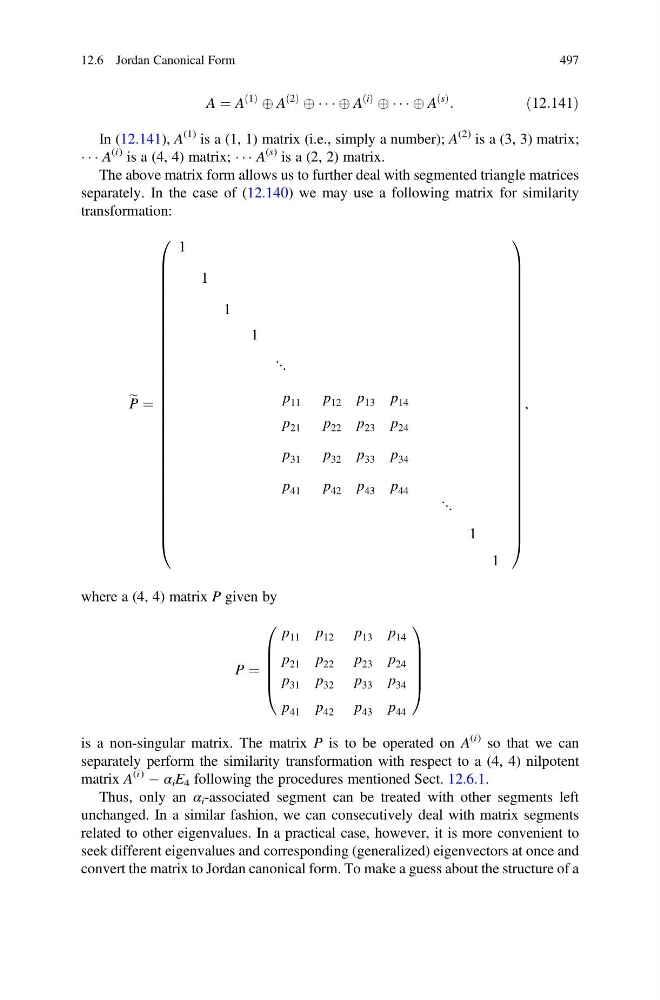
separately. In the case of (12.140) we may use a following matrix for similarity
transformation:
e
P ¼
1
1
1
1
⋱
p 11
p 12 p 13 p 14
p 21
p 31
p 41
p 22 p 23 p 24
p 32 p 33 p 34
p 42 p 43 p 44
⋱
1
1
0
B
B
B
B
B
B
B
B
B
B
B
B
B
B
B
B
B
B
B
B
B
B
B
B
B
B
B
B
B
B
B
@
1
C
C
C
C
C
C
C
C
C
C
C
C
C
C
C
C
C
C
C
C
C
C
C
C
C
C
C
C
C
C
C
A
,
where a (4, 4) matrix P given by
P ¼
p 11 p 12
p 21 p 22
p 13 p 14
p 23 p 24
p 31 p 32
p 41 p 42
p 33 p 34
p 43 p 44
0
B
B
B
B
@
1
C
C
C
C
A
is a non-singular matrix. The matrix P is to be operated on A
(i) so that we can
separately perform the similarity transformation with respect to a (4, 4) nilpotent
matrix A
(i)
À α i E 4 following the procedures mentioned Sect. 12.6.1.
Thus, only an α i -associated segment can be treated with other segments left
unchanged. In a similar fashion, we can consecutively deal with matrix segments
related to other eigenvalues. In a practical case, however, it is more convenient to
seek different eigenvalues and corresponding (generalized) eigenvectors at once and
convert the matrix to Jordan canonical form. To make a guess about the structure of a
12.6 Jordan Canonical Form
497
1
ð Þ
È A
2
ð Þ
È Á Á Á È A
i
ð Þ
È Á Á Á È A
s
ð Þ
:
ð12:141Þ
In (12.141), A
(1) is a (1, 1) matrix (i.e., simply a number); A
(2) is a (3, 3) matrix;
Á Á Á A
(i) is a (4, 4) matrix; Á Á Á A
(s) is a (2, 2) matrix.
The above matrix form allows us to further deal with segmented triangle matrices
separately. In the case of (12.140) we may use a following matrix for similarity
transformation:
e
P ¼
1
1
1
1
⋱
p 11
p 12 p 13 p 14
p 21
p 31
p 41
p 22 p 23 p 24
p 32 p 33 p 34
p 42 p 43 p 44
⋱
1
1
0
B
B
B
B
B
B
B
B
B
B
B
B
B
B
B
B
B
B
B
B
B
B
B
B
B
B
B
B
B
B
B
@
1
C
C
C
C
C
C
C
C
C
C
C
C
C
C
C
C
C
C
C
C
C
C
C
C
C
C
C
C
C
C
C
A
,
where a (4, 4) matrix P given by
P ¼
p 11 p 12
p 21 p 22
p 13 p 14
p 23 p 24
p 31 p 32
p 41 p 42
p 33 p 34
p 43 p 44
0
B
B
B
B
@
1
C
C
C
C
A
is a non-singular matrix. The matrix P is to be operated on A
(i) so that we can
separately perform the similarity transformation with respect to a (4, 4) nilpotent
matrix A
(i)
À α i E 4 following the procedures mentioned Sect. 12.6.1.
Thus, only an α i -associated segment can be treated with other segments left
unchanged. In a similar fashion, we can consecutively deal with matrix segments
related to other eigenvalues. In a practical case, however, it is more convenient to
seek different eigenvalues and corresponding (generalized) eigenvectors at once and
convert the matrix to Jordan canonical form. To make a guess about the structure of a
12.6 Jordan Canonical Form
497