

A (n i , n i ) matrix A
(i) of (12.102) pertinent to an eigenvalue α i contains a direct
sum of Jordan blocks whose dimension ranges from 1 to n i . The largest possible
number of Jordan blocks of dimension d (that satisfies
n i
2 þ 1
Â
Ã
d n i , where [μ]
denotes a largest integer that does not exceed μ) is at most one.
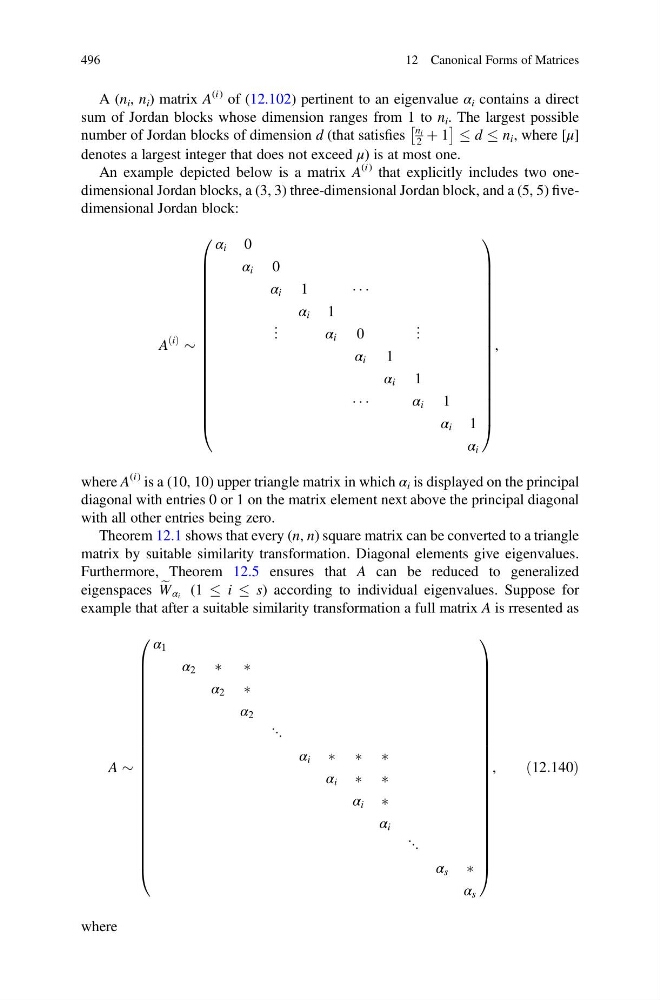
An example depicted below is a matrix A
(i) that explicitly includes two onedimensional Jordan blocks, a (3, 3) three-dimensional Jordan block, and a (5, 5) fivedimensional Jordan block:
A
i
ð Þ
$
α i 0
α i 0
α i 1
Á Á Á
α i 1
⋮
α i 0
⋮
α i 1
α i 1
Á Á Á
α i 1
α i 1
α i
0
B
B
B
B
B
B
B
B
B
B
B
B
B
B
B
B
B
B
@
1
C
C
C
C
C
C
C
C
C
C
C
C
C
C
C
C
C
C
A
,
where A
(i) is a (10, 10) upper triangle matrix in which α i is displayed on the principal
diagonal with entries 0 or 1 on the matrix element next above the principal diagonal
with all other entries being zero.
Theorem 12.1 shows that every (n, n) square matrix can be converted to a triangle
matrix by suitable similarity transformation. Diagonal elements give eigenvalues.
Furthermore, Theorem 12.5 ensures that A can be reduced to generalized
eigenspaces e
W α i (1
i
s) according to individual eigenvalues. Suppose for
example that after a suitable similarity transformation a full matrix A is rresented as
A $
α 1
α 2 Ã Ã
α 2 Ã
α 2
⋱
α i à à Ã
α i à Ã
α i Ã
α i
⋱
α s Ã
α s
0
B
B
B
B
B
B
B
B
B
B
B
B
B
B
B
B
B
B
B
B
B
B
B
@
1
C
C
C
C
C
C
C
C
C
C
C
C
C
C
C
C
C
C
C
C
C
C
C
A
,
ð12:140Þ
where
496
12 Canonical Forms of Matrices
(i) of (12.102) pertinent to an eigenvalue α i contains a direct
sum of Jordan blocks whose dimension ranges from 1 to n i . The largest possible
number of Jordan blocks of dimension d (that satisfies
n i
2 þ 1
Â
Ã
d n i , where [μ]
denotes a largest integer that does not exceed μ) is at most one.
An example depicted below is a matrix A
(i) that explicitly includes two onedimensional Jordan blocks, a (3, 3) three-dimensional Jordan block, and a (5, 5) fivedimensional Jordan block:
A
i
ð Þ
$
α i 0
α i 0
α i 1
Á Á Á
α i 1
⋮
α i 0
⋮
α i 1
α i 1
Á Á Á
α i 1
α i 1
α i
0
B
B
B
B
B
B
B
B
B
B
B
B
B
B
B
B
B
B
@
1
C
C
C
C
C
C
C
C
C
C
C
C
C
C
C
C
C
C
A
,
where A
(i) is a (10, 10) upper triangle matrix in which α i is displayed on the principal
diagonal with entries 0 or 1 on the matrix element next above the principal diagonal
with all other entries being zero.
Theorem 12.1 shows that every (n, n) square matrix can be converted to a triangle
matrix by suitable similarity transformation. Diagonal elements give eigenvalues.
Furthermore, Theorem 12.5 ensures that A can be reduced to generalized
eigenspaces e
W α i (1
i
s) according to individual eigenvalues. Suppose for
example that after a suitable similarity transformation a full matrix A is rresented as
A $
α 1
α 2 Ã Ã
α 2 Ã
α 2
⋱
α i à à Ã
α i à Ã
α i Ã
α i
⋱
α s Ã
α s
0
B
B
B
B
B
B
B
B
B
B
B
B
B
B
B
B
B
B
B
B
B
B
B
@
1
C
C
C
C
C
C
C
C
C
C
C
C
C
C
C
C
C
C
C
C
C
C
C
A
,
ð12:140Þ
where
496
12 Canonical Forms of Matrices