

where E n i denotes (n i , n i ) identity matrix. We express a nilpotent matrix as N i as
before. In (12.134) the number n i corresponds to n in V
n of Sect. 12.6.1. As N i is a
(n i , n i ) matrix, we have
N i
n i ¼ 0:
Here we are speaking of ν-th order nilpotent matrices N i such that N i
ν À 1
6 ¼ 0 and
N i
ν
¼ 0 (1 ν n i ). We can deal with N i in a manner fully consistent with the theory
we developed in Sect. 12.6.1. Each A
(i) comprises one or more Jordan blocks A
(κ)
that is expressed as
A
κ
ð Þ
¼ N κ i þ α i E κ i 1 κ i n i
ð
Þ ,
ð12:135Þ
where A
(κ) denotes the κ-th Jordan block in A
(i) . In A
(κ)
, N κ i and E κ i are nilpotent
(κ i , κ i ) matrix and (κ i , κ i ) identity matrix, respectively. In N κ i , κ i zeros are displayed
on the principal diagonal and entries of 1 are positioned on the matrix element next
above the principal diagonal. All other entries are zero; see, e.g., a matrix of
(12.122). As in the Sect. 12.6.1, the number κ i is called a dimension of the Jordan
block. Thus, A
(i) of (12.102) can further be reduced to segmented matrices A
(κ)
. Our
next task is to find out how many Jordan blocks are contained in individual A
(i) and
what is the dimension of those Jordan blocks.
Corresponding to (12.122), the matrix representation of the linear transformation
by A
(κ) with respect to the set of κ i vectors is
(b)
(a)
, , ⋯ ,
⋯
=
= = ⋯ = 1
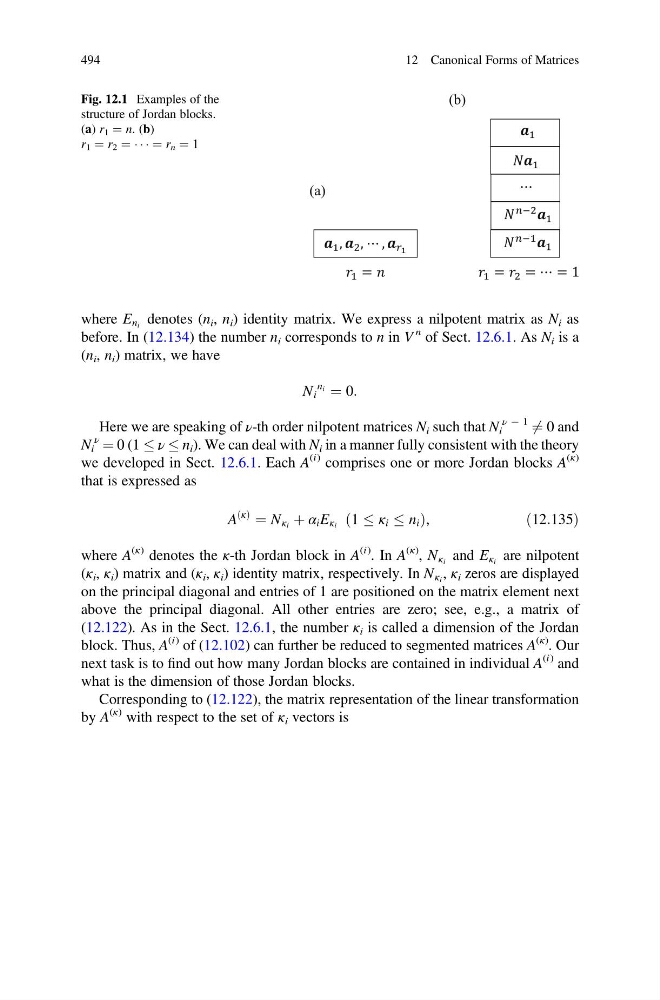
Fig. 12.1 Examples of the
structure of Jordan blocks.
(a) r 1 ¼ n. (b)
r 1 ¼ r 2 ¼ Á Á Á ¼ r n ¼ 1
494
12 Canonical Forms of Matrices
before. In (12.134) the number n i corresponds to n in V
n of Sect. 12.6.1. As N i is a
(n i , n i ) matrix, we have
N i
n i ¼ 0:
Here we are speaking of ν-th order nilpotent matrices N i such that N i
ν À 1
6 ¼ 0 and
N i
ν
¼ 0 (1 ν n i ). We can deal with N i in a manner fully consistent with the theory
we developed in Sect. 12.6.1. Each A
(i) comprises one or more Jordan blocks A
(κ)
that is expressed as
A
κ
ð Þ
¼ N κ i þ α i E κ i 1 κ i n i
ð
Þ ,
ð12:135Þ
where A
(κ) denotes the κ-th Jordan block in A
(i) . In A
(κ)
, N κ i and E κ i are nilpotent
(κ i , κ i ) matrix and (κ i , κ i ) identity matrix, respectively. In N κ i , κ i zeros are displayed
on the principal diagonal and entries of 1 are positioned on the matrix element next
above the principal diagonal. All other entries are zero; see, e.g., a matrix of
(12.122). As in the Sect. 12.6.1, the number κ i is called a dimension of the Jordan
block. Thus, A
(i) of (12.102) can further be reduced to segmented matrices A
(κ)
. Our
next task is to find out how many Jordan blocks are contained in individual A
(i) and
what is the dimension of those Jordan blocks.
Corresponding to (12.122), the matrix representation of the linear transformation
by A
(κ) with respect to the set of κ i vectors is
(b)
(a)
, , ⋯ ,
⋯
=
= = ⋯ = 1
Fig. 12.1 Examples of the
structure of Jordan blocks.
(a) r 1 ¼ n. (b)
r 1 ¼ r 2 ¼ Á Á Á ¼ r n ¼ 1
494
12 Canonical Forms of Matrices