

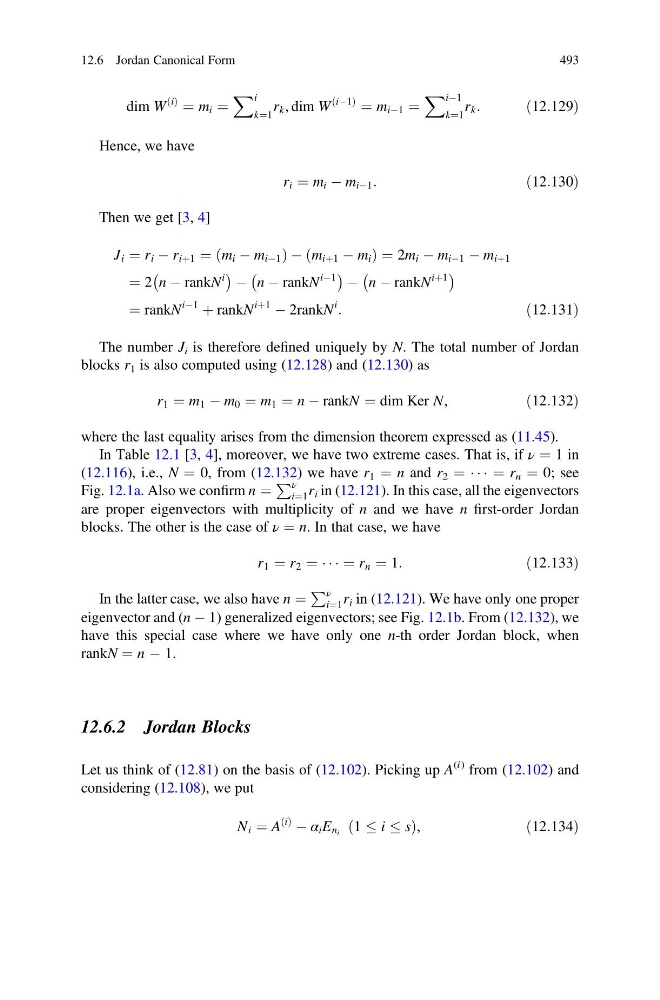
dim W
i
ð Þ
¼ m i ¼
X i
k¼1
r k , dim W
iÀ1
ð
Þ
¼ m iÀ1 ¼
X iÀ1
k¼1
r k :
ð12:129Þ
Hence, we have
r i ¼ m i À m iÀ1 :
ð12:130Þ
Then we get [3, 4]
J i ¼ r i À r iþ1 ¼ m i À m iÀ1
ð
ÞÀ m iþ1 À m i
ð
Þ¼2m i À m iÀ1 À m iþ1
¼ 2 n À rankN
i
À
Á À n À rankN
iÀ1
À
Á À n À rankN
iþ1
À
Á
¼ rankN
iÀ1
þ rankN
iþ1
À 2rankN
i
:
ð12:131Þ
The number J i is therefore defined uniquely by N. The total number of Jordan
blocks r 1 is also computed using (12.128) and (12.130) as
r 1 ¼ m 1 À m 0 ¼ m 1 ¼ n À rankN ¼ dim Ker N,
ð12:132Þ
where the last equality arises from the dimension theorem expressed as (11.45).
In Table 12.1 [3, 4], moreover, we have two extreme cases. That is, if ν ¼ 1 in
(12.116), i.e., N ¼ 0, from (12.132) we have r 1 ¼ n and r 2 ¼ Á Á Á ¼ r n ¼ 0; see
Fig. 12.1a. Also we confirm n ¼
P ν
i¼1 r i in (12.121). In this case, all the eigenvectors
are proper eigenvectors with multiplicity of n and we have n first-order Jordan
blocks. The other is the case of ν ¼ n. In that case, we have
r 1 ¼ r 2 ¼ Á Á Á ¼ r n ¼ 1:
ð12:133Þ
In the latter case, we also have n ¼
P ν
i¼1 r i in (12.121). We have only one proper
eigenvector and (n À 1) generalized eigenvectors; see Fig. 12.1b. From (12.132), we
have this special case where we have only one n-th order Jordan block, when
rankN ¼ n À 1.
12.6.2 Jordan Blocks
Let us think of (12.81) on the basis of (12.102). Picking up A
(i) from (12.102) and
considering (12.108), we put
N i ¼ A
i
ð Þ
À α i E n i 1 i s
ð
Þ ,
ð12:134Þ
12.6 Jordan Canonical Form
493
i
ð Þ
¼ m i ¼
X i
k¼1
r k , dim W
iÀ1
ð
Þ
¼ m iÀ1 ¼
X iÀ1
k¼1
r k :
ð12:129Þ
Hence, we have
r i ¼ m i À m iÀ1 :
ð12:130Þ
Then we get [3, 4]
J i ¼ r i À r iþ1 ¼ m i À m iÀ1
ð
ÞÀ m iþ1 À m i
ð
Þ¼2m i À m iÀ1 À m iþ1
¼ 2 n À rankN
i
À
Á À n À rankN
iÀ1
À
Á À n À rankN
iþ1
À
Á
¼ rankN
iÀ1
þ rankN
iþ1
À 2rankN
i
:
ð12:131Þ
The number J i is therefore defined uniquely by N. The total number of Jordan
blocks r 1 is also computed using (12.128) and (12.130) as
r 1 ¼ m 1 À m 0 ¼ m 1 ¼ n À rankN ¼ dim Ker N,
ð12:132Þ
where the last equality arises from the dimension theorem expressed as (11.45).
In Table 12.1 [3, 4], moreover, we have two extreme cases. That is, if ν ¼ 1 in
(12.116), i.e., N ¼ 0, from (12.132) we have r 1 ¼ n and r 2 ¼ Á Á Á ¼ r n ¼ 0; see
Fig. 12.1a. Also we confirm n ¼
P ν
i¼1 r i in (12.121). In this case, all the eigenvectors
are proper eigenvectors with multiplicity of n and we have n first-order Jordan
blocks. The other is the case of ν ¼ n. In that case, we have
r 1 ¼ r 2 ¼ Á Á Á ¼ r n ¼ 1:
ð12:133Þ
In the latter case, we also have n ¼
P ν
i¼1 r i in (12.121). We have only one proper
eigenvector and (n À 1) generalized eigenvectors; see Fig. 12.1b. From (12.132), we
have this special case where we have only one n-th order Jordan block, when
rankN ¼ n À 1.
12.6.2 Jordan Blocks
Let us think of (12.81) on the basis of (12.102). Picking up A
(i) from (12.102) and
considering (12.108), we put
N i ¼ A
i
ð Þ
À α i E n i 1 i s
ð
Þ ,
ð12:134Þ
12.6 Jordan Canonical Form
493