

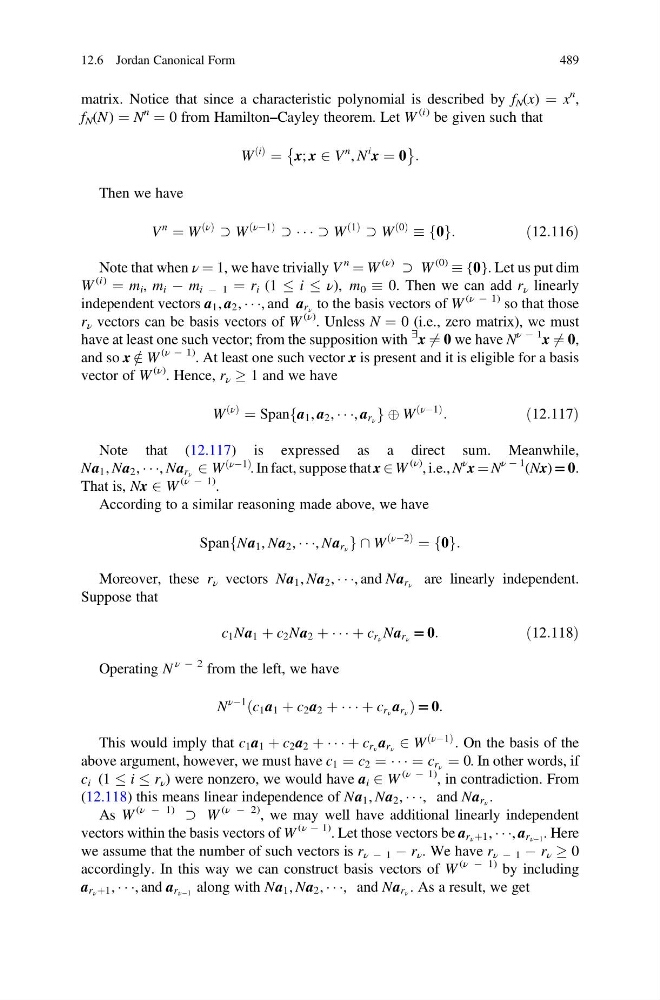
matrix. Notice that since a characteristic polynomial is described by f N (x) ¼ x
n ,
f N (N ) ¼ N
n
¼ 0 from Hamilton–Cayley theorem. Let W
(i) be given such that
W
i
ð Þ
¼ x; x 2 V
n , N
i x ¼ 0
È
É :
Then we have
V
n
¼ W
ν
ð Þ
⊃ W
νÀ1
ð
Þ
⊃ Á Á Á ⊃ W
1
ð Þ
⊃ W
0
ð Þ
0
f g:
ð12:116Þ
Note that when ν ¼ 1, we have trivially V
n
¼ W
(ν)
⊃ W
(0)
{0}. Let us put dim
W
(i)
¼ m i , m i À m i À 1 ¼ r i (1
i
ν), m 0 0. Then we can add r ν linearly
independent vectors a 1 , a 2 , Á Á Á, and a r ν to the basis vectors of W
(ν À 1) so that those
r ν vectors can be basis vectors of W
(ν) . Unless N ¼ 0 (i.e., zero matrix), we must
have at least one such vector; from the supposition with
∃ x 6 ¼ 0 we have N
ν À 1 x 6 ¼ 0,
and so x =
2 W
(ν À 1)
. At least one such vector x is present and it is eligible for a basis
vector of W
(ν)
. Hence, r ν ! 1 and we have
W
ν
ð Þ
¼ Span a 1 , a 2 , Á Á Á, a r ν
f
g È W
νÀ1
ð
Þ
:
ð12:117Þ
Note that (12.117) is expressed as a direct sum. Meanwhile,
Na 1 , Na 2 , Á Á Á, Na r ν 2 W
νÀ1
ð
Þ
. In fact, suppose that x 2 W
(ν) , i.e., N
ν x ¼ N
ν À 1 (Nx) = 0.
That is, Nx 2 W
(ν À 1) .
According to a similar reasoning made above, we have
Span Na 1 , Na 2 , Á Á Á, Na r ν
f
g \ W
νÀ2
ð
Þ
¼ 0
f g:
Moreover, these r ν vectors Na 1 , Na 2 , Á Á Á, and Na r ν are linearly independent.
Suppose that
c 1 Na 1 þ c 2 Na 2 þ Á Á Á þ c r ν Na r ν = 0:
ð12:118Þ
Operating N
ν À 2 from the left, we have
N
νÀ1 c 1 a 1 þ c 2 a 2 þ Á Á Á þ c r ν a r ν
ð
Þ = 0:
This would imply that c 1 a 1 þ c 2 a 2 þ Á Á Á þ c r ν a r ν 2 W
νÀ1
ð
Þ . On the basis of the
above argument, however, we must have c 1 ¼ c 2 ¼ Á Á Á ¼ c r ν ¼ 0. In other words, if
c i (1 i r ν ) were nonzero, we would have a i 2 W
(ν À 1) , in contradiction. From
(12.118) this means linear independence of Na 1 , Na 2 , Á Á Á, and Na r ν .
As W
(ν À 1)
⊃ W
(ν À 2) , we may well have additional linearly independent
vectors within the basis vectors of W
(ν À 1)
. Let those vectors be a r ν þ1 , Á Á Á, a r νÀ1 . Here
we assume that the number of such vectors is r ν À 1 À r ν . We have r ν À 1 À r ν ! 0
accordingly. In this way we can construct basis vectors of W
(ν À 1) by including
a r ν þ1 , Á Á Á, and a r νÀ1 along with Na 1 , Na 2 , Á Á Á, and Na r ν . As a result, we get
12.6 Jordan Canonical Form
489
n ,
f N (N ) ¼ N
n
¼ 0 from Hamilton–Cayley theorem. Let W
(i) be given such that
W
i
ð Þ
¼ x; x 2 V
n , N
i x ¼ 0
È
É :
Then we have
V
n
¼ W
ν
ð Þ
⊃ W
νÀ1
ð
Þ
⊃ Á Á Á ⊃ W
1
ð Þ
⊃ W
0
ð Þ
0
f g:
ð12:116Þ
Note that when ν ¼ 1, we have trivially V
n
¼ W
(ν)
⊃ W
(0)
{0}. Let us put dim
W
(i)
¼ m i , m i À m i À 1 ¼ r i (1
i
ν), m 0 0. Then we can add r ν linearly
independent vectors a 1 , a 2 , Á Á Á, and a r ν to the basis vectors of W
(ν À 1) so that those
r ν vectors can be basis vectors of W
(ν) . Unless N ¼ 0 (i.e., zero matrix), we must
have at least one such vector; from the supposition with
∃ x 6 ¼ 0 we have N
ν À 1 x 6 ¼ 0,
and so x =
2 W
(ν À 1)
. At least one such vector x is present and it is eligible for a basis
vector of W
(ν)
. Hence, r ν ! 1 and we have
W
ν
ð Þ
¼ Span a 1 , a 2 , Á Á Á, a r ν
f
g È W
νÀ1
ð
Þ
:
ð12:117Þ
Note that (12.117) is expressed as a direct sum. Meanwhile,
Na 1 , Na 2 , Á Á Á, Na r ν 2 W
νÀ1
ð
Þ
. In fact, suppose that x 2 W
(ν) , i.e., N
ν x ¼ N
ν À 1 (Nx) = 0.
That is, Nx 2 W
(ν À 1) .
According to a similar reasoning made above, we have
Span Na 1 , Na 2 , Á Á Á, Na r ν
f
g \ W
νÀ2
ð
Þ
¼ 0
f g:
Moreover, these r ν vectors Na 1 , Na 2 , Á Á Á, and Na r ν are linearly independent.
Suppose that
c 1 Na 1 þ c 2 Na 2 þ Á Á Á þ c r ν Na r ν = 0:
ð12:118Þ
Operating N
ν À 2 from the left, we have
N
νÀ1 c 1 a 1 þ c 2 a 2 þ Á Á Á þ c r ν a r ν
ð
Þ = 0:
This would imply that c 1 a 1 þ c 2 a 2 þ Á Á Á þ c r ν a r ν 2 W
νÀ1
ð
Þ . On the basis of the
above argument, however, we must have c 1 ¼ c 2 ¼ Á Á Á ¼ c r ν ¼ 0. In other words, if
c i (1 i r ν ) were nonzero, we would have a i 2 W
(ν À 1) , in contradiction. From
(12.118) this means linear independence of Na 1 , Na 2 , Á Á Á, and Na r ν .
As W
(ν À 1)
⊃ W
(ν À 2) , we may well have additional linearly independent
vectors within the basis vectors of W
(ν À 1)
. Let those vectors be a r ν þ1 , Á Á Á, a r νÀ1 . Here
we assume that the number of such vectors is r ν À 1 À r ν . We have r ν À 1 À r ν ! 0
accordingly. In this way we can construct basis vectors of W
(ν À 1) by including
a r ν þ1 , Á Á Á, and a r νÀ1 along with Na 1 , Na 2 , Á Á Á, and Na r ν . As a result, we get
12.6 Jordan Canonical Form
489