

V
n
¼ W 1 È W 2 È Á Á Á È W n
¼ Span a 1
f g È Span a 2
f g È Á Á Á È Span a n
f g,
ð12:56Þ
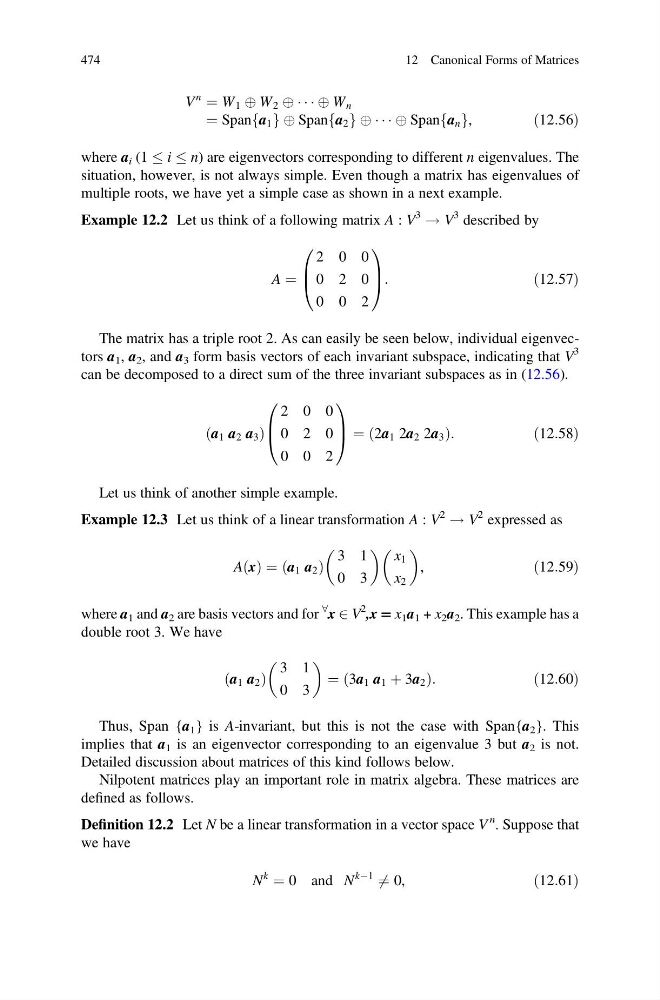
where a i (1 i n) are eigenvectors corresponding to different n eigenvalues. The
situation, however, is not always simple. Even though a matrix has eigenvalues of
multiple roots, we have yet a simple case as shown in a next example.
Example 12.2 Let us think of a following matrix A : V
3
! V
3 described by
A ¼
2 0 0
0 2 0
0 0 2
0
B
@
1
C
A:
ð12:57Þ
The matrix has a triple root 2. As can easily be seen below, individual eigenvectors a 1 , a 2 , and a 3 form basis vectors of each invariant subspace, indicating that V
3
can be decomposed to a direct sum of the three invariant subspaces as in (12.56).
a 1 a 2 a 3
ð
Þ
2 0 0
0 2 0
0 0 2
0
B
@
1
C
A ¼ 2a 1 2a 2 2a 3
ð
Þ :
ð12:58Þ
Let us think of another simple example.
Example 12.3 Let us think of a linear transformation A : V
2
! V
2 expressed as
A x
ð Þ ¼ a 1 a 2
ð
Þ
3 1
0 3
x 1
x 2
,
ð12:59Þ
where a 1 and a 2 are basis vectors and for
8 x 2 V
2 ,x = x 1 a 1 + x 2 a 2 . This example has a
double root 3. We have
a 1 a 2
ð
Þ
3 1
0 3
¼ 3a 1 a 1 þ 3a 2
ð
Þ :
ð12:60Þ
Thus, Span {a 1 } is A-invariant, but this is not the case with Span{a 2 }. This
implies that a 1 is an eigenvector corresponding to an eigenvalue 3 but a 2 is not.
Detailed discussion about matrices of this kind follows below.
Nilpotent matrices play an important role in matrix algebra. These matrices are
defined as follows.
Definition 12.2 Let N be a linear transformation in a vector space V
n . Suppose that
we have
N
k
¼ 0 and N
kÀ1
6 ¼ 0,
ð12:61Þ
474
12 Canonical Forms of Matrices
n
¼ W 1 È W 2 È Á Á Á È W n
¼ Span a 1
f g È Span a 2
f g È Á Á Á È Span a n
f g,
ð12:56Þ
where a i (1 i n) are eigenvectors corresponding to different n eigenvalues. The
situation, however, is not always simple. Even though a matrix has eigenvalues of
multiple roots, we have yet a simple case as shown in a next example.
Example 12.2 Let us think of a following matrix A : V
3
! V
3 described by
A ¼
2 0 0
0 2 0
0 0 2
0
B
@
1
C
A:
ð12:57Þ
The matrix has a triple root 2. As can easily be seen below, individual eigenvectors a 1 , a 2 , and a 3 form basis vectors of each invariant subspace, indicating that V
3
can be decomposed to a direct sum of the three invariant subspaces as in (12.56).
a 1 a 2 a 3
ð
Þ
2 0 0
0 2 0
0 0 2
0
B
@
1
C
A ¼ 2a 1 2a 2 2a 3
ð
Þ :
ð12:58Þ
Let us think of another simple example.
Example 12.3 Let us think of a linear transformation A : V
2
! V
2 expressed as
A x
ð Þ ¼ a 1 a 2
ð
Þ
3 1
0 3
x 1
x 2
,
ð12:59Þ
where a 1 and a 2 are basis vectors and for
8 x 2 V
2 ,x = x 1 a 1 + x 2 a 2 . This example has a
double root 3. We have
a 1 a 2
ð
Þ
3 1
0 3
¼ 3a 1 a 1 þ 3a 2
ð
Þ :
ð12:60Þ
Thus, Span {a 1 } is A-invariant, but this is not the case with Span{a 2 }. This
implies that a 1 is an eigenvector corresponding to an eigenvalue 3 but a 2 is not.
Detailed discussion about matrices of this kind follows below.
Nilpotent matrices play an important role in matrix algebra. These matrices are
defined as follows.
Definition 12.2 Let N be a linear transformation in a vector space V
n . Suppose that
we have
N
k
¼ 0 and N
kÀ1
6 ¼ 0,
ð12:61Þ
474
12 Canonical Forms of Matrices