

α 1 À α 2
ð
Þ a 1 = 0:
ð12:37Þ
As α 1 6 ¼ α 2 , α 1 À α 2 6 ¼ 0. This implies a 1 = 0, in contradiction to that a 1 is a
eigenvector. Thus, a 1 and a 2 must be linearly independent.
Next we assume that Theorem 12.2 is true of the case where we have (n À 1)
eigenvalues α 1 , α 2 , Á Á Á, and α n À 1 that are different from one another and
corresponding eigenvectors a 1 , a 2 , Á Á Á, and a n À 1 are linearly independent. Let us
think of a following equation:
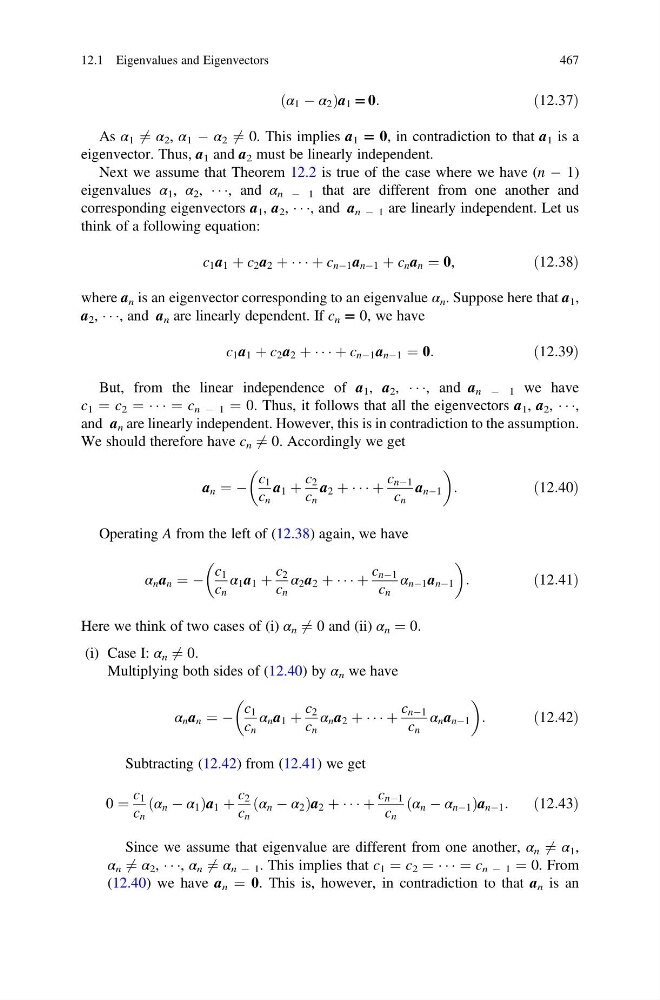
c 1 a 1 þ c 2 a 2 þ Á Á Á þ c nÀ1 a nÀ1 þ c n a n ¼ 0,
ð12:38Þ
where a n is an eigenvector corresponding to an eigenvalue α n . Suppose here that a 1 ,
a 2 , Á Á Á, and a n are linearly dependent. If c n = 0, we have
c 1 a 1 þ c 2 a 2 þ Á Á Á þ c nÀ1 a nÀ1 ¼ 0:
ð12:39Þ
But, from the linear independence of a 1 , a 2 , Á Á Á, and a n À 1 we have
c 1 ¼ c 2 ¼ Á Á Á ¼ c n À 1 ¼ 0. Thus, it follows that all the eigenvectors a 1 , a 2 , Á Á Á,
and a n are linearly independent. However, this is in contradiction to the assumption.
We should therefore have c n 6 ¼ 0. Accordingly we get
a n ¼ À
c 1
c n
a 1 þ
c 2
c n
a 2 þ Á Á Á þ
c nÀ1
c n
a nÀ1
:
ð12:40Þ
Operating A from the left of (12.38) again, we have
α n a n ¼ À
c 1
c n
α 1 a 1 þ
c 2
c n
α 2 a 2 þ Á Á Á þ
c nÀ1
c n
α nÀ1 a nÀ1
:
ð12:41Þ
Here we think of two cases of (i) α n 6 ¼ 0 and (ii) α n ¼ 0.
(i) Case I: α n 6 ¼ 0.
Multiplying both sides of (12.40) by α n we have
α n a n ¼ À
c 1
c n
α n a 1 þ
c 2
c n
α n a 2 þ Á Á Á þ
c nÀ1
c n
α n a nÀ1
:
ð12:42Þ
Subtracting (12.42) from (12.41) we get
0 ¼
c 1
c n
α n À α 1
ð
Þ a 1 þ
c 2
c n
α n À α 2
ð
Þ a 2 þ Á Á Á þ
c nÀ1
c n
α n À α nÀ1
ð
Þ a nÀ1 :
ð12:43Þ
Since we assume that eigenvalue are different from one another, α n 6 ¼ α 1 ,
α n 6 ¼ α 2 , Á Á Á, α n 6 ¼ α n À 1 . This implies that c 1 ¼ c 2 ¼ Á Á Á ¼ c n À 1 ¼ 0. From
(12.40) we have a n ¼ 0. This is, however, in contradiction to that a n is an
12.1 Eigenvalues and Eigenvectors
467
ð
Þ a 1 = 0:
ð12:37Þ
As α 1 6 ¼ α 2 , α 1 À α 2 6 ¼ 0. This implies a 1 = 0, in contradiction to that a 1 is a
eigenvector. Thus, a 1 and a 2 must be linearly independent.
Next we assume that Theorem 12.2 is true of the case where we have (n À 1)
eigenvalues α 1 , α 2 , Á Á Á, and α n À 1 that are different from one another and
corresponding eigenvectors a 1 , a 2 , Á Á Á, and a n À 1 are linearly independent. Let us
think of a following equation:
c 1 a 1 þ c 2 a 2 þ Á Á Á þ c nÀ1 a nÀ1 þ c n a n ¼ 0,
ð12:38Þ
where a n is an eigenvector corresponding to an eigenvalue α n . Suppose here that a 1 ,
a 2 , Á Á Á, and a n are linearly dependent. If c n = 0, we have
c 1 a 1 þ c 2 a 2 þ Á Á Á þ c nÀ1 a nÀ1 ¼ 0:
ð12:39Þ
But, from the linear independence of a 1 , a 2 , Á Á Á, and a n À 1 we have
c 1 ¼ c 2 ¼ Á Á Á ¼ c n À 1 ¼ 0. Thus, it follows that all the eigenvectors a 1 , a 2 , Á Á Á,
and a n are linearly independent. However, this is in contradiction to the assumption.
We should therefore have c n 6 ¼ 0. Accordingly we get
a n ¼ À
c 1
c n
a 1 þ
c 2
c n
a 2 þ Á Á Á þ
c nÀ1
c n
a nÀ1
:
ð12:40Þ
Operating A from the left of (12.38) again, we have
α n a n ¼ À
c 1
c n
α 1 a 1 þ
c 2
c n
α 2 a 2 þ Á Á Á þ
c nÀ1
c n
α nÀ1 a nÀ1
:
ð12:41Þ
Here we think of two cases of (i) α n 6 ¼ 0 and (ii) α n ¼ 0.
(i) Case I: α n 6 ¼ 0.
Multiplying both sides of (12.40) by α n we have
α n a n ¼ À
c 1
c n
α n a 1 þ
c 2
c n
α n a 2 þ Á Á Á þ
c nÀ1
c n
α n a nÀ1
:
ð12:42Þ
Subtracting (12.42) from (12.41) we get
0 ¼
c 1
c n
α n À α 1
ð
Þ a 1 þ
c 2
c n
α n À α 2
ð
Þ a 2 þ Á Á Á þ
c nÀ1
c n
α n À α nÀ1
ð
Þ a nÀ1 :
ð12:43Þ
Since we assume that eigenvalue are different from one another, α n 6 ¼ α 1 ,
α n 6 ¼ α 2 , Á Á Á, α n 6 ¼ α n À 1 . This implies that c 1 ¼ c 2 ¼ Á Á Á ¼ c n À 1 ¼ 0. From
(12.40) we have a n ¼ 0. This is, however, in contradiction to that a n is an
12.1 Eigenvalues and Eigenvectors
467