

A x
ð Þ = e
0
1 Á Á Áe
0
n
À
Á
A
0
e
x 1
⋮
e
x n
0
B
@
1
C
A:
ð11:87Þ
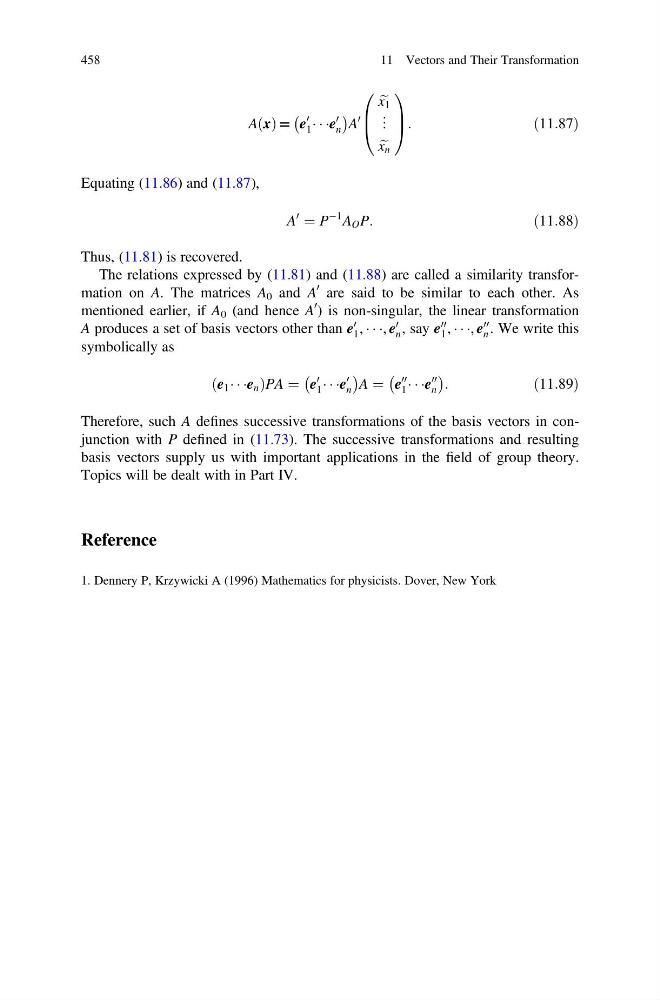
Equating (11.86) and (11.87),
A
0
¼ P
À1 A O P:
ð11:88Þ
Thus, (11.81) is recovered.
The relations expressed by (11.81) and (11.88) are called a similarity transformation on A. The matrices A 0 and A
0 are said to be similar to each other. As
mentioned earlier, if A 0 (and hence A
0 ) is non-singular, the linear transformation
A produces a set of basis vectors other than e
0
1 , Á Á Á, e
0
n , say e
00
1 , Á Á Á, e
00
n . We write this
symbolically as
e 1 Á Á Áe n
ð
ÞPA ¼ e
0
1 Á Á Áe
0
n
À
Á
A ¼ e
00
1 Á Á Áe
00
n
À
Á :
ð11:89Þ
Therefore, such A defines successive transformations of the basis vectors in conjunction with P defined in (11.73). The successive transformations and resulting
basis vectors supply us with important applications in the field of group theory.
Topics will be dealt with in Part IV.
Reference
1. Dennery P, Krzywicki A (1996) Mathematics for physicists. Dover, New York
458
11 Vectors and Their Transformation
ð Þ = e
0
1 Á Á Áe
0
n
À
Á
A
0
e
x 1
⋮
e
x n
0
B
@
1
C
A:
ð11:87Þ
Equating (11.86) and (11.87),
A
0
¼ P
À1 A O P:
ð11:88Þ
Thus, (11.81) is recovered.
The relations expressed by (11.81) and (11.88) are called a similarity transformation on A. The matrices A 0 and A
0 are said to be similar to each other. As
mentioned earlier, if A 0 (and hence A
0 ) is non-singular, the linear transformation
A produces a set of basis vectors other than e
0
1 , Á Á Á, e
0
n , say e
00
1 , Á Á Á, e
00
n . We write this
symbolically as
e 1 Á Á Áe n
ð
ÞPA ¼ e
0
1 Á Á Áe
0
n
À
Á
A ¼ e
00
1 Á Á Áe
00
n
À
Á :
ð11:89Þ
Therefore, such A defines successive transformations of the basis vectors in conjunction with P defined in (11.73). The successive transformations and resulting
basis vectors supply us with important applications in the field of group theory.
Topics will be dealt with in Part IV.
Reference
1. Dennery P, Krzywicki A (1996) Mathematics for physicists. Dover, New York
458
11 Vectors and Their Transformation