

V
4
¼ A V
4
À Á È Ker A:
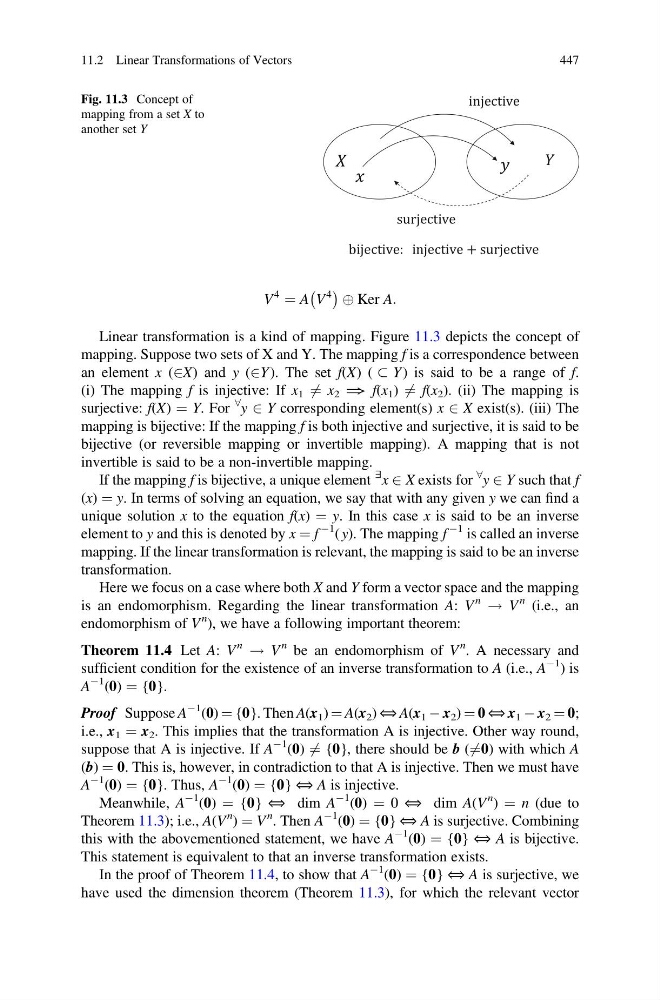
Linear transformation is a kind of mapping. Figure 11.3 depicts the concept of
mapping. Suppose two sets of X and Y. The mapping f is a correspondence between
an element x (2X) and y (2Y ). The set f(X) ( ⊂ Y ) is said to be a range of f.
(i) The mapping f is injective: If x 1 6 ¼ x 2 ⟹ f(x 1 ) 6 ¼ f(x 2 ). (ii) The mapping is
surjective: f(X) ¼ Y. For
8 y 2 Y corresponding element(s) x 2 X exist(s). (iii) The
mapping is bijective: If the mapping f is both injective and surjective, it is said to be
bijective (or reversible mapping or invertible mapping). A mapping that is not
invertible is said to be a non-invertible mapping.
If the mapping f is bijective, a unique element
∃
x 2 X exists for
8 y 2 Y such that f
(x) ¼ y. In terms of solving an equation, we say that with any given y we can find a
unique solution x to the equation f(x) ¼ y. In this case x is said to be an inverse
element to y and this is denoted by x ¼ f
À1 ( y). The mapping f
À1 is called an inverse
mapping. If the linear transformation is relevant, the mapping is said to be an inverse
transformation.
Here we focus on a case where both X and Y form a vector space and the mapping
is an endomorphism. Regarding the linear transformation A: V
n
! V
n (i.e., an
endomorphism of V
n ), we have a following important theorem:
Theorem 11.4 Let A: V
n
! V
n be an endomorphism of V
n . A necessary and
sufficient condition for the existence of an inverse transformation to A (i.e., A
À1 ) is
A
À1 (0) ¼ {0}.
Proof Suppose A
À1 (0) ¼ {0}. Then A(x 1 ) ¼ A(x 2 ) ⟺ A(x 1 À x 2 ) ¼ 0 ⟺ x 1 À x 2 ¼ 0;
i.e., x 1 ¼ x 2 . This implies that the transformation A is injective. Other way round,
suppose that A is injective. If A
À1 (0) 6 ¼ {0}, there should be b (6 ¼0) with which A
(b) ¼ 0. This is, however, in contradiction to that A is injective. Then we must have
A
À1 (0) ¼ {0}. Thus, A
À1 (0) ¼ {0} ⟺ A is injective.
Meanwhile, A
À1 (0) ¼ {0} ⟺ dim A
À1 (0) ¼ 0 ⟺ dim A(V
n ) ¼ n (due to
Theorem 11.3); i.e., A(V
n ) ¼ V
n . Then A
À1 (0) ¼ {0} ⟺ A is surjective. Combining
this with the abovementioned statement, we have A
À1 (0) ¼ {0} ⟺ A is bijective.
This statement is equivalent to that an inverse transformation exists.
In the proof of Theorem 11.4, to show that A
À1 (0) ¼ {0} ⟺ A is surjective, we
have used the dimension theorem (Theorem 11.3), for which the relevant vector
injective
surjective
bijective: injective + surjective
Fig. 11.3 Concept of
mapping from a set X to
another set Y
11.2 Linear Transformations of Vectors
447
4
¼ A V
4
À Á È Ker A:
Linear transformation is a kind of mapping. Figure 11.3 depicts the concept of
mapping. Suppose two sets of X and Y. The mapping f is a correspondence between
an element x (2X) and y (2Y ). The set f(X) ( ⊂ Y ) is said to be a range of f.
(i) The mapping f is injective: If x 1 6 ¼ x 2 ⟹ f(x 1 ) 6 ¼ f(x 2 ). (ii) The mapping is
surjective: f(X) ¼ Y. For
8 y 2 Y corresponding element(s) x 2 X exist(s). (iii) The
mapping is bijective: If the mapping f is both injective and surjective, it is said to be
bijective (or reversible mapping or invertible mapping). A mapping that is not
invertible is said to be a non-invertible mapping.
If the mapping f is bijective, a unique element
∃
x 2 X exists for
8 y 2 Y such that f
(x) ¼ y. In terms of solving an equation, we say that with any given y we can find a
unique solution x to the equation f(x) ¼ y. In this case x is said to be an inverse
element to y and this is denoted by x ¼ f
À1 ( y). The mapping f
À1 is called an inverse
mapping. If the linear transformation is relevant, the mapping is said to be an inverse
transformation.
Here we focus on a case where both X and Y form a vector space and the mapping
is an endomorphism. Regarding the linear transformation A: V
n
! V
n (i.e., an
endomorphism of V
n ), we have a following important theorem:
Theorem 11.4 Let A: V
n
! V
n be an endomorphism of V
n . A necessary and
sufficient condition for the existence of an inverse transformation to A (i.e., A
À1 ) is
A
À1 (0) ¼ {0}.
Proof Suppose A
À1 (0) ¼ {0}. Then A(x 1 ) ¼ A(x 2 ) ⟺ A(x 1 À x 2 ) ¼ 0 ⟺ x 1 À x 2 ¼ 0;
i.e., x 1 ¼ x 2 . This implies that the transformation A is injective. Other way round,
suppose that A is injective. If A
À1 (0) 6 ¼ {0}, there should be b (6 ¼0) with which A
(b) ¼ 0. This is, however, in contradiction to that A is injective. Then we must have
A
À1 (0) ¼ {0}. Thus, A
À1 (0) ¼ {0} ⟺ A is injective.
Meanwhile, A
À1 (0) ¼ {0} ⟺ dim A
À1 (0) ¼ 0 ⟺ dim A(V
n ) ¼ n (due to
Theorem 11.3); i.e., A(V
n ) ¼ V
n . Then A
À1 (0) ¼ {0} ⟺ A is surjective. Combining
this with the abovementioned statement, we have A
À1 (0) ¼ {0} ⟺ A is bijective.
This statement is equivalent to that an inverse transformation exists.
In the proof of Theorem 11.4, to show that A
À1 (0) ¼ {0} ⟺ A is surjective, we
have used the dimension theorem (Theorem 11.3), for which the relevant vector
injective
surjective
bijective: injective + surjective
Fig. 11.3 Concept of
mapping from a set X to
another set Y
11.2 Linear Transformations of Vectors
447