

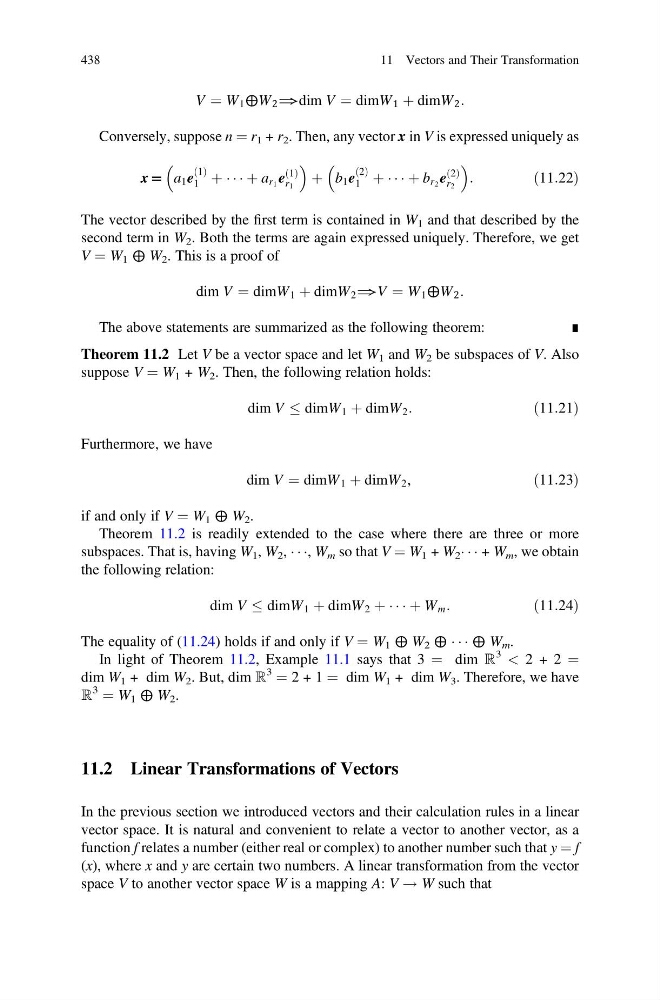
V ¼ W 1 ⨁W 2 ⟹dim V ¼ dimW 1 þ dimW 2 :
Conversely, suppose n ¼ r 1 + r 2 . Then, any vector x in V is expressed uniquely as
x = a 1 e
1
ð Þ
1 þ Á Á Á þ a r 1 e
1
ð Þ
r 1
þ b 1 e
2
ð Þ
1 þ Á Á Á þ b r 2 e
2
ð Þ
r 2
:
ð11:22Þ
The vector described by the first term is contained in W 1 and that described by the
second term in W 2 . Both the terms are again expressed uniquely. Therefore, we get
V ¼ W 1 ⨁ W 2 . This is a proof of
dim V ¼ dimW 1 þ dimW 2 ⟹V ¼ W 1 ⨁W 2 :
The above statements are summarized as the following theorem:
∎
Theorem 11.2 Let V be a vector space and let W 1 and W 2 be subspaces of V. Also
suppose V ¼ W 1 + W 2 . Then, the following relation holds:
dim V dimW 1 þ dimW 2 :
ð11:21Þ
Furthermore, we have
dim V ¼ dimW 1 þ dimW 2 ,
ð11:23Þ
if and only if V ¼ W 1 ⨁ W 2 .
Theorem 11.2 is readily extended to the case where there are three or more
subspaces. That is, having W 1 , W 2 , Á Á Á, W m so that V ¼ W 1 + W 2 Á Á Á + W m , we obtain
the following relation:
dim V dimW 1 þ dimW 2 þ Á Á Á þ W m :
ð11:24Þ
The equality of (11.24) holds if and only if V ¼ W 1 ⨁ W 2 ⨁ Á Á Á ⨁ W m .
In light of Theorem 11.2, Example 11.1 says that 3 ¼ dim ℝ
3
< 2 + 2 ¼
dim W 1 + dim W 2 . But, dim ℝ
3 ¼ 2 + 1 ¼ dim W 1 + dim W 3 . Therefore, we have
ℝ
3
¼ W 1 ⨁ W 2 .
11.2 Linear Transformations of Vectors
In the previous section we introduced vectors and their calculation rules in a linear
vector space. It is natural and convenient to relate a vector to another vector, as a
function f relates a number (either real or complex) to another number such that y ¼ f
(x), where x and y are certain two numbers. A linear transformation from the vector
space V to another vector space W is a mapping A: V ! W such that
438
11 Vectors and Their Transformation
Conversely, suppose n ¼ r 1 + r 2 . Then, any vector x in V is expressed uniquely as
x = a 1 e
1
ð Þ
1 þ Á Á Á þ a r 1 e
1
ð Þ
r 1
þ b 1 e
2
ð Þ
1 þ Á Á Á þ b r 2 e
2
ð Þ
r 2
:
ð11:22Þ
The vector described by the first term is contained in W 1 and that described by the
second term in W 2 . Both the terms are again expressed uniquely. Therefore, we get
V ¼ W 1 ⨁ W 2 . This is a proof of
dim V ¼ dimW 1 þ dimW 2 ⟹V ¼ W 1 ⨁W 2 :
The above statements are summarized as the following theorem:
∎
Theorem 11.2 Let V be a vector space and let W 1 and W 2 be subspaces of V. Also
suppose V ¼ W 1 + W 2 . Then, the following relation holds:
dim V dimW 1 þ dimW 2 :
ð11:21Þ
Furthermore, we have
dim V ¼ dimW 1 þ dimW 2 ,
ð11:23Þ
if and only if V ¼ W 1 ⨁ W 2 .
Theorem 11.2 is readily extended to the case where there are three or more
subspaces. That is, having W 1 , W 2 , Á Á Á, W m so that V ¼ W 1 + W 2 Á Á Á + W m , we obtain
the following relation:
dim V dimW 1 þ dimW 2 þ Á Á Á þ W m :
ð11:24Þ
The equality of (11.24) holds if and only if V ¼ W 1 ⨁ W 2 ⨁ Á Á Á ⨁ W m .
In light of Theorem 11.2, Example 11.1 says that 3 ¼ dim ℝ
3
< 2 + 2 ¼
dim W 1 + dim W 2 . But, dim ℝ
3 ¼ 2 + 1 ¼ dim W 1 + dim W 3 . Therefore, we have
ℝ
3
¼ W 1 ⨁ W 2 .
11.2 Linear Transformations of Vectors
In the previous section we introduced vectors and their calculation rules in a linear
vector space. It is natural and convenient to relate a vector to another vector, as a
function f relates a number (either real or complex) to another number such that y ¼ f
(x), where x and y are certain two numbers. A linear transformation from the vector
space V to another vector space W is a mapping A: V ! W such that
438
11 Vectors and Their Transformation