

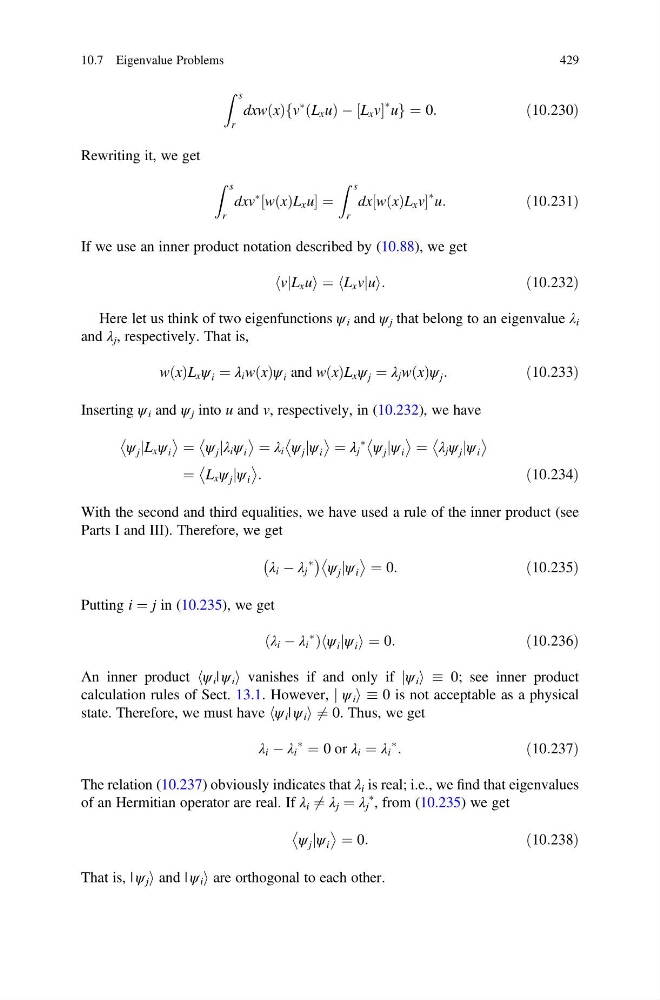
Z s
r
dxw x
ð Þ v
à L x u
ð ÞÀ L x v
½
à u
f
g ¼ 0:
ð10:230Þ
Rewriting it, we get
Z s
r
dxv
à w x
ð ÞL x u
½
¼
Z s
r
dx w x
ð ÞL x v
½
à u:
ð10:231Þ
If we use an inner product notation described by (10.88), we get
vjL x u
h
i¼ L x vju
h
i:
ð10:232Þ
Here let us think of two eigenfunctions ψ i and ψ j that belong to an eigenvalue λ i
and λ j , respectively. That is,
w x
ð ÞL x ψ i ¼ λ i w x
ð Þψ i and w x
ð ÞL x ψ j ¼ λ j w x
ð Þψ j :
ð10:233Þ
Inserting ψ i and ψ j into u and v, respectively, in (10.232), we have
ψ j jL x ψ i
¼ ψ j jλ i ψ i
¼ λ i ψ j jψ i
¼ λ j
Ã
ψ j jψ i
¼ λ j ψ j jψ i
¼ L x ψ j jψ i
:
ð10:234Þ
With the second and third equalities, we have used a rule of the inner product (see
Parts I and III). Therefore, we get
λ i À λ j
Ã
À
Á ψ j jψ i
¼ 0:
ð10:235Þ
Putting i ¼ j in (10.235), we get
λ i À λ i
Ã
ð
Þψ i jψ i
h
i¼ 0:
ð10:236Þ
An inner product hψ i | ψ i i vanishes if and only if jψ i i 0; see inner product
calculation rules of Sect. 13.1. However, j ψ i i 0 is not acceptable as a physical
state. Therefore, we must have hψ i | ψ i i 6 ¼ 0. Thus, we get
λ i À λ i
Ã
¼ 0 or λ i ¼ λ i
Ã
:
ð10:237Þ
The relation (10.237) obviously indicates that λ i is real; i.e., we find that eigenvalues
of an Hermitian operator are real. If λ i 6 ¼ λ j ¼ λ j
à , from (10.235) we get
ψ j jψ i
¼ 0:
ð10:238Þ
That is, | ψ j i and | ψ i i are orthogonal to each other.
10.7 Eigenvalue Problems
429
r
dxw x
ð Þ v
à L x u
ð ÞÀ L x v
½
à u
f
g ¼ 0:
ð10:230Þ
Rewriting it, we get
Z s
r
dxv
à w x
ð ÞL x u
½
¼
Z s
r
dx w x
ð ÞL x v
½
à u:
ð10:231Þ
If we use an inner product notation described by (10.88), we get
vjL x u
h
i¼ L x vju
h
i:
ð10:232Þ
Here let us think of two eigenfunctions ψ i and ψ j that belong to an eigenvalue λ i
and λ j , respectively. That is,
w x
ð ÞL x ψ i ¼ λ i w x
ð Þψ i and w x
ð ÞL x ψ j ¼ λ j w x
ð Þψ j :
ð10:233Þ
Inserting ψ i and ψ j into u and v, respectively, in (10.232), we have
ψ j jL x ψ i
¼ ψ j jλ i ψ i
¼ λ i ψ j jψ i
¼ λ j
Ã
ψ j jψ i
¼ λ j ψ j jψ i
¼ L x ψ j jψ i
:
ð10:234Þ
With the second and third equalities, we have used a rule of the inner product (see
Parts I and III). Therefore, we get
λ i À λ j
Ã
À
Á ψ j jψ i
¼ 0:
ð10:235Þ
Putting i ¼ j in (10.235), we get
λ i À λ i
Ã
ð
Þψ i jψ i
h
i¼ 0:
ð10:236Þ
An inner product hψ i | ψ i i vanishes if and only if jψ i i 0; see inner product
calculation rules of Sect. 13.1. However, j ψ i i 0 is not acceptable as a physical
state. Therefore, we must have hψ i | ψ i i 6 ¼ 0. Thus, we get
λ i À λ i
Ã
¼ 0 or λ i ¼ λ i
Ã
:
ð10:237Þ
The relation (10.237) obviously indicates that λ i is real; i.e., we find that eigenvalues
of an Hermitian operator are real. If λ i 6 ¼ λ j ¼ λ j
à , from (10.235) we get
ψ j jψ i
¼ 0:
ð10:238Þ
That is, | ψ j i and | ψ i i are orthogonal to each other.
10.7 Eigenvalue Problems
429