

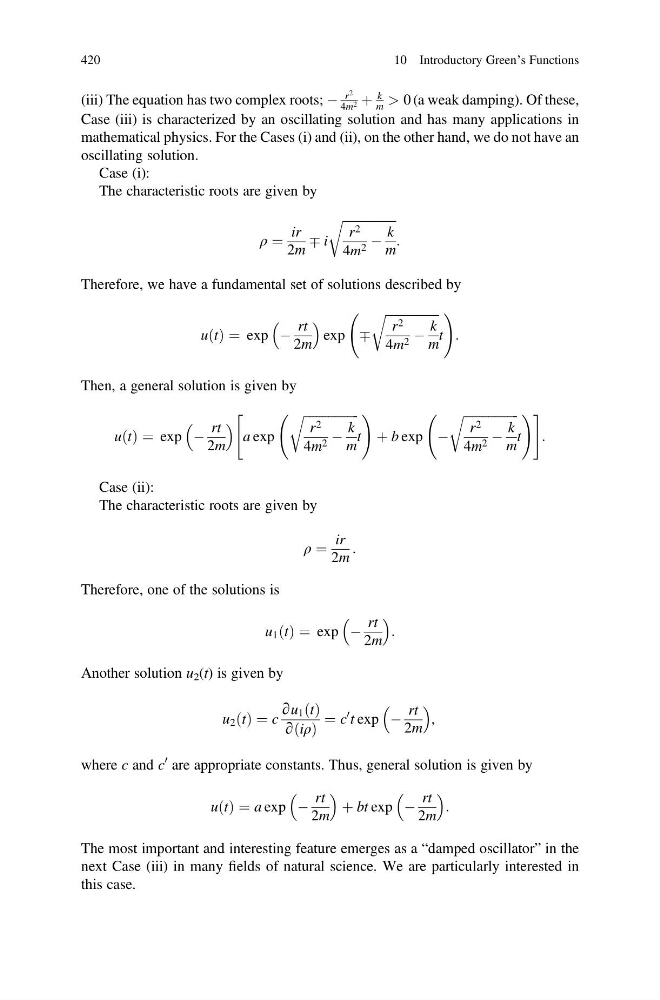
(iii) The equation has two complex roots; À
r
2
4m 2 þ
k
m > 0 (a weak damping). Of these,
Case (iii) is characterized by an oscillating solution and has many applications in
mathematical physics. For the Cases (i) and (ii), on the other hand, we do not have an
oscillating solution.
Case (i):
The characteristic roots are given by
ρ ¼
ir
2m
Ç i
ffiffiffiffiffiffiffiffiffiffiffiffiffiffiffiffiffi ffi
r 2
4m 2 À
k
m
r
:
Therefore, we have a fundamental set of solutions described by
u t
ð Þ ¼ exp À
rt
2m
exp Ç
ffiffiffiffiffiffiffiffiffiffiffiffiffiffiffiffiffi ffi
r 2
4m 2 À
k
m
r
t
!
:
Then, a general solution is given by
u t
ð Þ ¼ exp À
rt
2m
a exp
ffiffiffiffiffiffiffiffiffiffiffiffiffiffiffiffiffi ffi
r 2
4m 2 À
k
m
r
t
!
þ b exp À
ffiffiffiffiffiffiffiffiffiffiffiffiffiffiffiffiffi ffi
r 2
4m 2 À
k
m
r
t
!
"
#
:
Case (ii):
The characteristic roots are given by
ρ ¼
ir
2m
:
Therefore, one of the solutions is
u 1 t
ð Þ ¼ exp À
rt
2m
:
Another solution u 2 (t) is given by
u 2 t
ð Þ ¼ c
∂u 1 t
ð Þ
∂ iρ
ð Þ
¼ c
0 t exp À
rt
2m
,
where c and c
0 are appropriate constants. Thus, general solution is given by
u t
ð Þ ¼ a exp À
rt
2m
þ bt exp À
rt
2m
:
The most important and interesting feature emerges as a “damped oscillator” in the
next Case (iii) in many fields of natural science. We are particularly interested in
this case.
420
10 Introductory Green’s Functions
r
2
4m 2 þ
k
m > 0 (a weak damping). Of these,
Case (iii) is characterized by an oscillating solution and has many applications in
mathematical physics. For the Cases (i) and (ii), on the other hand, we do not have an
oscillating solution.
Case (i):
The characteristic roots are given by
ρ ¼
ir
2m
Ç i
ffiffiffiffiffiffiffiffiffiffiffiffiffiffiffiffiffi ffi
r 2
4m 2 À
k
m
r
:
Therefore, we have a fundamental set of solutions described by
u t
ð Þ ¼ exp À
rt
2m
exp Ç
ffiffiffiffiffiffiffiffiffiffiffiffiffiffiffiffiffi ffi
r 2
4m 2 À
k
m
r
t
!
:
Then, a general solution is given by
u t
ð Þ ¼ exp À
rt
2m
a exp
ffiffiffiffiffiffiffiffiffiffiffiffiffiffiffiffiffi ffi
r 2
4m 2 À
k
m
r
t
!
þ b exp À
ffiffiffiffiffiffiffiffiffiffiffiffiffiffiffiffiffi ffi
r 2
4m 2 À
k
m
r
t
!
"
#
:
Case (ii):
The characteristic roots are given by
ρ ¼
ir
2m
:
Therefore, one of the solutions is
u 1 t
ð Þ ¼ exp À
rt
2m
:
Another solution u 2 (t) is given by
u 2 t
ð Þ ¼ c
∂u 1 t
ð Þ
∂ iρ
ð Þ
¼ c
0 t exp À
rt
2m
,
where c and c
0 are appropriate constants. Thus, general solution is given by
u t
ð Þ ¼ a exp À
rt
2m
þ bt exp À
rt
2m
:
The most important and interesting feature emerges as a “damped oscillator” in the
next Case (iii) in many fields of natural science. We are particularly interested in
this case.
420
10 Introductory Green’s Functions