

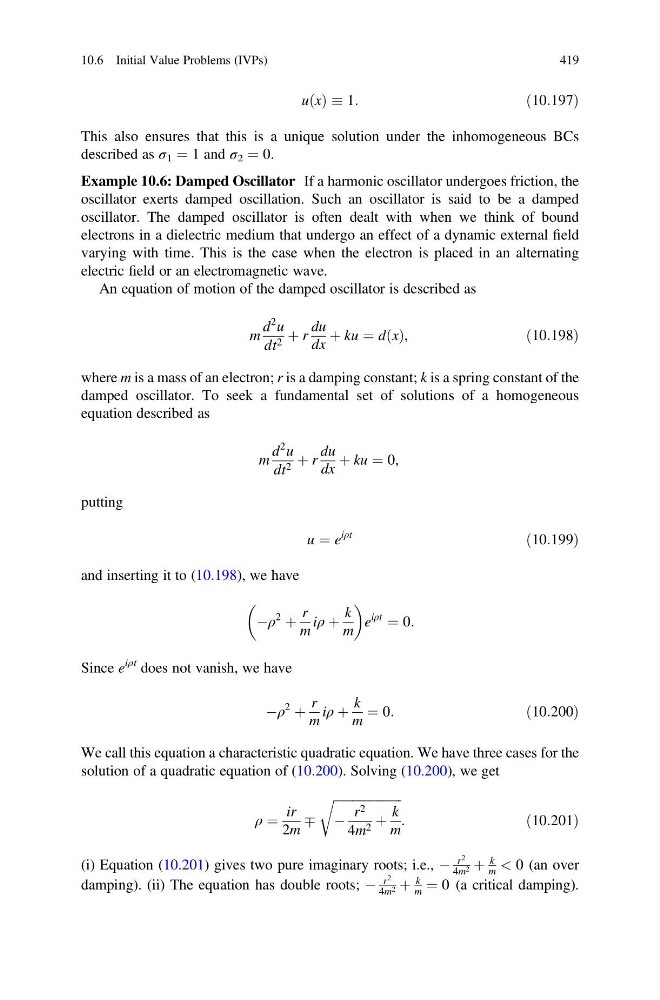
u x
ð Þ 1:
ð10:197Þ
This also ensures that this is a unique solution under the inhomogeneous BCs
described as σ 1 ¼ 1 and σ 2 ¼ 0.
Example 10.6: Damped Oscillator If a harmonic oscillator undergoes friction, the
oscillator exerts damped oscillation. Such an oscillator is said to be a damped
oscillator. The damped oscillator is often dealt with when we think of bound
electrons in a dielectric medium that undergo an effect of a dynamic external field
varying with time. This is the case when the electron is placed in an alternating
electric field or an electromagnetic wave.
An equation of motion of the damped oscillator is described as
m
d
2 u
dt 2 þ r
du
dx
þ ku ¼ d x
ð Þ,
ð10:198Þ
where m is a mass of an electron; r is a damping constant; k is a spring constant of the
damped oscillator. To seek a fundamental set of solutions of a homogeneous
equation described as
m
d
2 u
dt 2 þ r
du
dx
þ ku ¼ 0,
putting
u ¼ e
iρt
ð10:199Þ
and inserting it to (10.198), we have
Àρ
2
þ
r
m
iρ þ
k
m
e
iρt
¼ 0:
Since e
iρt does not vanish, we have
Àρ
2
þ
r
m
iρ þ
k
m
¼ 0:
ð10:200Þ
We call this equation a characteristic quadratic equation. We have three cases for the
solution of a quadratic equation of (10.200). Solving (10.200), we get
ρ ¼
ir
2m
Ç
ffiffiffiffiffiffiffiffiffiffiffiffiffiffiffiffiffiffiffiffiffiffi
À
r 2
4m 2 þ
k
m
r
:
ð10:201Þ
(i) Equation (10.201) gives two pure imaginary roots; i.e., À
r
2
4m 2 þ
k
m < 0 (an over
damping). (ii) The equation has double roots; À
r
2
4m 2 þ
k
m ¼ 0 (a critical damping).
10.6 Initial Value Problems (IVPs)
419
ð Þ 1:
ð10:197Þ
This also ensures that this is a unique solution under the inhomogeneous BCs
described as σ 1 ¼ 1 and σ 2 ¼ 0.
Example 10.6: Damped Oscillator If a harmonic oscillator undergoes friction, the
oscillator exerts damped oscillation. Such an oscillator is said to be a damped
oscillator. The damped oscillator is often dealt with when we think of bound
electrons in a dielectric medium that undergo an effect of a dynamic external field
varying with time. This is the case when the electron is placed in an alternating
electric field or an electromagnetic wave.
An equation of motion of the damped oscillator is described as
m
d
2 u
dt 2 þ r
du
dx
þ ku ¼ d x
ð Þ,
ð10:198Þ
where m is a mass of an electron; r is a damping constant; k is a spring constant of the
damped oscillator. To seek a fundamental set of solutions of a homogeneous
equation described as
m
d
2 u
dt 2 þ r
du
dx
þ ku ¼ 0,
putting
u ¼ e
iρt
ð10:199Þ
and inserting it to (10.198), we have
Àρ
2
þ
r
m
iρ þ
k
m
e
iρt
¼ 0:
Since e
iρt does not vanish, we have
Àρ
2
þ
r
m
iρ þ
k
m
¼ 0:
ð10:200Þ
We call this equation a characteristic quadratic equation. We have three cases for the
solution of a quadratic equation of (10.200). Solving (10.200), we get
ρ ¼
ir
2m
Ç
ffiffiffiffiffiffiffiffiffiffiffiffiffiffiffiffiffiffiffiffiffiffi
À
r 2
4m 2 þ
k
m
r
:
ð10:201Þ
(i) Equation (10.201) gives two pure imaginary roots; i.e., À
r
2
4m 2 þ
k
m < 0 (an over
damping). (ii) The equation has double roots; À
r
2
4m 2 þ
k
m ¼ 0 (a critical damping).
10.6 Initial Value Problems (IVPs)
419