

L x
{ v x
ð Þ ¼ h x
ð Þ
ð10:82Þ
under homogeneous adjoint BCs [1, 2] with an inhomogeneous term h(x) being an
arbitrary function as well.
Let us describe the above relations as
Ljui ¼ jdi and L
{
jvi ¼ jhi:
ð10:83Þ
Suppose that there is an inverse operator L
À1
G such that
GL ¼ LG ¼ E,
ð10:84Þ
where E is an identity operator. Operating G on (10.83), we have
GLjui ¼ Ejui ¼ jui ¼ Gjdi:
ð10:85Þ
This implies that (10.81) has been solved and the solution is given by G| di. Since an
inverse operation to differentiation is integration, G is expected to be an integral
operator.
We have
xjLG j y
h
i¼ L x xjG j y
h
i¼ L x G x, y
ð Þ:
ð10:86Þ
Meanwhile, using (10.84) we get
xjLG j y
h
i¼ xjE j y
h
i¼ xjy
h i:
ð10:87Þ
Using a weight function w(x), we generalize an inner product of (1.128) such that
gj f
h i
Z s
r
w x
ð Þg x
ð Þ
à f x
ð Þdx:
ð10:88Þ
As we expand an arbitrary vector using basis vectors, we “expand” an arbitrary
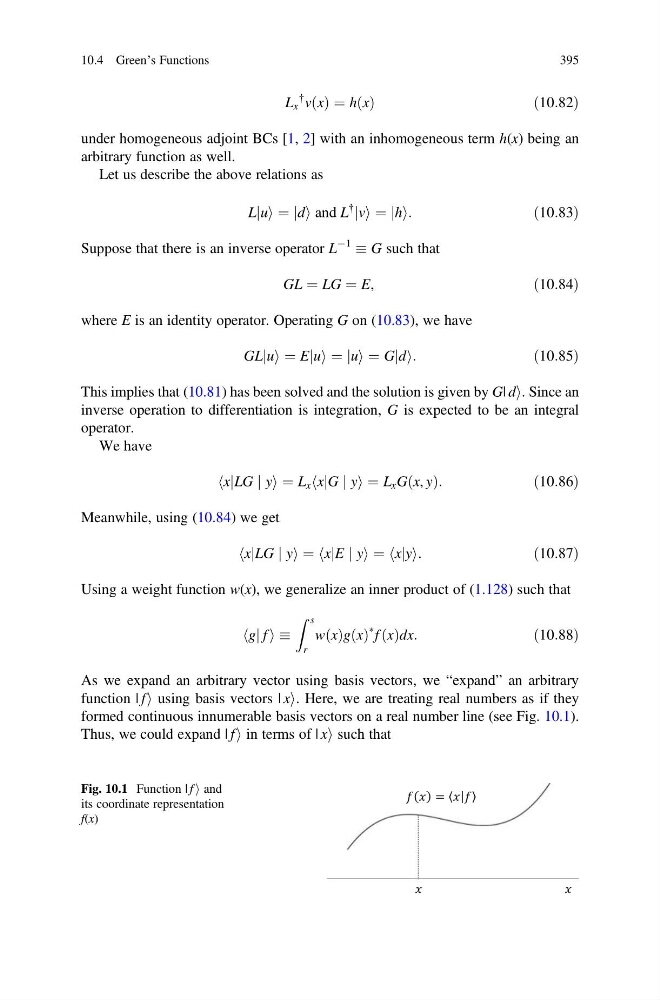
function | f i using basis vectors | xi. Here, we are treating real numbers as if they
formed continuous innumerable basis vectors on a real number line (see Fig. 10.1).
Thus, we could expand | f i in terms of | xi such that
=
Fig. 10.1 Function | f i and
its coordinate representation
f(x)
10.4 Green’s Functions
395
{ v x
ð Þ ¼ h x
ð Þ
ð10:82Þ
under homogeneous adjoint BCs [1, 2] with an inhomogeneous term h(x) being an
arbitrary function as well.
Let us describe the above relations as
Ljui ¼ jdi and L
{
jvi ¼ jhi:
ð10:83Þ
Suppose that there is an inverse operator L
À1
G such that
GL ¼ LG ¼ E,
ð10:84Þ
where E is an identity operator. Operating G on (10.83), we have
GLjui ¼ Ejui ¼ jui ¼ Gjdi:
ð10:85Þ
This implies that (10.81) has been solved and the solution is given by G| di. Since an
inverse operation to differentiation is integration, G is expected to be an integral
operator.
We have
xjLG j y
h
i¼ L x xjG j y
h
i¼ L x G x, y
ð Þ:
ð10:86Þ
Meanwhile, using (10.84) we get
xjLG j y
h
i¼ xjE j y
h
i¼ xjy
h i:
ð10:87Þ
Using a weight function w(x), we generalize an inner product of (1.128) such that
gj f
h i
Z s
r
w x
ð Þg x
ð Þ
à f x
ð Þdx:
ð10:88Þ
As we expand an arbitrary vector using basis vectors, we “expand” an arbitrary
function | f i using basis vectors | xi. Here, we are treating real numbers as if they
formed continuous innumerable basis vectors on a real number line (see Fig. 10.1).
Thus, we could expand | f i in terms of | xi such that
=
Fig. 10.1 Function | f i and
its coordinate representation
f(x)
10.4 Green’s Functions
395