

¼ bw
ð Þ
0 v
Ã
þ bwv
Ã
0 þ aw
ð Þ
0 v
Ã
0 þ awv
Ã
00 À bw
ð Þ
0 v
Ã
À bwv
Ã
0 þ cwv
Ã
¼ aw
ð Þ
0 v
Ã
0 þ awv
Ã
00 þ cwv
Ã
¼ bwv
Ã
0 þ awv
Ã
00 þ cwv
Ã
¼ w av
Ã
00 þ bv
Ã
0 þ cv
Ã
¼ w a
à v
Ã
00 þ b
à v
Ã
0 þ c
à v
Ã
¼ w av
00
þ bv
0
þ cv
ð
Þ
à :
ð10:66Þ
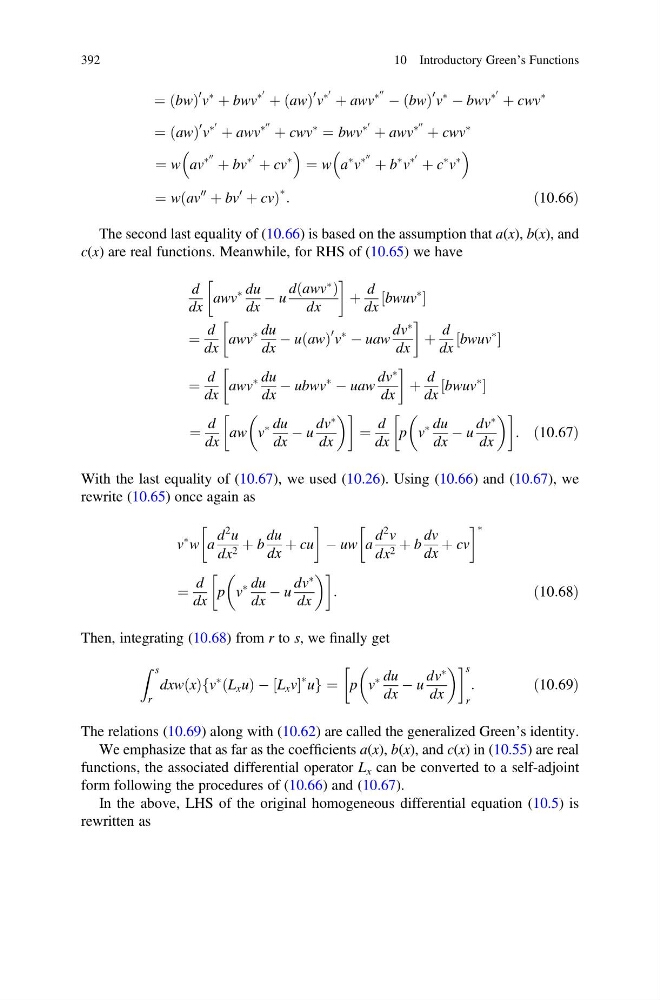
The second last equality of (10.66) is based on the assumption that a(x), b(x), and
c(x) are real functions. Meanwhile, for RHS of (10.65) we have
d
dx
awv
à du
dx
À u
d awv
Ã
ð
Þ
dx
!
þ
d
dx
bwuv
Ã
½
¼
d
dx
awv
à du
dx
À u aw
ð Þ
0 v
Ã
À uaw
dv
Ã
dx
!
þ
d
dx
bwuv
Ã
½
¼
d
dx
awv
à du
dx
À ubwv
Ã
À uaw
dv
Ã
dx
!
þ
d
dx
bwuv
Ã
½
¼
d
dx
aw v
à du
dx
À u
dv
Ã
dx
!
¼
d
dx
p v
à du
dx
À u
dv
Ã
dx
!
: ð10:67Þ
With the last equality of (10.67), we used (10.26). Using (10.66) and (10.67), we
rewrite (10.65) once again as
v
à w a
d
2 u
dx 2 þ b
du
dx
þ cu
!
À uw a
d
2 v
dx 2 þ b
dv
dx
þ cv
! Ã
¼
d
dx
p v
à du
dx
À u
dv
Ã
dx
!
:
ð10:68Þ
Then, integrating (10.68) from r to s, we finally get
Z s
r
dxw x
ð Þ v
à L x u
ð ÞÀ L x v
½
à u
f
g ¼ p v
à du
dx
À u
dv
Ã
dx
! s
r
:
ð10:69Þ
The relations (10.69) along with (10.62) are called the generalized Green’s identity.
We emphasize that as far as the coefficients a(x), b(x), and c(x) in (10.55) are real
functions, the associated differential operator L x can be converted to a self-adjoint
form following the procedures of (10.66) and (10.67).
In the above, LHS of the original homogeneous differential equation (10.5) is
rewritten as
392
10 Introductory Green’s Functions
ð Þ
0 v
Ã
þ bwv
Ã
0 þ aw
ð Þ
0 v
Ã
0 þ awv
Ã
00 À bw
ð Þ
0 v
Ã
À bwv
Ã
0 þ cwv
Ã
¼ aw
ð Þ
0 v
Ã
0 þ awv
Ã
00 þ cwv
Ã
¼ bwv
Ã
0 þ awv
Ã
00 þ cwv
Ã
¼ w av
Ã
00 þ bv
Ã
0 þ cv
Ã
¼ w a
à v
Ã
00 þ b
à v
Ã
0 þ c
à v
Ã
¼ w av
00
þ bv
0
þ cv
ð
Þ
à :
ð10:66Þ
The second last equality of (10.66) is based on the assumption that a(x), b(x), and
c(x) are real functions. Meanwhile, for RHS of (10.65) we have
d
dx
awv
à du
dx
À u
d awv
Ã
ð
Þ
dx
!
þ
d
dx
bwuv
Ã
½
¼
d
dx
awv
à du
dx
À u aw
ð Þ
0 v
Ã
À uaw
dv
Ã
dx
!
þ
d
dx
bwuv
Ã
½
¼
d
dx
awv
à du
dx
À ubwv
Ã
À uaw
dv
Ã
dx
!
þ
d
dx
bwuv
Ã
½
¼
d
dx
aw v
à du
dx
À u
dv
Ã
dx
!
¼
d
dx
p v
à du
dx
À u
dv
Ã
dx
!
: ð10:67Þ
With the last equality of (10.67), we used (10.26). Using (10.66) and (10.67), we
rewrite (10.65) once again as
v
à w a
d
2 u
dx 2 þ b
du
dx
þ cu
!
À uw a
d
2 v
dx 2 þ b
dv
dx
þ cv
! Ã
¼
d
dx
p v
à du
dx
À u
dv
Ã
dx
!
:
ð10:68Þ
Then, integrating (10.68) from r to s, we finally get
Z s
r
dxw x
ð Þ v
à L x u
ð ÞÀ L x v
½
à u
f
g ¼ p v
à du
dx
À u
dv
Ã
dx
! s
r
:
ð10:69Þ
The relations (10.69) along with (10.62) are called the generalized Green’s identity.
We emphasize that as far as the coefficients a(x), b(x), and c(x) in (10.55) are real
functions, the associated differential operator L x can be converted to a self-adjoint
form following the procedures of (10.66) and (10.67).
In the above, LHS of the original homogeneous differential equation (10.5) is
rewritten as
392
10 Introductory Green’s Functions