

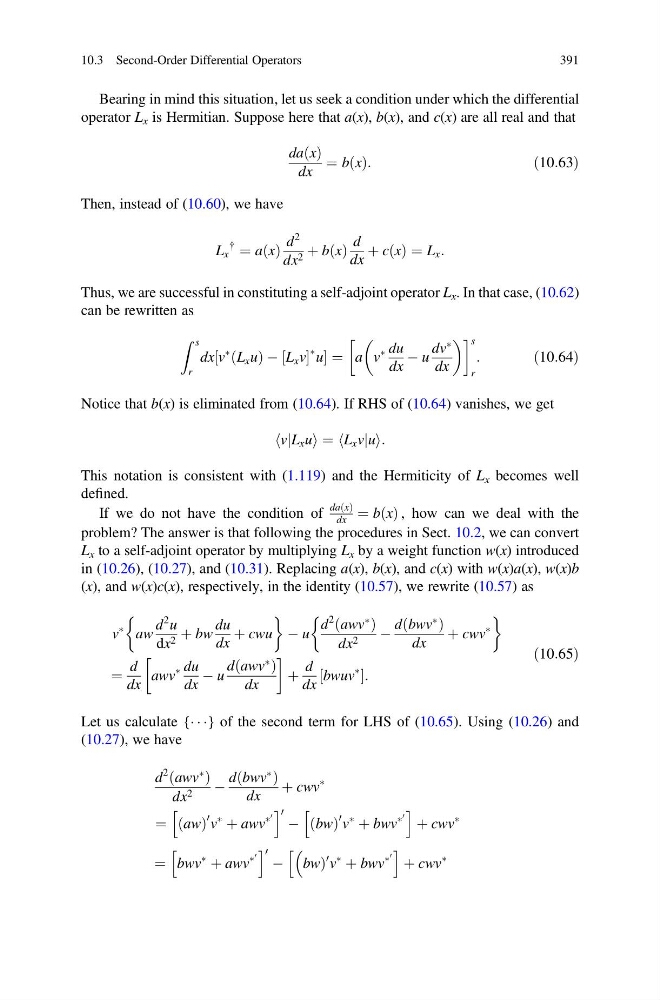
Bearing in mind this situation, let us seek a condition under which the differential
operator L x is Hermitian. Suppose here that a(x), b(x), and c(x) are all real and that
da x
ð Þ
dx
¼ b x
ð Þ:
ð10:63Þ
Then, instead of (10.60), we have
L x
{
¼ a x
ð Þ
d
2
dx 2 þ b x
ð Þ
d
dx
þ c x
ð Þ ¼ L x :
Thus, we are successful in constituting a self-adjoint operator L x . In that case, (10.62)
can be rewritten as
Z s
r
dx v
à L x u
ð ÞÀ L x v
½
à u
½
¼a v
à du
dx
À u
dv
Ã
dx
! s
r
:
ð10:64Þ
Notice that b(x) is eliminated from (10.64). If RHS of (10.64) vanishes, we get
vjL x u
h
i¼ L x vju
h
i:
This notation is consistent with (1.119) and the Hermiticity of L x becomes well
defined.
If we do not have the condition of
da x
ð Þ
dx ¼ b x
ð Þ , how can we deal with the
problem? The answer is that following the procedures in Sect. 10.2, we can convert
L x to a self-adjoint operator by multiplying L x by a weight function w(x) introduced
in (10.26), (10.27), and (10.31). Replacing a(x), b(x), and c(x) with w(x)a(x), w(x)b
(x), and w(x)c(x), respectively, in the identity (10.57), we rewrite (10.57) as
v
à aw
d
2 u
dx 2 þ bw
du
dx
þ cwu
&
'
À u
d
2 awv
Ã
ð
Þ
dx 2 À
d bwv
Ã
ð
Þ
dx
þ cwv
Ã
&
'
¼
d
dx
awv
à du
dx
À u
d awv
Ã
ð
Þ
dx
!
þ
d
dx
bwuv
Ã
½
:
ð10:65Þ
Let us calculate {Á Á Á} of the second term for LHS of (10.65). Using (10.26) and
(10.27), we have
d
2 awv
Ã
ð
Þ
dx 2 À
d bwv
Ã
ð
Þ
dx
þ cwv
Ã
¼ aw
ð Þ
0 v
Ã
þ awv
Ã
0
h
i 0 À bw
ð Þ
0 v
Ã
þ bwv
Ã
0
h
i
þ cwv
Ã
¼ bwv
Ã
þ awv
Ã
0
h
i 0 À bwÞ
0 v
Ã
þ bwv
Ã
0
i
þ cwv
Ã
h
10.3 Second-Order Differential Operators
391
operator L x is Hermitian. Suppose here that a(x), b(x), and c(x) are all real and that
da x
ð Þ
dx
¼ b x
ð Þ:
ð10:63Þ
Then, instead of (10.60), we have
L x
{
¼ a x
ð Þ
d
2
dx 2 þ b x
ð Þ
d
dx
þ c x
ð Þ ¼ L x :
Thus, we are successful in constituting a self-adjoint operator L x . In that case, (10.62)
can be rewritten as
Z s
r
dx v
à L x u
ð ÞÀ L x v
½
à u
½
¼a v
à du
dx
À u
dv
Ã
dx
! s
r
:
ð10:64Þ
Notice that b(x) is eliminated from (10.64). If RHS of (10.64) vanishes, we get
vjL x u
h
i¼ L x vju
h
i:
This notation is consistent with (1.119) and the Hermiticity of L x becomes well
defined.
If we do not have the condition of
da x
ð Þ
dx ¼ b x
ð Þ , how can we deal with the
problem? The answer is that following the procedures in Sect. 10.2, we can convert
L x to a self-adjoint operator by multiplying L x by a weight function w(x) introduced
in (10.26), (10.27), and (10.31). Replacing a(x), b(x), and c(x) with w(x)a(x), w(x)b
(x), and w(x)c(x), respectively, in the identity (10.57), we rewrite (10.57) as
v
à aw
d
2 u
dx 2 þ bw
du
dx
þ cwu
&
'
À u
d
2 awv
Ã
ð
Þ
dx 2 À
d bwv
Ã
ð
Þ
dx
þ cwv
Ã
&
'
¼
d
dx
awv
à du
dx
À u
d awv
Ã
ð
Þ
dx
!
þ
d
dx
bwuv
Ã
½
:
ð10:65Þ
Let us calculate {Á Á Á} of the second term for LHS of (10.65). Using (10.26) and
(10.27), we have
d
2 awv
Ã
ð
Þ
dx 2 À
d bwv
Ã
ð
Þ
dx
þ cwv
Ã
¼ aw
ð Þ
0 v
Ã
þ awv
Ã
0
h
i 0 À bw
ð Þ
0 v
Ã
þ bwv
Ã
0
h
i
þ cwv
Ã
¼ bwv
Ã
þ awv
Ã
0
h
i 0 À bwÞ
0 v
Ã
þ bwv
Ã
0
i
þ cwv
Ã
h
10.3 Second-Order Differential Operators
391