

A
{
ψjξi
¼ ψjAξi
h
:
ð1:112Þ
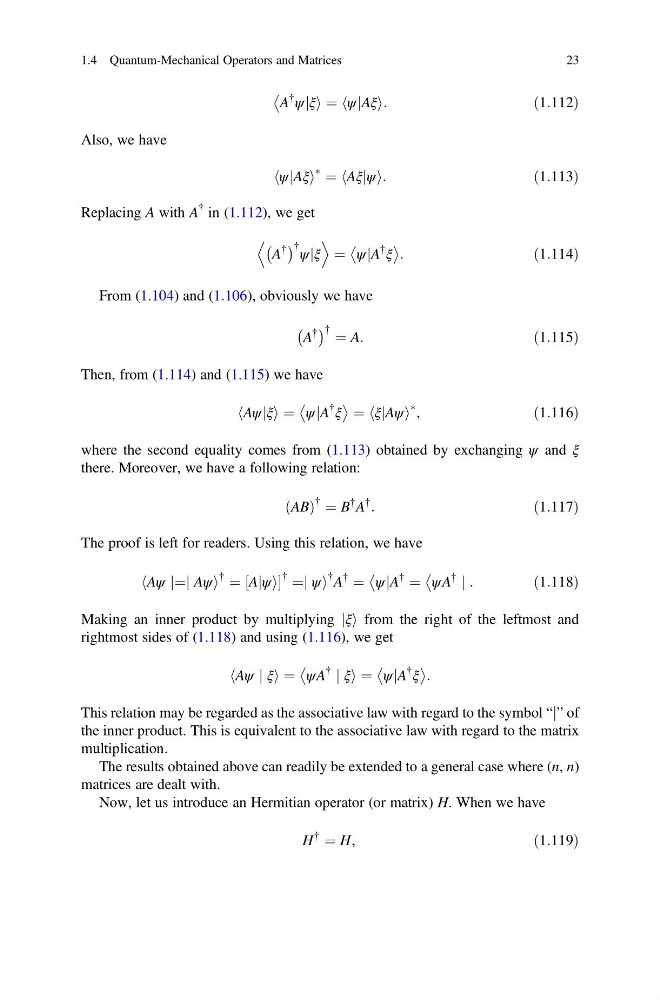
Also, we have
ψjA
h
ξi
à ¼ Aξjψi
h
:
ð1:113Þ
Replacing A with A
{ in (1.112), we get
A
{
À Á { ψjξ
D
E
¼ ψjA
{
ξ
:
ð1:114Þ
From (1.104) and (1.106), obviously we have
A
{
À Á { ¼ A:
ð1:115Þ
Then, from (1.114) and (1.115) we have
Aψjξ
h
i¼ ψjA
{
ξ
¼ ξjAψ
h
i
à ,
ð1:116Þ
where the second equality comes from (1.113) obtained by exchanging ψ and ξ
there. Moreover, we have a following relation:
AB
ð Þ
{ ¼ B
{ A
{
:
ð1:117Þ
The proof is left for readers. Using this relation, we have
Aψ
h
j¼j Aψi
{ ¼ Ajψi
½
{ ¼j ψi
{ A
{
¼ ψjA
{
¼ ψA
{
j :
ð1:118Þ
Making an inner product by multiplying jξi from the right of the leftmost and
rightmost sides of (1.118) and using (1.116), we get
Aψ
h
j ξi ¼ ψA
{
j ξi ¼ ψjA
{
ξ
:
This relation may be regarded as the associative law with regard to the symbol “j” of
the inner product. This is equivalent to the associative law with regard to the matrix
multiplication.
The results obtained above can readily be extended to a general case where (n, n)
matrices are dealt with.
Now, let us introduce an Hermitian operator (or matrix) H. When we have
H
{
¼ H,
ð1:119Þ
1.4 Quantum-Mechanical Operators and Matrices
23
{
ψjξi
¼ ψjAξi
h
:
ð1:112Þ
Also, we have
ψjA
h
ξi
à ¼ Aξjψi
h
:
ð1:113Þ
Replacing A with A
{ in (1.112), we get
A
{
À Á { ψjξ
D
E
¼ ψjA
{
ξ
:
ð1:114Þ
From (1.104) and (1.106), obviously we have
A
{
À Á { ¼ A:
ð1:115Þ
Then, from (1.114) and (1.115) we have
Aψjξ
h
i¼ ψjA
{
ξ
¼ ξjAψ
h
i
à ,
ð1:116Þ
where the second equality comes from (1.113) obtained by exchanging ψ and ξ
there. Moreover, we have a following relation:
AB
ð Þ
{ ¼ B
{ A
{
:
ð1:117Þ
The proof is left for readers. Using this relation, we have
Aψ
h
j¼j Aψi
{ ¼ Ajψi
½
{ ¼j ψi
{ A
{
¼ ψjA
{
¼ ψA
{
j :
ð1:118Þ
Making an inner product by multiplying jξi from the right of the leftmost and
rightmost sides of (1.118) and using (1.116), we get
Aψ
h
j ξi ¼ ψA
{
j ξi ¼ ψjA
{
ξ
:
This relation may be regarded as the associative law with regard to the symbol “j” of
the inner product. This is equivalent to the associative law with regard to the matrix
multiplication.
The results obtained above can readily be extended to a general case where (n, n)
matrices are dealt with.
Now, let us introduce an Hermitian operator (or matrix) H. When we have
H
{
¼ H,
ð1:119Þ
1.4 Quantum-Mechanical Operators and Matrices
23