

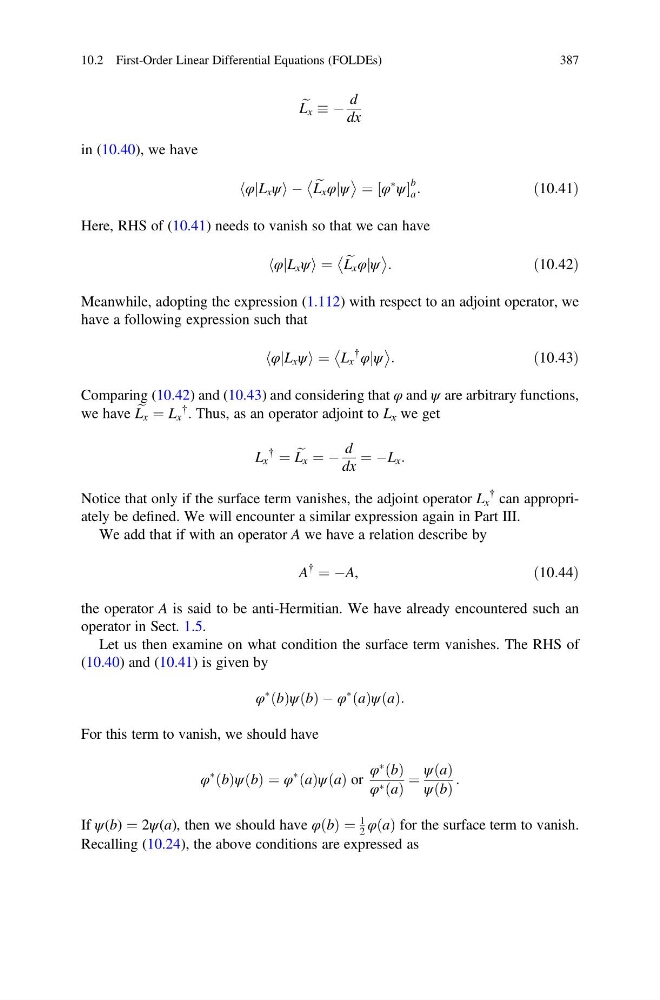
e
L x À
d
dx
in (10.40), we have
φjL x ψ
h
iÀ e
L x φjψ
¼ φ
Ã
ψ
½
b
a :
ð10:41Þ
Here, RHS of (10.41) needs to vanish so that we can have
φjL x ψ
h
i¼ e
L x φjψ
:
ð10:42Þ
Meanwhile, adopting the expression (1.112) with respect to an adjoint operator, we
have a following expression such that
φjL x ψ
h
i¼ L x
{
φjψ
:
ð10:43Þ
Comparing (10.42) and (10.43) and considering that φ and ψ are arbitrary functions,
we have e
L x ¼ L x
{ . Thus, as an operator adjoint to L x we get
L x
{
¼ e
L x ¼ À
d
dx
¼ ÀL x :
Notice that only if the surface term vanishes, the adjoint operator L x
{ can appropriately be defined. We will encounter a similar expression again in Part III.
We add that if with an operator A we have a relation describe by
A
{
¼ ÀA,
ð10:44Þ
the operator A is said to be anti-Hermitian. We have already encountered such an
operator in Sect. 1.5.
Let us then examine on what condition the surface term vanishes. The RHS of
(10.40) and (10.41) is given by
φ
à b
ð Þψ b
ð Þ À φ
à a
ð Þψ a
ð Þ:
For this term to vanish, we should have
φ
à b
ð Þψ b
ð Þ ¼ φ
à a
ð Þψ a
ð Þ or
φ
à b
ð Þ
φ Ã a
ð Þ
¼
ψ a
ð Þ
ψ b
ð Þ
:
If ψ(b) ¼ 2ψ(a), then we should have φ b
ð Þ ¼
1
2 φ a
ð Þ for the surface term to vanish.
Recalling (10.24), the above conditions are expressed as
10.2 First-Order Linear Differential Equations (FOLDEs)
387
L x À
d
dx
in (10.40), we have
φjL x ψ
h
iÀ e
L x φjψ
¼ φ
Ã
ψ
½
b
a :
ð10:41Þ
Here, RHS of (10.41) needs to vanish so that we can have
φjL x ψ
h
i¼ e
L x φjψ
:
ð10:42Þ
Meanwhile, adopting the expression (1.112) with respect to an adjoint operator, we
have a following expression such that
φjL x ψ
h
i¼ L x
{
φjψ
:
ð10:43Þ
Comparing (10.42) and (10.43) and considering that φ and ψ are arbitrary functions,
we have e
L x ¼ L x
{ . Thus, as an operator adjoint to L x we get
L x
{
¼ e
L x ¼ À
d
dx
¼ ÀL x :
Notice that only if the surface term vanishes, the adjoint operator L x
{ can appropriately be defined. We will encounter a similar expression again in Part III.
We add that if with an operator A we have a relation describe by
A
{
¼ ÀA,
ð10:44Þ
the operator A is said to be anti-Hermitian. We have already encountered such an
operator in Sect. 1.5.
Let us then examine on what condition the surface term vanishes. The RHS of
(10.40) and (10.41) is given by
φ
à b
ð Þψ b
ð Þ À φ
à a
ð Þψ a
ð Þ:
For this term to vanish, we should have
φ
à b
ð Þψ b
ð Þ ¼ φ
à a
ð Þψ a
ð Þ or
φ
à b
ð Þ
φ Ã a
ð Þ
¼
ψ a
ð Þ
ψ b
ð Þ
:
If ψ(b) ¼ 2ψ(a), then we should have φ b
ð Þ ¼
1
2 φ a
ð Þ for the surface term to vanish.
Recalling (10.24), the above conditions are expressed as
10.2 First-Order Linear Differential Equations (FOLDEs)
387