

Z x
a
w x
0
ð Þd x
0
ð Þdx
0
¼
Z x
a
x
0 exp
1
2
x
0
2 À a
2
h
i
dx
0
¼ exp À
a
2
2
Z x
2 =2
a 2 =2
exp tdt
¼ exp À
a
2
2
exp
x
2
2
À exp
a
2
2
!
¼ exp À
a
2
2
exp
x
2
2
À 1 ¼ p x
ð Þ À 1,
ð10:36Þ
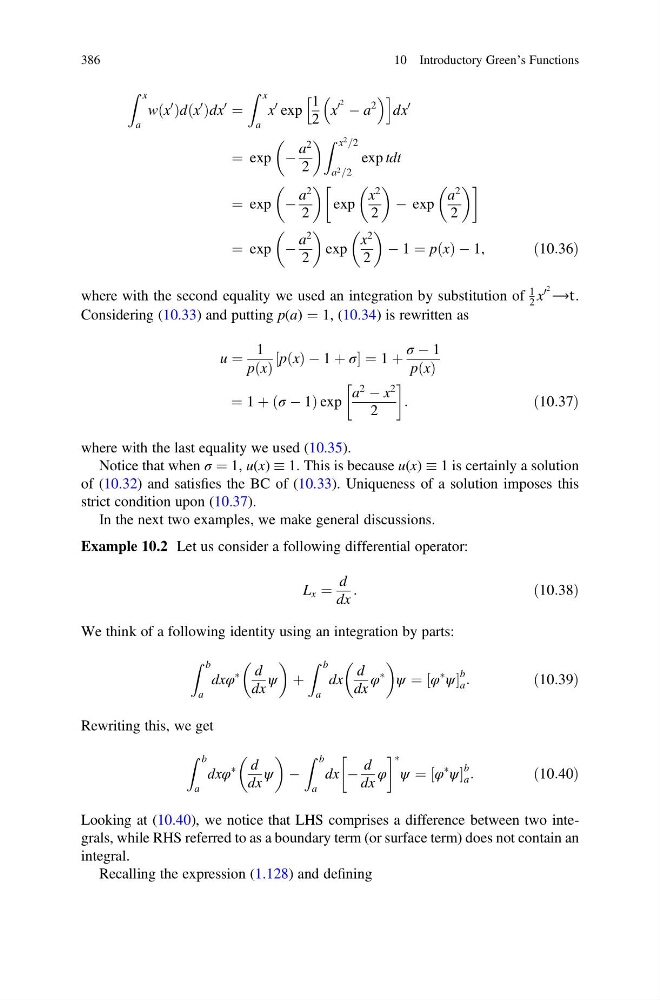
where with the second equality we used an integration by substitution of
1
2 x
0
2 ⟶t.
Considering (10.33) and putting p(a) ¼ 1, (10.34) is rewritten as
u ¼
1
p x
ð Þ
p x
ð Þ À 1 þ σ
½
¼1 þ
σ À 1
p x
ð Þ
¼ 1 þ σ À 1
ð
Þexp
a
2
À x
2
2
!
:
ð10:37Þ
where with the last equality we used (10.35).
Notice that when σ ¼ 1, u(x) 1. This is because u(x) 1 is certainly a solution
of (10.32) and satisfies the BC of (10.33). Uniqueness of a solution imposes this
strict condition upon (10.37).
In the next two examples, we make general discussions.
Example 10.2 Let us consider a following differential operator:
L x ¼
d
dx
:
ð10:38Þ
We think of a following identity using an integration by parts:
Z b
a
dxφ
à d
dx
ψ
þ
Z b
a
dx
d
dx
φ
Ã
ψ ¼ φ
Ã
ψ
½
b
a :
ð10:39Þ
Rewriting this, we get
Z b
a
dxφ
à d
dx
ψ
À
Z b
a
dx À
d
dx
φ
! Ã
ψ ¼ φ
Ã
ψ
½
b
a :
ð10:40Þ
Looking at (10.40), we notice that LHS comprises a difference between two integrals, while RHS referred to as a boundary term (or surface term) does not contain an
integral.
Recalling the expression (1.128) and defining
386
10 Introductory Green’s Functions
a
w x
0
ð Þd x
0
ð Þdx
0
¼
Z x
a
x
0 exp
1
2
x
0
2 À a
2
h
i
dx
0
¼ exp À
a
2
2
Z x
2 =2
a 2 =2
exp tdt
¼ exp À
a
2
2
exp
x
2
2
À exp
a
2
2
!
¼ exp À
a
2
2
exp
x
2
2
À 1 ¼ p x
ð Þ À 1,
ð10:36Þ
where with the second equality we used an integration by substitution of
1
2 x
0
2 ⟶t.
Considering (10.33) and putting p(a) ¼ 1, (10.34) is rewritten as
u ¼
1
p x
ð Þ
p x
ð Þ À 1 þ σ
½
¼1 þ
σ À 1
p x
ð Þ
¼ 1 þ σ À 1
ð
Þexp
a
2
À x
2
2
!
:
ð10:37Þ
where with the last equality we used (10.35).
Notice that when σ ¼ 1, u(x) 1. This is because u(x) 1 is certainly a solution
of (10.32) and satisfies the BC of (10.33). Uniqueness of a solution imposes this
strict condition upon (10.37).
In the next two examples, we make general discussions.
Example 10.2 Let us consider a following differential operator:
L x ¼
d
dx
:
ð10:38Þ
We think of a following identity using an integration by parts:
Z b
a
dxφ
à d
dx
ψ
þ
Z b
a
dx
d
dx
φ
Ã
ψ ¼ φ
Ã
ψ
½
b
a :
ð10:39Þ
Rewriting this, we get
Z b
a
dxφ
à d
dx
ψ
À
Z b
a
dx À
d
dx
φ
! Ã
ψ ¼ φ
Ã
ψ
½
b
a :
ð10:40Þ
Looking at (10.40), we notice that LHS comprises a difference between two integrals, while RHS referred to as a boundary term (or surface term) does not contain an
integral.
Recalling the expression (1.128) and defining
386
10 Introductory Green’s Functions