

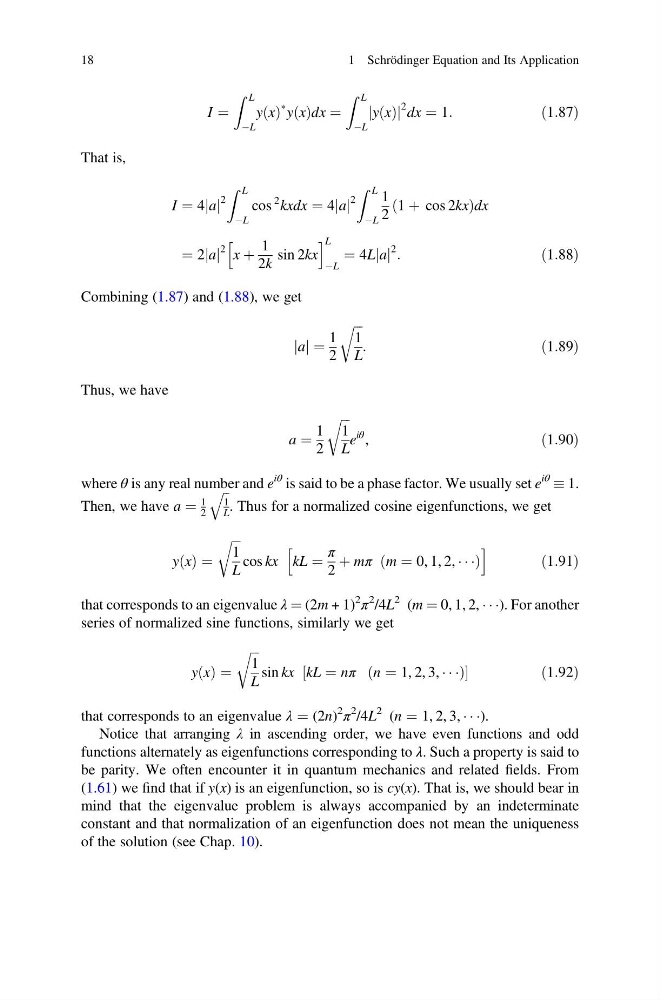
I ¼
Z L
ÀL
y x
ð Þ
à y x
ð Þdx ¼
Z L
ÀL
y x
ð Þ
j
j
2 dx ¼ 1:
ð1:87Þ
That is,
I ¼ 4 a
j j
2
Z L
ÀL
cos
2 kxdx ¼ 4 a
j j
2
Z L
ÀL
1
2
1 þ cos 2kx
ð
Þ dx
¼ 2 a
j j
2 x þ
1
2k
sin 2kx
h
i L
ÀL
¼ 4L a
j j
2 :
ð1:88Þ
Combining (1.87) and (1.88), we get
a
j j ¼
1
2
ffiffiffi
1
L
r
:
ð1:89Þ
Thus, we have
a ¼
1
2
ffiffiffi
1
L
r
e
iθ ,
ð1:90Þ
where θ is any real number and e
iθ is said to be a phase factor. We usually set e
iθ
1.
Then, we have a ¼
1
2
ffiffi
1
L
q
. Thus for a normalized cosine eigenfunctions, we get
y x
ð Þ ¼
ffiffiffi
1
L
r
cos kx kL ¼
π
2
þ mπ m ¼ 0, 1, 2, Á Á Á
ð
Þ
h
i
ð1:91Þ
that corresponds to an eigenvalue λ ¼ (2m + 1)
2
π
2
/4L
2 (m ¼ 0, 1, 2, Á Á Á). For another
series of normalized sine functions, similarly we get
y x
ð Þ ¼
ffiffiffi
1
L
r
sin kx kL ¼ nπ n ¼ 1, 2, 3, Á Á Á
ð
Þ
½
ð 1:92Þ
that corresponds to an eigenvalue λ ¼ (2n)
2
π
2 /4L
2 (n ¼ 1, 2, 3, Á Á Á).
Notice that arranging λ in ascending order, we have even functions and odd
functions alternately as eigenfunctions corresponding to λ. Such a property is said to
be parity. We often encounter it in quantum mechanics and related fields. From
(1.61) we find that if y(x) is an eigenfunction, so is cy(x). That is, we should bear in
mind that the eigenvalue problem is always accompanied by an indeterminate
constant and that normalization of an eigenfunction does not mean the uniqueness
of the solution (see Chap. 10).
18
1 Schrödinger Equation and Its Application
Z L
ÀL
y x
ð Þ
à y x
ð Þdx ¼
Z L
ÀL
y x
ð Þ
j
j
2 dx ¼ 1:
ð1:87Þ
That is,
I ¼ 4 a
j j
2
Z L
ÀL
cos
2 kxdx ¼ 4 a
j j
2
Z L
ÀL
1
2
1 þ cos 2kx
ð
Þ dx
¼ 2 a
j j
2 x þ
1
2k
sin 2kx
h
i L
ÀL
¼ 4L a
j j
2 :
ð1:88Þ
Combining (1.87) and (1.88), we get
a
j j ¼
1
2
ffiffiffi
1
L
r
:
ð1:89Þ
Thus, we have
a ¼
1
2
ffiffiffi
1
L
r
e
iθ ,
ð1:90Þ
where θ is any real number and e
iθ is said to be a phase factor. We usually set e
iθ
1.
Then, we have a ¼
1
2
ffiffi
1
L
q
. Thus for a normalized cosine eigenfunctions, we get
y x
ð Þ ¼
ffiffiffi
1
L
r
cos kx kL ¼
π
2
þ mπ m ¼ 0, 1, 2, Á Á Á
ð
Þ
h
i
ð1:91Þ
that corresponds to an eigenvalue λ ¼ (2m + 1)
2
π
2
/4L
2 (m ¼ 0, 1, 2, Á Á Á). For another
series of normalized sine functions, similarly we get
y x
ð Þ ¼
ffiffiffi
1
L
r
sin kx kL ¼ nπ n ¼ 1, 2, 3, Á Á Á
ð
Þ
½
ð 1:92Þ
that corresponds to an eigenvalue λ ¼ (2n)
2
π
2 /4L
2 (n ¼ 1, 2, 3, Á Á Á).
Notice that arranging λ in ascending order, we have even functions and odd
functions alternately as eigenfunctions corresponding to λ. Such a property is said to
be parity. We often encounter it in quantum mechanics and related fields. From
(1.61) we find that if y(x) is an eigenfunction, so is cy(x). That is, we should bear in
mind that the eigenvalue problem is always accompanied by an indeterminate
constant and that normalization of an eigenfunction does not mean the uniqueness
of the solution (see Chap. 10).
18
1 Schrödinger Equation and Its Application