

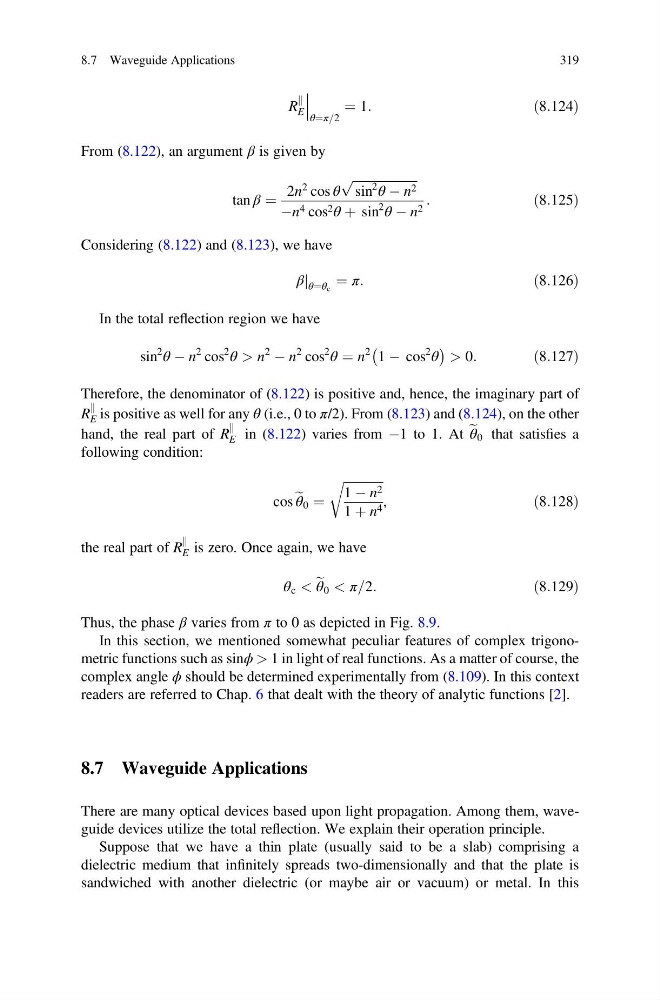
R
k
E
θ¼π=2
¼ 1:
ð8:124Þ
From (8.122), an argument β is given by
tan β ¼
2n
2 cos θ
ffiffiffiffiffiffiffiffiffiffiffiffiffiffiffiffiffiffiffiffiffi
sin
2
θ À n 2
p
Àn 4 cos 2 θ þ sin
2
θ À n 2 :
ð8:125Þ
Considering (8.122) and (8.123), we have
βj θ¼θ c ¼ π:
ð8:126Þ
In the total reflection region we have
sin
2
θ À n
2 cos
2
θ > n
2
À n
2 cos
2
θ ¼ n
2 1 À cos
2
θ
À
Á > 0:
ð8:127Þ
Therefore, the denominator of (8.122) is positive and, hence, the imaginary part of
R
k
E is positive as well for any θ (i.e., 0 to π/2). From (8.123) and (8.124), on the other
hand, the real part of R
k
E in (8.122) varies from À1 to 1. At e θ 0 that satisfies a
following condition:
cos e θ 0 ¼
ffiffiffiffiffiffiffiffiffiffiffiffiffi
1 À n 2
1 þ n 4
r
,
ð8:128Þ
the real part of R
k
E is zero. Once again, we have
θ c < e θ 0 < π=2:
ð8:129Þ
Thus, the phase β varies from π to 0 as depicted in Fig. 8.9.
In this section, we mentioned somewhat peculiar features of complex trigonometric functions such as sinϕ > 1 in light of real functions. As a matter of course, the
complex angle ϕ should be determined experimentally from (8.109). In this context
readers are referred to Chap. 6 that dealt with the theory of analytic functions [2].
8.7 Waveguide Applications
There are many optical devices based upon light propagation. Among them, waveguide devices utilize the total reflection. We explain their operation principle.
Suppose that we have a thin plate (usually said to be a slab) comprising a
dielectric medium that infinitely spreads two-dimensionally and that the plate is
sandwiched with another dielectric (or maybe air or vacuum) or metal. In this
8.7 Waveguide Applications
319
k
E
θ¼π=2
¼ 1:
ð8:124Þ
From (8.122), an argument β is given by
tan β ¼
2n
2 cos θ
ffiffiffiffiffiffiffiffiffiffiffiffiffiffiffiffiffiffiffiffiffi
sin
2
θ À n 2
p
Àn 4 cos 2 θ þ sin
2
θ À n 2 :
ð8:125Þ
Considering (8.122) and (8.123), we have
βj θ¼θ c ¼ π:
ð8:126Þ
In the total reflection region we have
sin
2
θ À n
2 cos
2
θ > n
2
À n
2 cos
2
θ ¼ n
2 1 À cos
2
θ
À
Á > 0:
ð8:127Þ
Therefore, the denominator of (8.122) is positive and, hence, the imaginary part of
R
k
E is positive as well for any θ (i.e., 0 to π/2). From (8.123) and (8.124), on the other
hand, the real part of R
k
E in (8.122) varies from À1 to 1. At e θ 0 that satisfies a
following condition:
cos e θ 0 ¼
ffiffiffiffiffiffiffiffiffiffiffiffiffi
1 À n 2
1 þ n 4
r
,
ð8:128Þ
the real part of R
k
E is zero. Once again, we have
θ c < e θ 0 < π=2:
ð8:129Þ
Thus, the phase β varies from π to 0 as depicted in Fig. 8.9.
In this section, we mentioned somewhat peculiar features of complex trigonometric functions such as sinϕ > 1 in light of real functions. As a matter of course, the
complex angle ϕ should be determined experimentally from (8.109). In this context
readers are referred to Chap. 6 that dealt with the theory of analytic functions [2].
8.7 Waveguide Applications
There are many optical devices based upon light propagation. Among them, waveguide devices utilize the total reflection. We explain their operation principle.
Suppose that we have a thin plate (usually said to be a slab) comprising a
dielectric medium that infinitely spreads two-dimensionally and that the plate is
sandwiched with another dielectric (or maybe air or vacuum) or metal. In this
8.7 Waveguide Applications
319