

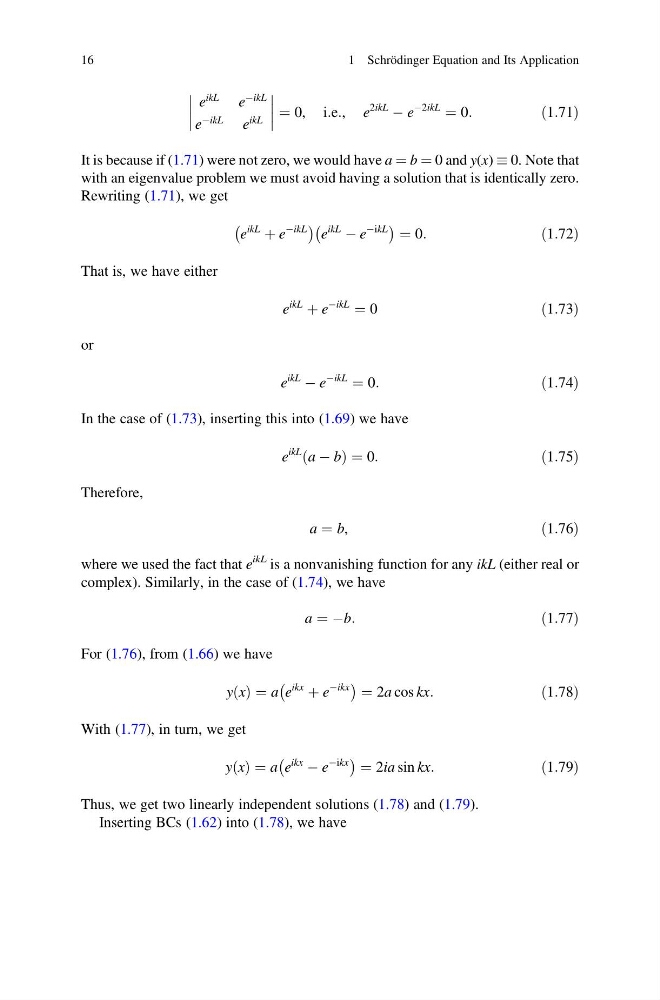
e
ikL
e
ÀikL
e
ÀikL
e
ikL
¼ 0, i:e:, e
2ikL
À e
À2ikL
¼ 0:
ð1:71Þ
It is because if (1.71) were not zero, we would have a ¼ b ¼ 0 and y(x) 0. Note that
with an eigenvalue problem we must avoid having a solution that is identically zero.
Rewriting (1.71), we get
e
ikL
þ e
ÀikL
À
Á
e
ikL
À e
ÀikL
À
Á ¼ 0:
ð1:72Þ
That is, we have either
e
ikL
þ e
ÀikL
¼ 0
ð1:73Þ
or
e
ikL
À e
ÀikL
¼ 0:
ð1:74Þ
In the case of (1.73), inserting this into (1.69) we have
e
ikL a À b
ð
Þ¼0:
ð1:75Þ
Therefore,
a ¼ b,
ð1:76Þ
where we used the fact that e
ikL is a nonvanishing function for any ikL (either real or
complex). Similarly, in the case of (1.74), we have
a ¼ Àb:
ð1:77Þ
For (1.76), from (1.66) we have
y x
ð Þ ¼ a e
ikx
þ e
Àikx
À
Á ¼ 2a cos kx:
ð1:78Þ
With (1.77), in turn, we get
y x
ð Þ ¼ a e
ikx
À e
Àikx
À
Á ¼ 2ia sin kx:
ð1:79Þ
Thus, we get two linearly independent solutions (1.78) and (1.79).
Inserting BCs (1.62) into (1.78), we have
16
1 Schrödinger Equation and Its Application
ikL
e
ÀikL
e
ÀikL
e
ikL
¼ 0, i:e:, e
2ikL
À e
À2ikL
¼ 0:
ð1:71Þ
It is because if (1.71) were not zero, we would have a ¼ b ¼ 0 and y(x) 0. Note that
with an eigenvalue problem we must avoid having a solution that is identically zero.
Rewriting (1.71), we get
e
ikL
þ e
ÀikL
À
Á
e
ikL
À e
ÀikL
À
Á ¼ 0:
ð1:72Þ
That is, we have either
e
ikL
þ e
ÀikL
¼ 0
ð1:73Þ
or
e
ikL
À e
ÀikL
¼ 0:
ð1:74Þ
In the case of (1.73), inserting this into (1.69) we have
e
ikL a À b
ð
Þ¼0:
ð1:75Þ
Therefore,
a ¼ b,
ð1:76Þ
where we used the fact that e
ikL is a nonvanishing function for any ikL (either real or
complex). Similarly, in the case of (1.74), we have
a ¼ Àb:
ð1:77Þ
For (1.76), from (1.66) we have
y x
ð Þ ¼ a e
ikx
þ e
Àikx
À
Á ¼ 2a cos kx:
ð1:78Þ
With (1.77), in turn, we get
y x
ð Þ ¼ a e
ikx
À e
Àikx
À
Á ¼ 2ia sin kx:
ð1:79Þ
Thus, we get two linearly independent solutions (1.78) and (1.79).
Inserting BCs (1.62) into (1.78), we have
16
1 Schrödinger Equation and Its Application