

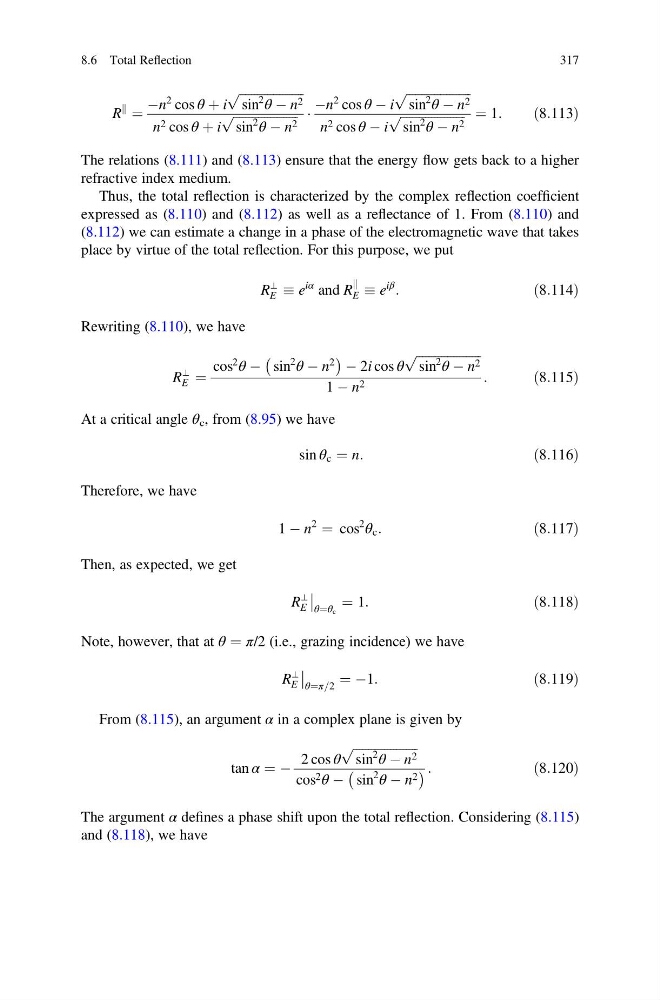
R
k
¼
Àn
2 cos θ þ i
ffiffiffiffiffiffiffiffiffiffiffiffiffiffiffiffiffiffiffiffiffi
sin
2
θ À n 2
p
n 2 cos θ þ i
ffiffiffiffiffiffiffiffiffiffiffiffiffiffiffiffiffiffiffiffiffi
sin
2
θ À n 2
p
Á
Àn
2 cos θ À i
ffiffiffiffiffiffiffiffiffiffiffiffiffiffiffiffiffiffiffiffiffi
sin
2
θ À n 2
p
n 2 cos θ À i
ffiffiffiffiffiffiffiffiffiffiffiffiffiffiffiffiffiffiffiffiffi
sin
2
θ À n 2
p
¼ 1:
ð8:113Þ
The relations (8.111) and (8.113) ensure that the energy flow gets back to a higher
refractive index medium.
Thus, the total reflection is characterized by the complex reflection coefficient
expressed as (8.110) and (8.112) as well as a reflectance of 1. From (8.110) and
(8.112) we can estimate a change in a phase of the electromagnetic wave that takes
place by virtue of the total reflection. For this purpose, we put
R
⊥
E e
iα and R
k
E e
iβ
:
ð8:114Þ
Rewriting (8.110), we have
R
⊥
E ¼
cos
2
θ À sin
2
θ À n
2
À
Á À 2i cos θ
ffiffiffiffiffiffiffiffiffiffiffiffiffiffiffiffiffiffiffiffiffi
sin
2
θ À n 2
p
1 À n 2
:
ð8:115Þ
At a critical angle θ c , from (8.95) we have
sin θ c ¼ n:
ð8:116Þ
Therefore, we have
1 À n
2
¼ cos
2
θ c :
ð8:117Þ
Then, as expected, we get
R
⊥
E
θ¼θ c ¼ 1:
ð8:118Þ
Note, however, that at θ ¼ π/2 (i.e., grazing incidence) we have
R
⊥
E
θ¼π=2 ¼ À1:
ð8:119Þ
From (8.115), an argument α in a complex plane is given by
tan α ¼ À
2 cos θ
ffiffiffiffiffiffiffiffiffiffiffiffiffiffiffiffiffiffiffiffiffi
sin
2
θ À n 2
p
cos 2 θ À sin
2
θ À n 2
À
Á:
ð8:120Þ
The argument α defines a phase shift upon the total reflection. Considering (8.115)
and (8.118), we have
8.6 Total Reflection
317
k
¼
Àn
2 cos θ þ i
ffiffiffiffiffiffiffiffiffiffiffiffiffiffiffiffiffiffiffiffiffi
sin
2
θ À n 2
p
n 2 cos θ þ i
ffiffiffiffiffiffiffiffiffiffiffiffiffiffiffiffiffiffiffiffiffi
sin
2
θ À n 2
p
Á
Àn
2 cos θ À i
ffiffiffiffiffiffiffiffiffiffiffiffiffiffiffiffiffiffiffiffiffi
sin
2
θ À n 2
p
n 2 cos θ À i
ffiffiffiffiffiffiffiffiffiffiffiffiffiffiffiffiffiffiffiffiffi
sin
2
θ À n 2
p
¼ 1:
ð8:113Þ
The relations (8.111) and (8.113) ensure that the energy flow gets back to a higher
refractive index medium.
Thus, the total reflection is characterized by the complex reflection coefficient
expressed as (8.110) and (8.112) as well as a reflectance of 1. From (8.110) and
(8.112) we can estimate a change in a phase of the electromagnetic wave that takes
place by virtue of the total reflection. For this purpose, we put
R
⊥
E e
iα and R
k
E e
iβ
:
ð8:114Þ
Rewriting (8.110), we have
R
⊥
E ¼
cos
2
θ À sin
2
θ À n
2
À
Á À 2i cos θ
ffiffiffiffiffiffiffiffiffiffiffiffiffiffiffiffiffiffiffiffiffi
sin
2
θ À n 2
p
1 À n 2
:
ð8:115Þ
At a critical angle θ c , from (8.95) we have
sin θ c ¼ n:
ð8:116Þ
Therefore, we have
1 À n
2
¼ cos
2
θ c :
ð8:117Þ
Then, as expected, we get
R
⊥
E
θ¼θ c ¼ 1:
ð8:118Þ
Note, however, that at θ ¼ π/2 (i.e., grazing incidence) we have
R
⊥
E
θ¼π=2 ¼ À1:
ð8:119Þ
From (8.115), an argument α in a complex plane is given by
tan α ¼ À
2 cos θ
ffiffiffiffiffiffiffiffiffiffiffiffiffiffiffiffiffiffiffiffiffi
sin
2
θ À n 2
p
cos 2 θ À sin
2
θ À n 2
À
Á:
ð8:120Þ
The argument α defines a phase shift upon the total reflection. Considering (8.115)
and (8.118), we have
8.6 Total Reflection
317