

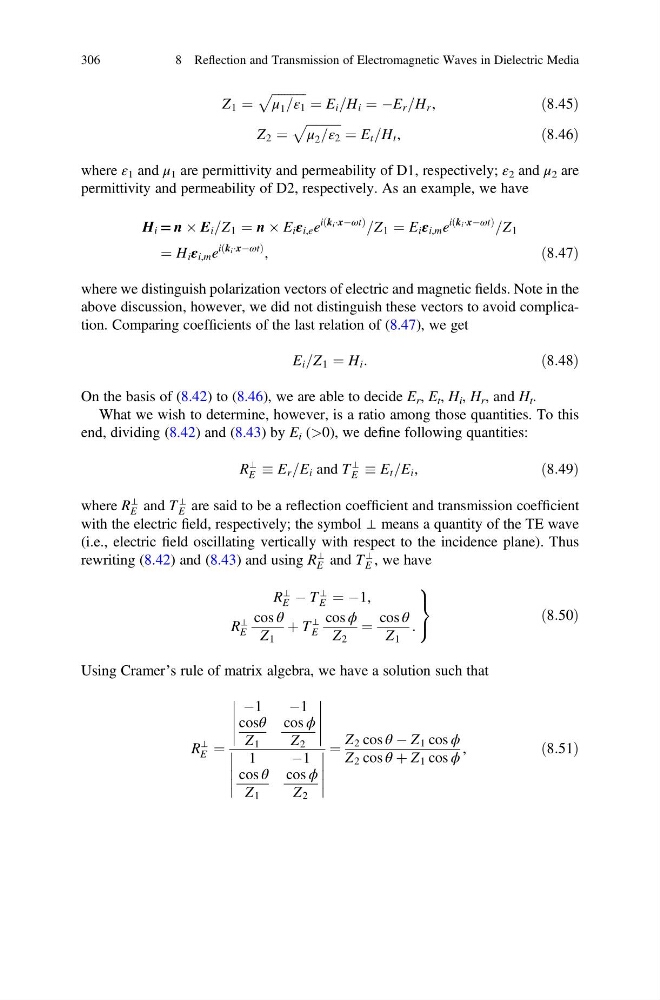
Z 1 ¼
ffiffiffiffiffiffiffiffiffiffiffi
μ 1 =ε 1
p
¼ E i =H i ¼ ÀE r =H r ,
ð8:45Þ
Z 2 ¼
ffiffiffiffiffiffiffiffiffiffiffi
μ 2 =ε 2
p
¼ E t =H t ,
ð8:46Þ
where ε 1 and μ 1 are permittivity and permeability of D1, respectively; ε 2 and μ 2 are
permittivity and permeability of D2, respectively. As an example, we have
H i = n  E i =Z 1 ¼ n  E i ε i,e e
i k i ÁxÀωt
ð
Þ
=Z 1 ¼ E i ε i,m e
i k i ÁxÀωt
ð
Þ
=Z 1
¼ H i ε i,m e
i k i ÁxÀωt
ð
Þ ,
ð8:47Þ
where we distinguish polarization vectors of electric and magnetic fields. Note in the
above discussion, however, we did not distinguish these vectors to avoid complication. Comparing coefficients of the last relation of (8.47), we get
E i =Z 1 ¼ H i :
ð8:48Þ
On the basis of (8.42) to (8.46), we are able to decide E r , E t , H i , H r , and H t .
What we wish to determine, however, is a ratio among those quantities. To this
end, dividing (8.42) and (8.43) by E i (>0), we define following quantities:
R
⊥
E E r =E i and T
⊥
E E t =E i ,
ð8:49Þ
where R
⊥
E and T
⊥
E are said to be a reflection coefficient and transmission coefficient
with the electric field, respectively; the symbol ⊥ means a quantity of the TE wave
(i.e., electric field oscillating vertically with respect to the incidence plane). Thus
rewriting (8.42) and (8.43) and using R
⊥
E and T
⊥
E , we have
R
⊥
E À T
⊥
E ¼ À1,
R
⊥
E
cos θ
Z 1
þ T
⊥
E
cos ϕ
Z 2
¼
cos θ
Z 1
:
9
=
;
ð8:50Þ
Using Cramer’s rule of matrix algebra, we have a solution such that
R
⊥
E ¼
À1
À1
cosθ
Z 1
cos ϕ
Z 2
1
À1
cos θ
Z 1
cos ϕ
Z 2
¼
Z 2 cos θ À Z 1 cos ϕ
Z 2 cos θ þ Z 1 cos ϕ
,
ð8:51Þ
306
8 Reflection and Transmission of Electromagnetic Waves in Dielectric Media
ffiffiffiffiffiffiffiffiffiffiffi
μ 1 =ε 1
p
¼ E i =H i ¼ ÀE r =H r ,
ð8:45Þ
Z 2 ¼
ffiffiffiffiffiffiffiffiffiffiffi
μ 2 =ε 2
p
¼ E t =H t ,
ð8:46Þ
where ε 1 and μ 1 are permittivity and permeability of D1, respectively; ε 2 and μ 2 are
permittivity and permeability of D2, respectively. As an example, we have
H i = n  E i =Z 1 ¼ n  E i ε i,e e
i k i ÁxÀωt
ð
Þ
=Z 1 ¼ E i ε i,m e
i k i ÁxÀωt
ð
Þ
=Z 1
¼ H i ε i,m e
i k i ÁxÀωt
ð
Þ ,
ð8:47Þ
where we distinguish polarization vectors of electric and magnetic fields. Note in the
above discussion, however, we did not distinguish these vectors to avoid complication. Comparing coefficients of the last relation of (8.47), we get
E i =Z 1 ¼ H i :
ð8:48Þ
On the basis of (8.42) to (8.46), we are able to decide E r , E t , H i , H r , and H t .
What we wish to determine, however, is a ratio among those quantities. To this
end, dividing (8.42) and (8.43) by E i (>0), we define following quantities:
R
⊥
E E r =E i and T
⊥
E E t =E i ,
ð8:49Þ
where R
⊥
E and T
⊥
E are said to be a reflection coefficient and transmission coefficient
with the electric field, respectively; the symbol ⊥ means a quantity of the TE wave
(i.e., electric field oscillating vertically with respect to the incidence plane). Thus
rewriting (8.42) and (8.43) and using R
⊥
E and T
⊥
E , we have
R
⊥
E À T
⊥
E ¼ À1,
R
⊥
E
cos θ
Z 1
þ T
⊥
E
cos ϕ
Z 2
¼
cos θ
Z 1
:
9
=
;
ð8:50Þ
Using Cramer’s rule of matrix algebra, we have a solution such that
R
⊥
E ¼
À1
À1
cosθ
Z 1
cos ϕ
Z 2
1
À1
cos θ
Z 1
cos ϕ
Z 2
¼
Z 2 cos θ À Z 1 cos ϕ
Z 2 cos θ þ Z 1 cos ϕ
,
ð8:51Þ
306
8 Reflection and Transmission of Electromagnetic Waves in Dielectric Media