

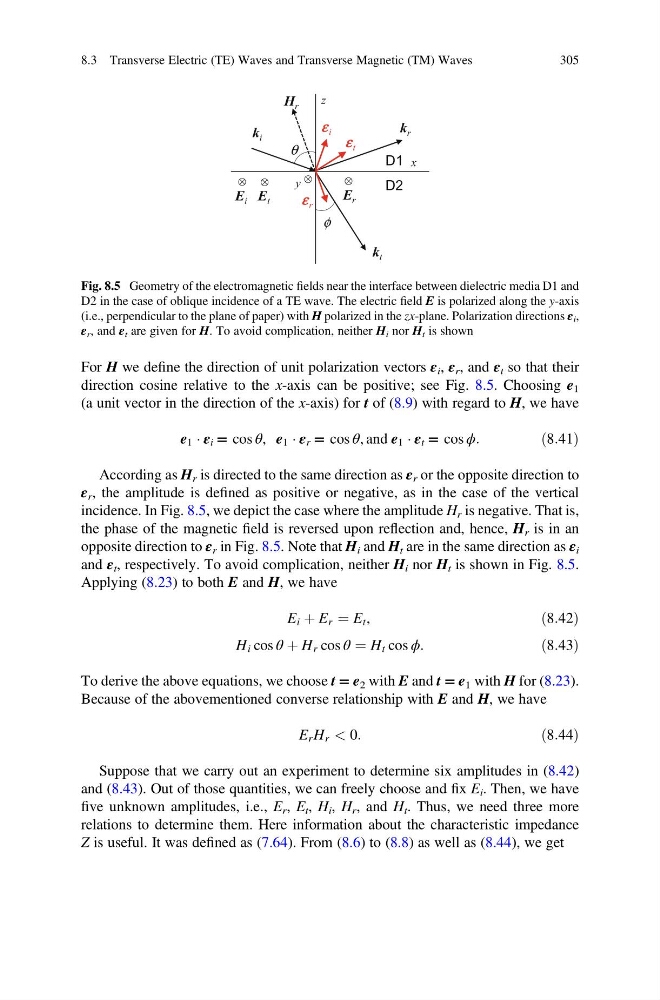
For H we define the direction of unit polarization vectors ε i , ε r , and ε t so that their
direction cosine relative to the x-axis can be positive; see Fig. 8.5. Choosing e 1
(a unit vector in the direction of the x-axis) for t of (8.9) with regard to H, we have
e 1 Á ε i = cos θ, e 1 Á ε r = cos θ, and e 1 Á ε t = cos ϕ:
ð8:41Þ
According as H r is directed to the same direction as ε r or the opposite direction to
ε r , the amplitude is defined as positive or negative, as in the case of the vertical
incidence. In Fig. 8.5, we depict the case where the amplitude H r is negative. That is,
the phase of the magnetic field is reversed upon reflection and, hence, H r is in an
opposite direction to ε r in Fig. 8.5. Note that H i and H t are in the same direction as ε i
and ε t , respectively. To avoid complication, neither H i nor H t is shown in Fig. 8.5.
Applying (8.23) to both E and H, we have
E i þ E r ¼ E t ,
ð8:42Þ
H i cos θ þ H r cos θ ¼ H t cos ϕ:
ð8:43Þ
To derive the above equations, we choose t = e 2 with E and t = e 1 with H for (8.23).
Because of the abovementioned converse relationship with E and H, we have
E r H r < 0:
ð8:44Þ
Suppose that we carry out an experiment to determine six amplitudes in (8.42)
and (8.43). Out of those quantities, we can freely choose and fix E i . Then, we have
five unknown amplitudes, i.e., E r , E t , H i , H r , and H t . Thus, we need three more
relations to determine them. Here information about the characteristic impedance
Z is useful. It was defined as (7.64). From (8.6) to (8.8) as well as (8.44), we get
x
z
θ
φ
k i
ε r
k t
ε t
k r
ε i
H r
'
'
E r
E t
E i
y
Fig. 8.5 Geometry of the electromagnetic fields near the interface between dielectric media D1 and
D2 in the case of oblique incidence of a TE wave. The electric field E is polarized along the y-axis
(i.e., perpendicular to the plane of paper) with H polarized in the zx-plane. Polarization directions ε i ,
ε r , and ε t are given for H. To avoid complication, neither H i nor H t is shown
8.3 Transverse Electric (TE) Waves and Transverse Magnetic (TM) Waves
305
direction cosine relative to the x-axis can be positive; see Fig. 8.5. Choosing e 1
(a unit vector in the direction of the x-axis) for t of (8.9) with regard to H, we have
e 1 Á ε i = cos θ, e 1 Á ε r = cos θ, and e 1 Á ε t = cos ϕ:
ð8:41Þ
According as H r is directed to the same direction as ε r or the opposite direction to
ε r , the amplitude is defined as positive or negative, as in the case of the vertical
incidence. In Fig. 8.5, we depict the case where the amplitude H r is negative. That is,
the phase of the magnetic field is reversed upon reflection and, hence, H r is in an
opposite direction to ε r in Fig. 8.5. Note that H i and H t are in the same direction as ε i
and ε t , respectively. To avoid complication, neither H i nor H t is shown in Fig. 8.5.
Applying (8.23) to both E and H, we have
E i þ E r ¼ E t ,
ð8:42Þ
H i cos θ þ H r cos θ ¼ H t cos ϕ:
ð8:43Þ
To derive the above equations, we choose t = e 2 with E and t = e 1 with H for (8.23).
Because of the abovementioned converse relationship with E and H, we have
E r H r < 0:
ð8:44Þ
Suppose that we carry out an experiment to determine six amplitudes in (8.42)
and (8.43). Out of those quantities, we can freely choose and fix E i . Then, we have
five unknown amplitudes, i.e., E r , E t , H i , H r , and H t . Thus, we need three more
relations to determine them. Here information about the characteristic impedance
Z is useful. It was defined as (7.64). From (8.6) to (8.8) as well as (8.44), we get
x
z
θ
φ
k i
ε r
k t
ε t
k r
ε i
H r
'
'
E r
E t
E i
y
Fig. 8.5 Geometry of the electromagnetic fields near the interface between dielectric media D1 and
D2 in the case of oblique incidence of a TE wave. The electric field E is polarized along the y-axis
(i.e., perpendicular to the plane of paper) with H polarized in the zx-plane. Polarization directions ε i ,
ε r , and ε t are given for H. To avoid complication, neither H i nor H t is shown
8.3 Transverse Electric (TE) Waves and Transverse Magnetic (TM) Waves
305