

1
ffiffiffiffiffiffiffiffiffiffi ffi
1 À x
p
% 1 þ
1
2
x
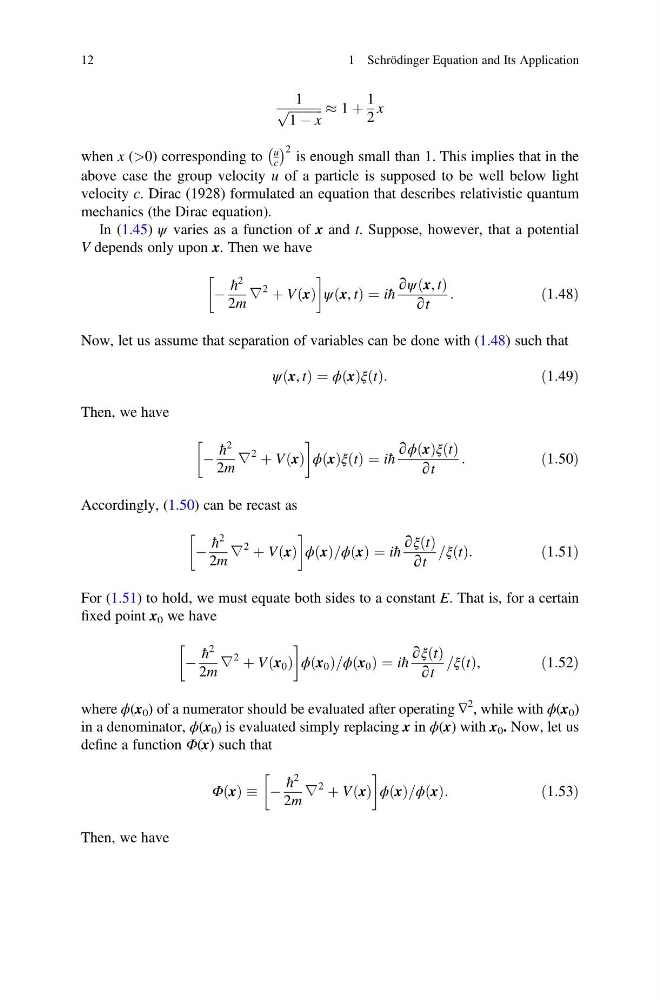
when x (>0) corresponding to
u
c
À Á 2 is enough small than 1. This implies that in the
above case the group velocity u of a particle is supposed to be well below light
velocity c. Dirac (1928) formulated an equation that describes relativistic quantum
mechanics (the Dirac equation).
In (1.45) ψ varies as a function of x and t. Suppose, however, that a potential
V depends only upon x. Then we have
À
ħ
2
2m
∇
2 þ V x
ð Þ
!
ψ x, t
ð Þ ¼ iħ
∂ψ x, t
ð Þ
∂t
:
ð1:48Þ
Now, let us assume that separation of variables can be done with (1.48) such that
ψ x, t
ð Þ ¼ ϕ x
ð Þξ t
ð Þ:
ð1:49Þ
Then, we have
À
ħ
2
2m
∇
2 þ V x
ð Þ
!
ϕ x
ð Þξ t
ð Þ ¼ iħ
∂ϕ x
ð Þξ t
ð Þ
∂t
:
ð1:50Þ
Accordingly, (1.50) can be recast as
À
ħ
2
2m
∇
2 þ V x
ð Þ
!
ϕ x
ð Þ=ϕ x
ð Þ ¼ iħ
∂ξ t
ð Þ
∂t
=ξ t
ð Þ:
ð1:51Þ
For (1.51) to hold, we must equate both sides to a constant E. That is, for a certain
fixed point x 0 we have
À
ħ
2
2m
∇
2 þ V x 0
ð Þ
!
ϕ x 0
ð Þ=ϕ x 0
ð Þ ¼ iħ
∂ξ t
ð Þ
∂t
=ξ t
ð Þ,
ð1:52Þ
where ϕ(x 0 ) of a numerator should be evaluated after operating ∇
2 , while with ϕ(x 0 )
in a denominator, ϕ(x 0 ) is evaluated simply replacing x in ϕ(x) with x 0 . Now, let us
define a function Φ(x) such that
Φ x
ð Þ À
ħ
2
2m
∇
2 þ V x
ð Þ
!
ϕ x
ð Þ=ϕ x
ð Þ:
ð1:53Þ
Then, we have
12
1 Schrödinger Equation and Its Application
ffiffiffiffiffiffiffiffiffiffi ffi
1 À x
p
% 1 þ
1
2
x
when x (>0) corresponding to
u
c
À Á 2 is enough small than 1. This implies that in the
above case the group velocity u of a particle is supposed to be well below light
velocity c. Dirac (1928) formulated an equation that describes relativistic quantum
mechanics (the Dirac equation).
In (1.45) ψ varies as a function of x and t. Suppose, however, that a potential
V depends only upon x. Then we have
À
ħ
2
2m
∇
2 þ V x
ð Þ
!
ψ x, t
ð Þ ¼ iħ
∂ψ x, t
ð Þ
∂t
:
ð1:48Þ
Now, let us assume that separation of variables can be done with (1.48) such that
ψ x, t
ð Þ ¼ ϕ x
ð Þξ t
ð Þ:
ð1:49Þ
Then, we have
À
ħ
2
2m
∇
2 þ V x
ð Þ
!
ϕ x
ð Þξ t
ð Þ ¼ iħ
∂ϕ x
ð Þξ t
ð Þ
∂t
:
ð1:50Þ
Accordingly, (1.50) can be recast as
À
ħ
2
2m
∇
2 þ V x
ð Þ
!
ϕ x
ð Þ=ϕ x
ð Þ ¼ iħ
∂ξ t
ð Þ
∂t
=ξ t
ð Þ:
ð1:51Þ
For (1.51) to hold, we must equate both sides to a constant E. That is, for a certain
fixed point x 0 we have
À
ħ
2
2m
∇
2 þ V x 0
ð Þ
!
ϕ x 0
ð Þ=ϕ x 0
ð Þ ¼ iħ
∂ξ t
ð Þ
∂t
=ξ t
ð Þ,
ð1:52Þ
where ϕ(x 0 ) of a numerator should be evaluated after operating ∇
2 , while with ϕ(x 0 )
in a denominator, ϕ(x 0 ) is evaluated simply replacing x in ϕ(x) with x 0 . Now, let us
define a function Φ(x) such that
Φ x
ð Þ À
ħ
2
2m
∇
2 þ V x
ð Þ
!
ϕ x
ð Þ=ϕ x
ð Þ:
ð1:53Þ
Then, we have
12
1 Schrödinger Equation and Its Application