

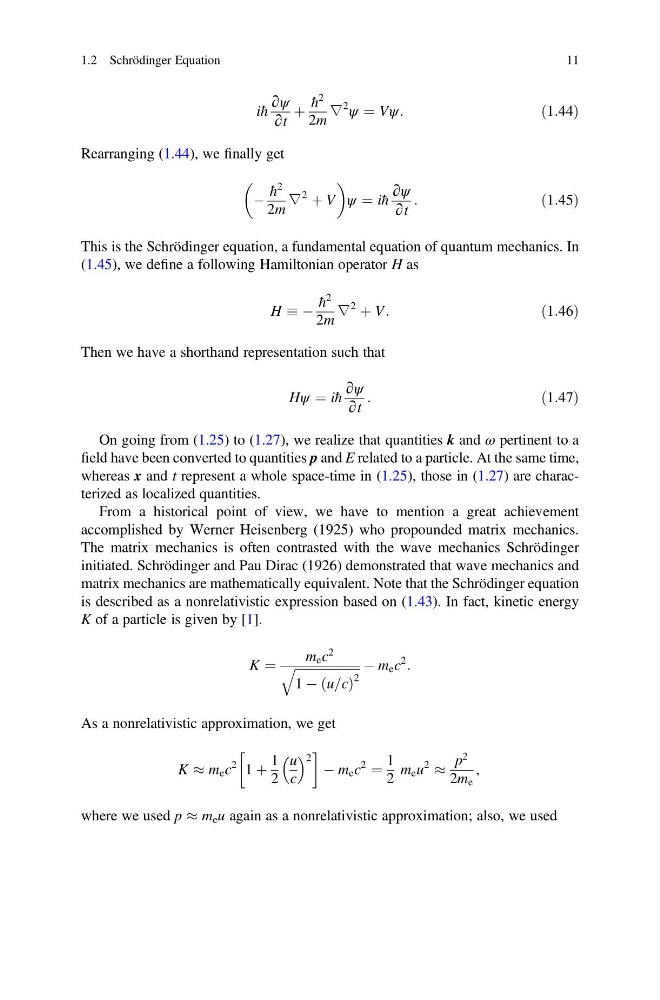
iħ
∂ψ
∂t
þ
ħ
2
2m
∇
2 ψ ¼ Vψ:
ð1:44Þ
Rearranging (1.44), we finally get
À
ħ
2
2m
∇
2 þ V
ψ ¼ iħ
∂ψ
∂t
:
ð1:45Þ
This is the Schrödinger equation, a fundamental equation of quantum mechanics. In
(1.45), we define a following Hamiltonian operator H as
H À
ħ
2
2m
∇
2
þ V:
ð1:46Þ
Then we have a shorthand representation such that
Hψ ¼ iħ
∂ψ
∂t
:
ð1:47Þ
On going from (1.25) to (1.27), we realize that quantities k and ω pertinent to a
field have been converted to quantities p and E related to a particle. At the same time,
whereas x and t represent a whole space-time in (1.25), those in (1.27) are characterized as localized quantities.
From a historical point of view, we have to mention a great achievement
accomplished by Werner Heisenberg (1925) who propounded matrix mechanics.
The matrix mechanics is often contrasted with the wave mechanics Schrödinger
initiated. Schrödinger and Pau Dirac (1926) demonstrated that wave mechanics and
matrix mechanics are mathematically equivalent. Note that the Schrödinger equation
is described as a nonrelativistic expression based on (1.43). In fact, kinetic energy
K of a particle is given by [1].
K ¼
m e c
2
ffiffiffiffiffiffiffiffiffiffiffiffiffiffiffiffiffiffiffiffiffi
1 À u=c
ð Þ
2
q
À m e c
2
:
As a nonrelativistic approximation, we get
K % m e c
2 1 þ
1
2
u
c
2
!
À m e c
2
¼
1
2
m e u
2
%
p
2
2m e
,
where we used p % m e u again as a nonrelativistic approximation; also, we used
1.2 Schrödinger Equation
11
∂ψ
∂t
þ
ħ
2
2m
∇
2 ψ ¼ Vψ:
ð1:44Þ
Rearranging (1.44), we finally get
À
ħ
2
2m
∇
2 þ V
ψ ¼ iħ
∂ψ
∂t
:
ð1:45Þ
This is the Schrödinger equation, a fundamental equation of quantum mechanics. In
(1.45), we define a following Hamiltonian operator H as
H À
ħ
2
2m
∇
2
þ V:
ð1:46Þ
Then we have a shorthand representation such that
Hψ ¼ iħ
∂ψ
∂t
:
ð1:47Þ
On going from (1.25) to (1.27), we realize that quantities k and ω pertinent to a
field have been converted to quantities p and E related to a particle. At the same time,
whereas x and t represent a whole space-time in (1.25), those in (1.27) are characterized as localized quantities.
From a historical point of view, we have to mention a great achievement
accomplished by Werner Heisenberg (1925) who propounded matrix mechanics.
The matrix mechanics is often contrasted with the wave mechanics Schrödinger
initiated. Schrödinger and Pau Dirac (1926) demonstrated that wave mechanics and
matrix mechanics are mathematically equivalent. Note that the Schrödinger equation
is described as a nonrelativistic expression based on (1.43). In fact, kinetic energy
K of a particle is given by [1].
K ¼
m e c
2
ffiffiffiffiffiffiffiffiffiffiffiffiffiffiffiffiffiffiffiffiffi
1 À u=c
ð Þ
2
q
À m e c
2
:
As a nonrelativistic approximation, we get
K % m e c
2 1 þ
1
2
u
c
2
!
À m e c
2
¼
1
2
m e u
2
%
p
2
2m e
,
where we used p % m e u again as a nonrelativistic approximation; also, we used
1.2 Schrödinger Equation
11