

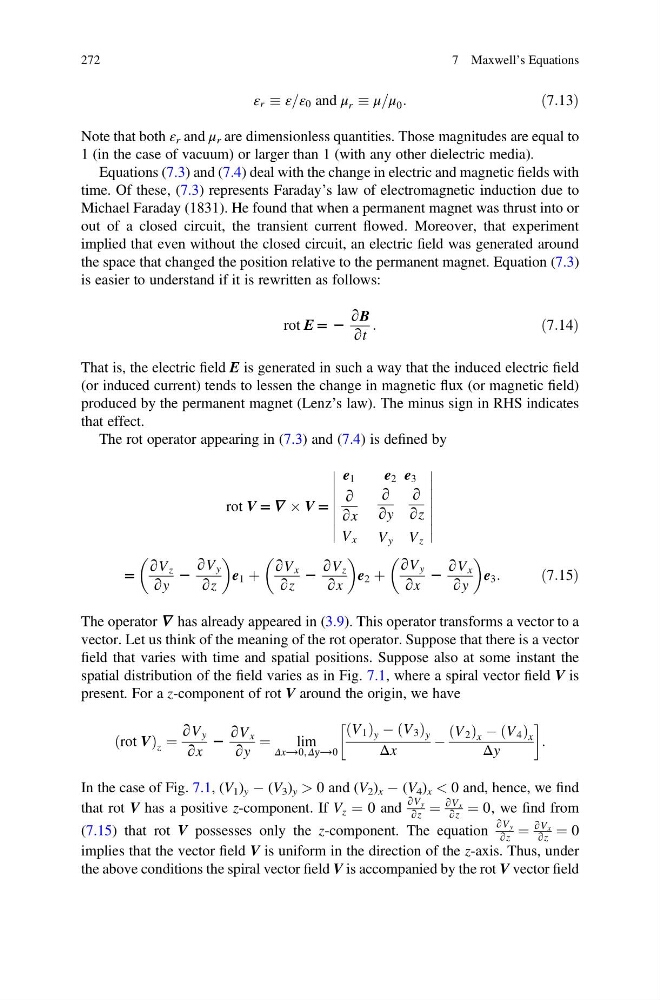
ε r ε=ε 0 and μ r μ=μ 0 :
ð7:13Þ
Note that both ε r and μ r are dimensionless quantities. Those magnitudes are equal to
1 (in the case of vacuum) or larger than 1 (with any other dielectric media).
Equations (7.3) and (7.4) deal with the change in electric and magnetic fields with
time. Of these, (7.3) represents Faraday’s law of electromagnetic induction due to
Michael Faraday (1831). He found that when a permanent magnet was thrust into or
out of a closed circuit, the transient current flowed. Moreover, that experiment
implied that even without the closed circuit, an electric field was generated around
the space that changed the position relative to the permanent magnet. Equation (7.3)
is easier to understand if it is rewritten as follows:
rot E = 2
∂B
∂t
:
ð7:14Þ
That is, the electric field E is generated in such a way that the induced electric field
(or induced current) tends to lessen the change in magnetic flux (or magnetic field)
produced by the permanent magnet (Lenz’s law). The minus sign in RHS indicates
that effect.
The rot operator appearing in (7.3) and (7.4) is defined by
rot V = — Â V =
e 1
e 2 e 3
∂
∂x
V x
∂
∂y
∂
∂z
V y V z
=
∂V z
∂y
2
∂V y
∂z
e 1 þ
∂V x
∂z
2
∂V z
∂x
e 2 þ
∂V y
∂x
2
∂V x
∂y
e 3 :
ð7:15Þ
The operator — has already appeared in (3.9). This operator transforms a vector to a
vector. Let us think of the meaning of the rot operator. Suppose that there is a vector
field that varies with time and spatial positions. Suppose also at some instant the
spatial distribution of the field varies as in Fig. 7.1, where a spiral vector field V is
present. For a z-component of rot V around the origin, we have
rot V
ð
Þ z ¼
∂V y
∂x
2
∂V x
∂y
¼
lim
Δx⟶0, Δy⟶0
V 1
ð Þ y À V 3
ð Þ y
Δx
À
V 2
ð Þ x À V 4
ð Þ x
Δy
!
:
In the case of Fig. 7.1, (V 1 ) y À (V 3 ) y > 0 and (V 2 ) x À (V 4 ) x < 0 and, hence, we find
that rot V has a positive z-component. If V z ¼ 0 and
∂V y
∂z
¼
∂V x
∂z
¼ 0, we find from
(7.15) that rot V possesses only the z-component. The equation
∂V y
∂z
¼
∂V x
∂z
¼ 0
implies that the vector field V is uniform in the direction of the z-axis. Thus, under
the above conditions the spiral vector field V is accompanied by the rot V vector field
272
7 Maxwell’s Equations
ð7:13Þ
Note that both ε r and μ r are dimensionless quantities. Those magnitudes are equal to
1 (in the case of vacuum) or larger than 1 (with any other dielectric media).
Equations (7.3) and (7.4) deal with the change in electric and magnetic fields with
time. Of these, (7.3) represents Faraday’s law of electromagnetic induction due to
Michael Faraday (1831). He found that when a permanent magnet was thrust into or
out of a closed circuit, the transient current flowed. Moreover, that experiment
implied that even without the closed circuit, an electric field was generated around
the space that changed the position relative to the permanent magnet. Equation (7.3)
is easier to understand if it is rewritten as follows:
rot E = 2
∂B
∂t
:
ð7:14Þ
That is, the electric field E is generated in such a way that the induced electric field
(or induced current) tends to lessen the change in magnetic flux (or magnetic field)
produced by the permanent magnet (Lenz’s law). The minus sign in RHS indicates
that effect.
The rot operator appearing in (7.3) and (7.4) is defined by
rot V = — Â V =
e 1
e 2 e 3
∂
∂x
V x
∂
∂y
∂
∂z
V y V z
=
∂V z
∂y
2
∂V y
∂z
e 1 þ
∂V x
∂z
2
∂V z
∂x
e 2 þ
∂V y
∂x
2
∂V x
∂y
e 3 :
ð7:15Þ
The operator — has already appeared in (3.9). This operator transforms a vector to a
vector. Let us think of the meaning of the rot operator. Suppose that there is a vector
field that varies with time and spatial positions. Suppose also at some instant the
spatial distribution of the field varies as in Fig. 7.1, where a spiral vector field V is
present. For a z-component of rot V around the origin, we have
rot V
ð
Þ z ¼
∂V y
∂x
2
∂V x
∂y
¼
lim
Δx⟶0, Δy⟶0
V 1
ð Þ y À V 3
ð Þ y
Δx
À
V 2
ð Þ x À V 4
ð Þ x
Δy
!
:
In the case of Fig. 7.1, (V 1 ) y À (V 3 ) y > 0 and (V 2 ) x À (V 4 ) x < 0 and, hence, we find
that rot V has a positive z-component. If V z ¼ 0 and
∂V y
∂z
¼
∂V x
∂z
¼ 0, we find from
(7.15) that rot V possesses only the z-component. The equation
∂V y
∂z
¼
∂V x
∂z
¼ 0
implies that the vector field V is uniform in the direction of the z-axis. Thus, under
the above conditions the spiral vector field V is accompanied by the rot V vector field
272
7 Maxwell’s Equations