

∂ψ
∂x
¼
i
ħ
p x ψ 0 e
i
p
ħ ∙ xÀ
E
ħ t
ð
Þ ¼
i
ħ
p x ψ:
ð1:28Þ
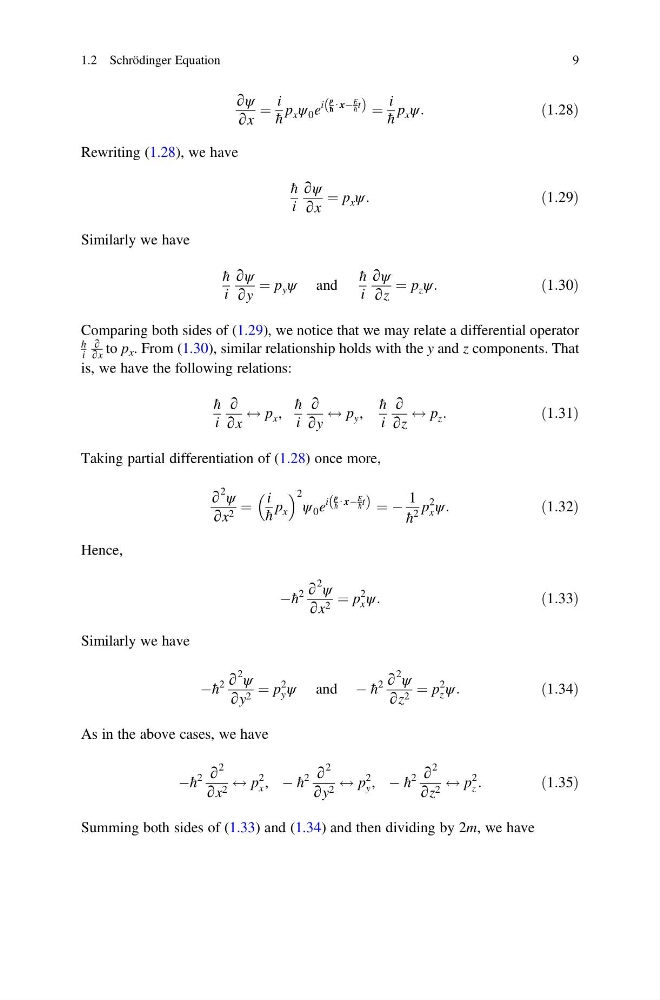
Rewriting (1.28), we have
ħ
i
∂ψ
∂x
¼ p x ψ:
ð1:29Þ
Similarly we have
ħ
i
∂ψ
∂y
¼ p y ψ and
ħ
i
∂ψ
∂z
¼ p z ψ:
ð1:30Þ
Comparing both sides of (1.29), we notice that we may relate a differential operator
ħ
i
∂
∂x
to p x . From (1.30), similar relationship holds with the y and z components. That
is, we have the following relations:
ħ
i
∂
∂x
$ p x ,
ħ
i
∂
∂y
$ p y ,
ħ
i
∂
∂z
$ p z :
ð1:31Þ
Taking partial differentiation of (1.28) once more,
∂
2 ψ
∂x 2 ¼
i
ħ
p x
2
ψ 0 e
i
p
ħ ∙ xÀ
E
ħ t
ð
Þ ¼ À
1
ħ
2
p
2
x ψ:
ð1:32Þ
Hence,
Àħ
2 ∂
2 ψ
∂x 2 ¼ p
2
x ψ:
ð1:33Þ
Similarly we have
Àħ
2 ∂
2 ψ
∂y 2 ¼ p
2
y ψ and À ħ
2 ∂
2 ψ
∂z 2 ¼ p
2
z ψ:
ð1:34Þ
As in the above cases, we have
Àħ
2 ∂
2
∂x 2 $ p
2
x , À ħ
2 ∂
2
∂y 2 $ p
2
y , À ħ
2 ∂
2
∂z 2 $ p
2
z :
ð1:35Þ
Summing both sides of (1.33) and (1.34) and then dividing by 2m, we have
1.2 Schrödinger Equation
9
∂x
¼
i
ħ
p x ψ 0 e
i
p
ħ ∙ xÀ
E
ħ t
ð
Þ ¼
i
ħ
p x ψ:
ð1:28Þ
Rewriting (1.28), we have
ħ
i
∂ψ
∂x
¼ p x ψ:
ð1:29Þ
Similarly we have
ħ
i
∂ψ
∂y
¼ p y ψ and
ħ
i
∂ψ
∂z
¼ p z ψ:
ð1:30Þ
Comparing both sides of (1.29), we notice that we may relate a differential operator
ħ
i
∂
∂x
to p x . From (1.30), similar relationship holds with the y and z components. That
is, we have the following relations:
ħ
i
∂
∂x
$ p x ,
ħ
i
∂
∂y
$ p y ,
ħ
i
∂
∂z
$ p z :
ð1:31Þ
Taking partial differentiation of (1.28) once more,
∂
2 ψ
∂x 2 ¼
i
ħ
p x
2
ψ 0 e
i
p
ħ ∙ xÀ
E
ħ t
ð
Þ ¼ À
1
ħ
2
p
2
x ψ:
ð1:32Þ
Hence,
Àħ
2 ∂
2 ψ
∂x 2 ¼ p
2
x ψ:
ð1:33Þ
Similarly we have
Àħ
2 ∂
2 ψ
∂y 2 ¼ p
2
y ψ and À ħ
2 ∂
2 ψ
∂z 2 ¼ p
2
z ψ:
ð1:34Þ
As in the above cases, we have
Àħ
2 ∂
2
∂x 2 $ p
2
x , À ħ
2 ∂
2
∂y 2 $ p
2
y , À ħ
2 ∂
2
∂z 2 $ p
2
z :
ð1:35Þ
Summing both sides of (1.33) and (1.34) and then dividing by 2m, we have
1.2 Schrödinger Equation
9