

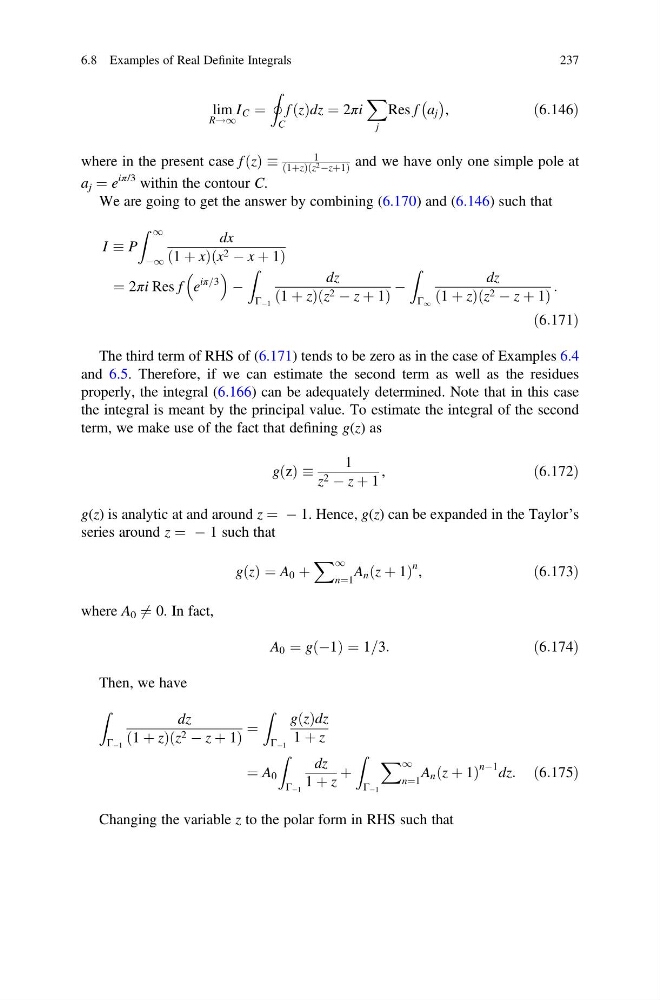
lim
R!1
I C ¼
I
C
f z
ð Þdz ¼ 2πi
X
j
Res f a j
À Á
,
ð6:146Þ
where in the present case f z
ð Þ
1
1þz
ð
Þ z 2 Àzþ1
ð
Þ and we have only one simple pole at
a j ¼ e
iπ/3 within the contour C.
We are going to get the answer by combining (6.170) and (6.146) such that
I P
Z 1
À1
dx
1 þ x
ð
Þ x 2 À x þ 1
ð
Þ
¼ 2πi Res f e
iπ=3
À
Z
Γ À1
dz
1 þ z
ð
Þ z 2 À z þ 1
ð
Þ
À
Z
Γ 1
dz
1 þ z
ð
Þ z 2 À z þ 1
ð
Þ
:
ð6:171Þ
The third term of RHS of (6.171) tends to be zero as in the case of Examples 6.4
and 6.5. Therefore, if we can estimate the second term as well as the residues
properly, the integral (6.166) can be adequately determined. Note that in this case
the integral is meant by the principal value. To estimate the integral of the second
term, we make use of the fact that defining g(z) as
g z
ð Þ
1
z 2 À z þ 1
,
ð6:172Þ
g(z) is analytic at and around z ¼ À 1. Hence, g(z) can be expanded in the Taylor’s
series around z ¼ À 1 such that
g z
ð Þ ¼ A 0 þ
X 1
n¼1
A n z þ 1
ð
Þ
n ,
ð6:173Þ
where A 0 6 ¼ 0. In fact,
A 0 ¼ g À1
ð Þ ¼ 1=3:
ð6:174Þ
Then, we have
Z
Γ À1
dz
1 þ z
ð
Þ z 2 À z þ 1
ð
Þ
¼
Z
Γ À1
g z
ð Þdz
1 þ z
¼ A 0
Z
Γ À1
dz
1 þ z
þ
Z
Γ À1
X 1
n¼1
A n z þ 1
ð
Þ
nÀ1 dz: ð6:175Þ
Changing the variable z to the polar form in RHS such that
6.8 Examples of Real Definite Integrals
237
R!1
I C ¼
I
C
f z
ð Þdz ¼ 2πi
X
j
Res f a j
À Á
,
ð6:146Þ
where in the present case f z
ð Þ
1
1þz
ð
Þ z 2 Àzþ1
ð
Þ and we have only one simple pole at
a j ¼ e
iπ/3 within the contour C.
We are going to get the answer by combining (6.170) and (6.146) such that
I P
Z 1
À1
dx
1 þ x
ð
Þ x 2 À x þ 1
ð
Þ
¼ 2πi Res f e
iπ=3
À
Z
Γ À1
dz
1 þ z
ð
Þ z 2 À z þ 1
ð
Þ
À
Z
Γ 1
dz
1 þ z
ð
Þ z 2 À z þ 1
ð
Þ
:
ð6:171Þ
The third term of RHS of (6.171) tends to be zero as in the case of Examples 6.4
and 6.5. Therefore, if we can estimate the second term as well as the residues
properly, the integral (6.166) can be adequately determined. Note that in this case
the integral is meant by the principal value. To estimate the integral of the second
term, we make use of the fact that defining g(z) as
g z
ð Þ
1
z 2 À z þ 1
,
ð6:172Þ
g(z) is analytic at and around z ¼ À 1. Hence, g(z) can be expanded in the Taylor’s
series around z ¼ À 1 such that
g z
ð Þ ¼ A 0 þ
X 1
n¼1
A n z þ 1
ð
Þ
n ,
ð6:173Þ
where A 0 6 ¼ 0. In fact,
A 0 ¼ g À1
ð Þ ¼ 1=3:
ð6:174Þ
Then, we have
Z
Γ À1
dz
1 þ z
ð
Þ z 2 À z þ 1
ð
Þ
¼
Z
Γ À1
g z
ð Þdz
1 þ z
¼ A 0
Z
Γ À1
dz
1 þ z
þ
Z
Γ À1
X 1
n¼1
A n z þ 1
ð
Þ
nÀ1 dz: ð6:175Þ
Changing the variable z to the polar form in RHS such that
6.8 Examples of Real Definite Integrals
237