

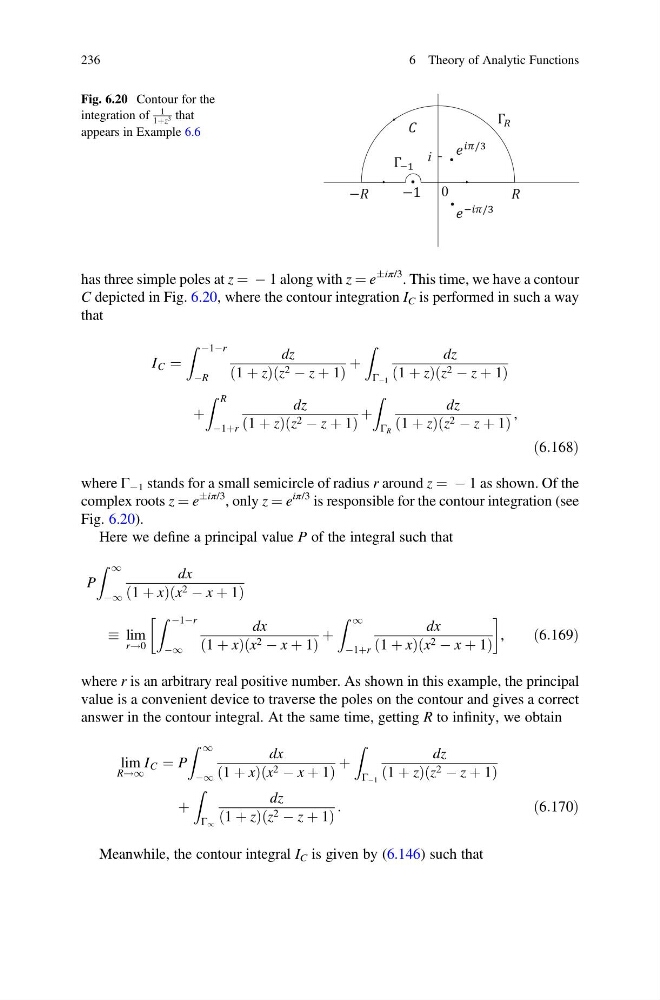
has three simple poles at z ¼ À 1 along with z ¼ e
Æiπ/3 . This time, we have a contour
C depicted in Fig. 6.20, where the contour integration I C is performed in such a way
that
I C ¼
Z À1Àr
ÀR
dz
1 þ z
ð
Þ z 2 À z þ 1
ð
Þ
þ
Z
Γ À1
dz
1 þ z
ð
Þ z 2 À z þ 1
ð
Þ
þ
Z R
À1þr
dz
1 þ z
ð
Þ z 2 À z þ 1
ð
Þ
þ
Z
Γ R
dz
1 þ z
ð
Þ z 2 À z þ 1
ð
Þ
,
ð6:168Þ
where Γ À1 stands for a small semicircle of radius r around z ¼ À 1 as shown. Of the
complex roots z ¼ e
Æiπ/3 , only z ¼ e
iπ/3 is responsible for the contour integration (see
Fig. 6.20).
Here we define a principal value P of the integral such that
P
Z 1
À1
dx
1 þ x
ð
Þ x 2 À x þ 1
ð
Þ
lim
r!0
Z À1Àr
À1
dx
1 þ x
ð
Þ x 2 À x þ 1
ð
Þ
þ
Z 1
À1þr
dx
1 þ x
ð
Þ x 2 À x þ 1
ð
Þ
!
,
ð6:169Þ
where r is an arbitrary real positive number. As shown in this example, the principal
value is a convenient device to traverse the poles on the contour and gives a correct
answer in the contour integral. At the same time, getting R to infinity, we obtain
lim
R!1
I C ¼ P
Z 1
À1
dx
1 þ x
ð
Þ x 2 À x þ 1
ð
Þ
þ
Z
Γ À1
dz
1 þ z
ð
Þ z 2 À z þ 1
ð
Þ
þ
Z
Γ 1
dz
1 þ z
ð
Þ z 2 À z þ 1
ð
Þ
:
ð6:170Þ
Meanwhile, the contour integral I C is given by (6.146) such that
i
−1 0
−
Γ
Γ
/
/
Fig. 6.20 Contour for the
integration of
1
1þz 3 that
appears in Example 6.6
236
6 Theory of Analytic Functions
Æiπ/3 . This time, we have a contour
C depicted in Fig. 6.20, where the contour integration I C is performed in such a way
that
I C ¼
Z À1Àr
ÀR
dz
1 þ z
ð
Þ z 2 À z þ 1
ð
Þ
þ
Z
Γ À1
dz
1 þ z
ð
Þ z 2 À z þ 1
ð
Þ
þ
Z R
À1þr
dz
1 þ z
ð
Þ z 2 À z þ 1
ð
Þ
þ
Z
Γ R
dz
1 þ z
ð
Þ z 2 À z þ 1
ð
Þ
,
ð6:168Þ
where Γ À1 stands for a small semicircle of radius r around z ¼ À 1 as shown. Of the
complex roots z ¼ e
Æiπ/3 , only z ¼ e
iπ/3 is responsible for the contour integration (see
Fig. 6.20).
Here we define a principal value P of the integral such that
P
Z 1
À1
dx
1 þ x
ð
Þ x 2 À x þ 1
ð
Þ
lim
r!0
Z À1Àr
À1
dx
1 þ x
ð
Þ x 2 À x þ 1
ð
Þ
þ
Z 1
À1þr
dx
1 þ x
ð
Þ x 2 À x þ 1
ð
Þ
!
,
ð6:169Þ
where r is an arbitrary real positive number. As shown in this example, the principal
value is a convenient device to traverse the poles on the contour and gives a correct
answer in the contour integral. At the same time, getting R to infinity, we obtain
lim
R!1
I C ¼ P
Z 1
À1
dx
1 þ x
ð
Þ x 2 À x þ 1
ð
Þ
þ
Z
Γ À1
dz
1 þ z
ð
Þ z 2 À z þ 1
ð
Þ
þ
Z
Γ 1
dz
1 þ z
ð
Þ z 2 À z þ 1
ð
Þ
:
ð6:170Þ
Meanwhile, the contour integral I C is given by (6.146) such that
i
−1 0
−
Γ
Γ
/
/
Fig. 6.20 Contour for the
integration of
1
1þz 3 that
appears in Example 6.6
236
6 Theory of Analytic Functions