

f z
ð Þ ¼ e f ζ
ð Þ ¼
1
ζ þ 2i
ð
Þ
3 ζ
3
¼
1
ζ
3
Á
1
2i
ð Þ
3
Á 1 þ
ζ
2i
À3
¼
1
ζ
3
Á
1
2i
ð Þ
3
Á 1 þ À3
ð Þ
ζ
2i
þ
À3
ð Þ À4
ð Þ
2!
ζ
2i
2
þ
À3
ð Þ À4
ð Þ À5
ð Þ
3!
ζ
2i
3
þ Á Á Á
"
#
¼ À
1
8i
1
ζ
3
À
3
2iζ
2
À
3
2ζ
þ
5
4i
þ Á Á Á
!
,
ð6:163Þ
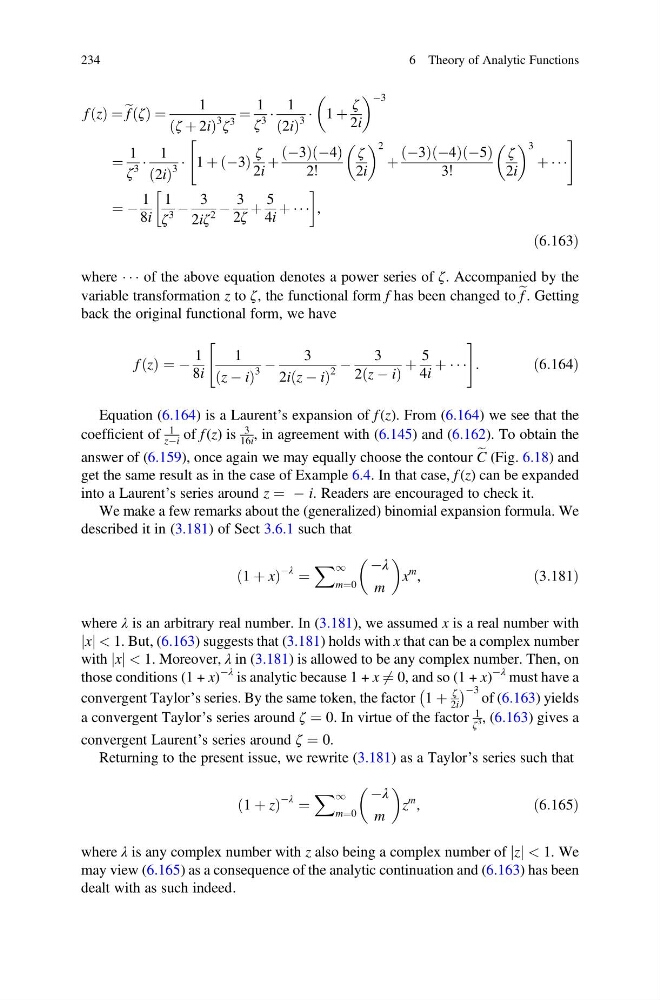
where Á Á Á of the above equation denotes a power series of ζ. Accompanied by the
variable transformation z to ζ, the functional form f has been changed to e f . Getting
back the original functional form, we have
f z
ð Þ ¼ À
1
8i
1
z À i
ð
Þ
3
À
3
2i z À i
ð
Þ
2
À
3
2 z À i
ð
Þ
þ
5
4i
þ Á Á Á
"
#
:
ð6:164Þ
Equation (6.164) is a Laurent’s expansion of f (z). From (6.164) we see that the
coefficient of
1
zÀi of f (z) is
3
16i , in agreement with (6.145) and (6.162). To obtain the
answer of (6.159), once again we may equally choose the contour e
C (Fig. 6.18) and
get the same result as in the case of Example 6.4. In that case, f (z) can be expanded
into a Laurent’s series around z ¼ À i. Readers are encouraged to check it.
We make a few remarks about the (generalized) binomial expansion formula. We
described it in (3.181) of Sect 3.6.1 such that
1 þ x
ð
Þ
Àλ ¼
X 1
m¼0
Àλ
m
x
m ,
ð3:181Þ
where λ is an arbitrary real number. In (3.181), we assumed x is a real number with
jxj < 1. But, (6.163) suggests that (3.181) holds with x that can be a complex number
with jxj < 1. Moreover, λ in (3.181) is allowed to be any complex number. Then, on
those conditions (1 + x)
Àλ is analytic because 1 + x 6 ¼ 0, and so (1 + x)
Àλ must have a
convergent Taylor’s series. By the same token, the factor 1 þ
ζ
2i
À
Á À3 of (6.163) yields
a convergent Taylor’s series around ζ ¼ 0. In virtue of the factor
1
ζ
3 , (6.163) gives a
convergent Laurent’s series around ζ ¼ 0.
Returning to the present issue, we rewrite (3.181) as a Taylor’s series such that
1 þ z
ð
Þ
Àλ ¼
X 1
m¼0
Àλ
m
z
m ,
ð6:165Þ
where λ is any complex number with z also being a complex number of jzj < 1. We
may view (6.165) as a consequence of the analytic continuation and (6.163) has been
dealt with as such indeed.
234
6 Theory of Analytic Functions
ð Þ ¼ e f ζ
ð Þ ¼
1
ζ þ 2i
ð
Þ
3 ζ
3
¼
1
ζ
3
Á
1
2i
ð Þ
3
Á 1 þ
ζ
2i
À3
¼
1
ζ
3
Á
1
2i
ð Þ
3
Á 1 þ À3
ð Þ
ζ
2i
þ
À3
ð Þ À4
ð Þ
2!
ζ
2i
2
þ
À3
ð Þ À4
ð Þ À5
ð Þ
3!
ζ
2i
3
þ Á Á Á
"
#
¼ À
1
8i
1
ζ
3
À
3
2iζ
2
À
3
2ζ
þ
5
4i
þ Á Á Á
!
,
ð6:163Þ
where Á Á Á of the above equation denotes a power series of ζ. Accompanied by the
variable transformation z to ζ, the functional form f has been changed to e f . Getting
back the original functional form, we have
f z
ð Þ ¼ À
1
8i
1
z À i
ð
Þ
3
À
3
2i z À i
ð
Þ
2
À
3
2 z À i
ð
Þ
þ
5
4i
þ Á Á Á
"
#
:
ð6:164Þ
Equation (6.164) is a Laurent’s expansion of f (z). From (6.164) we see that the
coefficient of
1
zÀi of f (z) is
3
16i , in agreement with (6.145) and (6.162). To obtain the
answer of (6.159), once again we may equally choose the contour e
C (Fig. 6.18) and
get the same result as in the case of Example 6.4. In that case, f (z) can be expanded
into a Laurent’s series around z ¼ À i. Readers are encouraged to check it.
We make a few remarks about the (generalized) binomial expansion formula. We
described it in (3.181) of Sect 3.6.1 such that
1 þ x
ð
Þ
Àλ ¼
X 1
m¼0
Àλ
m
x
m ,
ð3:181Þ
where λ is an arbitrary real number. In (3.181), we assumed x is a real number with
jxj < 1. But, (6.163) suggests that (3.181) holds with x that can be a complex number
with jxj < 1. Moreover, λ in (3.181) is allowed to be any complex number. Then, on
those conditions (1 + x)
Àλ is analytic because 1 + x 6 ¼ 0, and so (1 + x)
Àλ must have a
convergent Taylor’s series. By the same token, the factor 1 þ
ζ
2i
À
Á À3 of (6.163) yields
a convergent Taylor’s series around ζ ¼ 0. In virtue of the factor
1
ζ
3 , (6.163) gives a
convergent Laurent’s series around ζ ¼ 0.
Returning to the present issue, we rewrite (3.181) as a Taylor’s series such that
1 þ z
ð
Þ
Àλ ¼
X 1
m¼0
Àλ
m
z
m ,
ð6:165Þ
where λ is any complex number with z also being a complex number of jzj < 1. We
may view (6.165) as a consequence of the analytic continuation and (6.163) has been
dealt with as such indeed.
234
6 Theory of Analytic Functions