

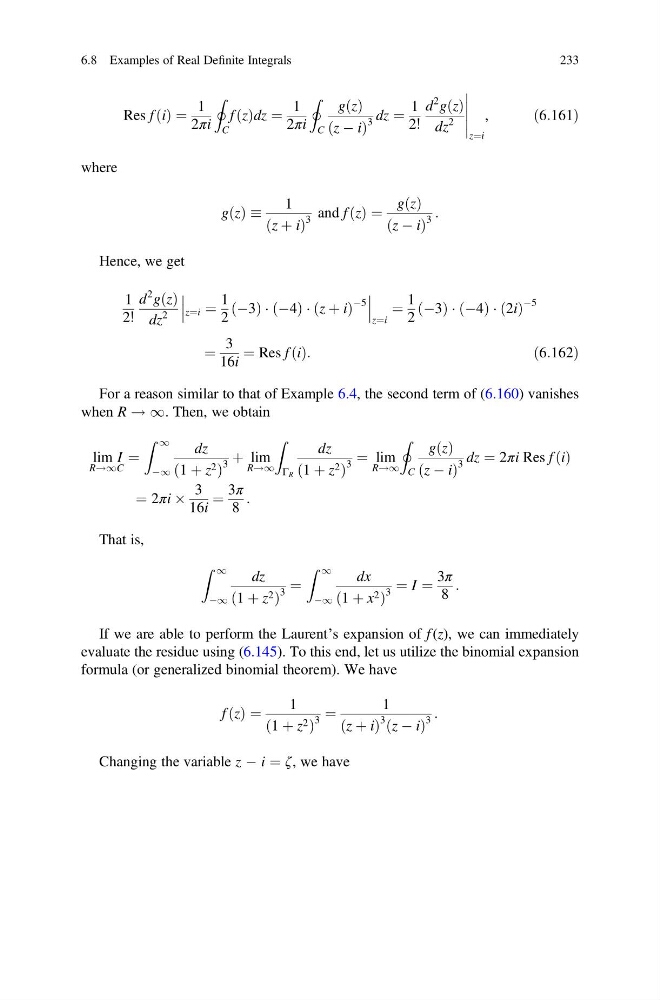
Res f i
ð Þ ¼
1
2πi
I
C
f z
ð Þdz ¼
1
2πi
I
C
g z
ð Þ
z À i
ð
Þ
3
dz ¼
1
2!
d
2 g z
ð Þ
dz
2
z¼i
,
ð6:161Þ
where
g z
ð Þ
1
z þ i
ð
Þ
3
and f z
ð Þ ¼
g z
ð Þ
z À i
ð
Þ
3
:
Hence, we get
1
2!
d
2 g z
ð Þ
dz
2
z¼i ¼
1
2
À3
ð ÞÁ À4
ð ÞÁ z þ i
ð
Þ
À5
z¼i
¼
1
2
À3
ð ÞÁ À4
ð ÞÁ 2i
ð Þ
À5
¼
3
16i
¼ Res f i
ð Þ:
ð6:162Þ
For a reason similar to that of Example 6.4, the second term of (6.160) vanishes
when R ! 1. Then, we obtain
lim
R!1
I
C
¼
Z 1
À1
dz
1 þ z 2
ð
Þ
3
þ lim
R!1
Z
Γ R
dz
1 þ z 2
ð
Þ
3
¼ lim
R!1
I
C
g z
ð Þ
z À i
ð
Þ
3
dz ¼ 2πi Res f i
ð Þ
¼ 2πi Â
3
16i
¼
3π
8
:
That is,
Z 1
À1
dz
1 þ z 2
ð
Þ
3
¼
Z 1
À1
dx
1 þ x 2
ð
Þ
3
¼ I ¼
3π
8
:
If we are able to perform the Laurent’s expansion of f (z), we can immediately
evaluate the residue using (6.145). To this end, let us utilize the binomial expansion
formula (or generalized binomial theorem). We have
f z
ð Þ ¼
1
1 þ z 2
ð
Þ
3
¼
1
z þ i
ð
Þ
3 z À i
ð
Þ
3
:
Changing the variable z À i ¼ ζ, we have
6.8 Examples of Real Definite Integrals
233
ð Þ ¼
1
2πi
I
C
f z
ð Þdz ¼
1
2πi
I
C
g z
ð Þ
z À i
ð
Þ
3
dz ¼
1
2!
d
2 g z
ð Þ
dz
2
z¼i
,
ð6:161Þ
where
g z
ð Þ
1
z þ i
ð
Þ
3
and f z
ð Þ ¼
g z
ð Þ
z À i
ð
Þ
3
:
Hence, we get
1
2!
d
2 g z
ð Þ
dz
2
z¼i ¼
1
2
À3
ð ÞÁ À4
ð ÞÁ z þ i
ð
Þ
À5
z¼i
¼
1
2
À3
ð ÞÁ À4
ð ÞÁ 2i
ð Þ
À5
¼
3
16i
¼ Res f i
ð Þ:
ð6:162Þ
For a reason similar to that of Example 6.4, the second term of (6.160) vanishes
when R ! 1. Then, we obtain
lim
R!1
I
C
¼
Z 1
À1
dz
1 þ z 2
ð
Þ
3
þ lim
R!1
Z
Γ R
dz
1 þ z 2
ð
Þ
3
¼ lim
R!1
I
C
g z
ð Þ
z À i
ð
Þ
3
dz ¼ 2πi Res f i
ð Þ
¼ 2πi Â
3
16i
¼
3π
8
:
That is,
Z 1
À1
dz
1 þ z 2
ð
Þ
3
¼
Z 1
À1
dx
1 þ x 2
ð
Þ
3
¼ I ¼
3π
8
:
If we are able to perform the Laurent’s expansion of f (z), we can immediately
evaluate the residue using (6.145). To this end, let us utilize the binomial expansion
formula (or generalized binomial theorem). We have
f z
ð Þ ¼
1
1 þ z 2
ð
Þ
3
¼
1
z þ i
ð
Þ
3 z À i
ð
Þ
3
:
Changing the variable z À i ¼ ζ, we have
6.8 Examples of Real Definite Integrals
233