

Theorem 6.16 Let f 1 (z) and f 2 (z) be two functions that are analytic within a region
R . Suppose that the two functions coincide in a set chosen from among (i) a
neighborhood of a point z 2 R , or (ii) a segment of a curve lying in R , or (iii) a
set of points containing an accumulation point belonging to R . Then, the two
functions f 1 (z) and f 2 (z) coincide throughout R .
Proof Suppose that f 1 (z) and f 2 (z) coincide on the above set chosen from the three.
Then, since f 1 (z) À f 2 (z) ¼ 0 on that set, the set comprises the zeros of f 1 (z) À f 2 (z).
This implies that the zeros are not isolated in R . Thus, as evidenced from the
discussion of Sect. 6.5, we conclude that f 1 (z) À f 2 (z) 0 throughout R . That is,
f 1 (z) f 2 (z). This completes the proof.
∎
The theorem can be understood as follows: Two different analytic functions
cannot coincide in the set chosen from the above three (or more succinctly, a set
that contains an accumulation point). In other words, the behavior of an analytic
function in R is uniquely determined by the limited information of the subset
belonging to R .
The above statement is reminiscent of the pre-established harmony and, hence,
occasionally talked about mysteriously. Instead, we wish to give a simple example.
Example 6.3 In Example 6.2 we described a tangible illustration of the Taylor’s
expansion of a function 1/z as follows:
1
z
¼
X 1
n¼0
À1
ð Þ
n
a nþ1 z À a
ð
Þ
n ¼
1
a
X 1
n¼0
1 À
z
a
n :
ð6:119Þ
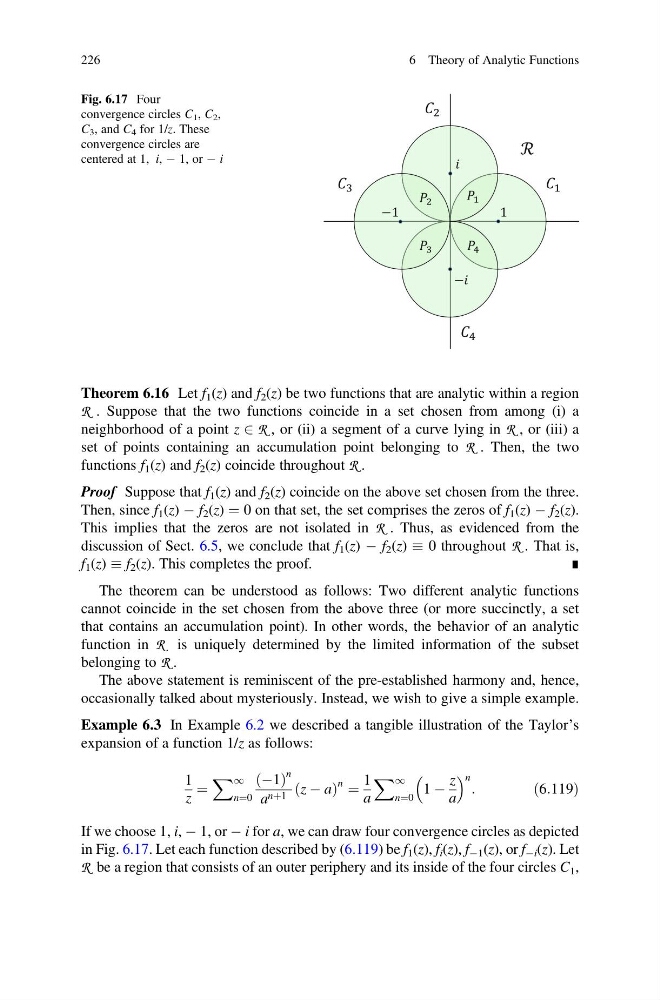
If we choose 1, i, À 1, or À i for a, we can draw four convergence circles as depicted
in Fig. 6.17. Let each function described by (6.119) be f 1 (z), f i (z), f À1 (z), or f Ài (z). Let
R be a region that consists of an outer periphery and its inside of the four circles C 1 ,
−1
1
−
ℛ
Fig. 6.17 Four
convergence circles C 1 , C 2 ,
C 3 , and C 4 for 1/z. These
convergence circles are
centered at 1, i, À 1, or À i
226
6 Theory of Analytic Functions
R . Suppose that the two functions coincide in a set chosen from among (i) a
neighborhood of a point z 2 R , or (ii) a segment of a curve lying in R , or (iii) a
set of points containing an accumulation point belonging to R . Then, the two
functions f 1 (z) and f 2 (z) coincide throughout R .
Proof Suppose that f 1 (z) and f 2 (z) coincide on the above set chosen from the three.
Then, since f 1 (z) À f 2 (z) ¼ 0 on that set, the set comprises the zeros of f 1 (z) À f 2 (z).
This implies that the zeros are not isolated in R . Thus, as evidenced from the
discussion of Sect. 6.5, we conclude that f 1 (z) À f 2 (z) 0 throughout R . That is,
f 1 (z) f 2 (z). This completes the proof.
∎
The theorem can be understood as follows: Two different analytic functions
cannot coincide in the set chosen from the above three (or more succinctly, a set
that contains an accumulation point). In other words, the behavior of an analytic
function in R is uniquely determined by the limited information of the subset
belonging to R .
The above statement is reminiscent of the pre-established harmony and, hence,
occasionally talked about mysteriously. Instead, we wish to give a simple example.
Example 6.3 In Example 6.2 we described a tangible illustration of the Taylor’s
expansion of a function 1/z as follows:
1
z
¼
X 1
n¼0
À1
ð Þ
n
a nþ1 z À a
ð
Þ
n ¼
1
a
X 1
n¼0
1 À
z
a
n :
ð6:119Þ
If we choose 1, i, À 1, or À i for a, we can draw four convergence circles as depicted
in Fig. 6.17. Let each function described by (6.119) be f 1 (z), f i (z), f À1 (z), or f Ài (z). Let
R be a region that consists of an outer periphery and its inside of the four circles C 1 ,
−1
1
−
ℛ
Fig. 6.17 Four
convergence circles C 1 , C 2 ,
C 3 , and C 4 for 1/z. These
convergence circles are
centered at 1, i, À 1, or À i
226
6 Theory of Analytic Functions