

f z
ð Þ ¼
g z
ð Þ
z À a
ð
Þ
n ,
ð6:140Þ
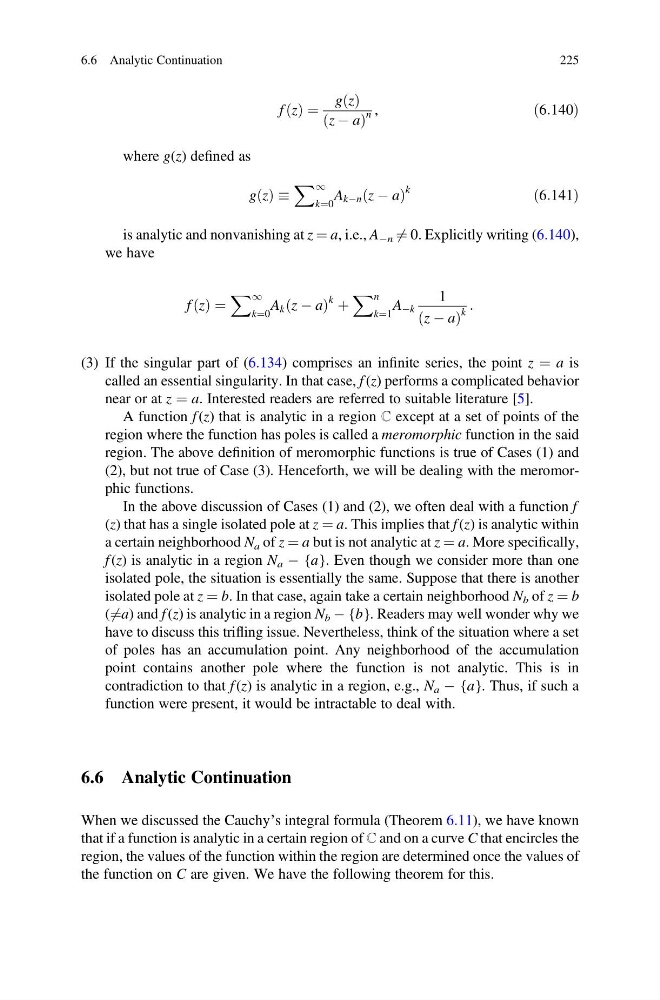
where g(z) defined as
g z
ð Þ
X 1
k¼0
A kÀn z À a
ð
Þ
k
ð6:141Þ
is analytic and nonvanishing at z ¼ a, i.e., A Àn 6 ¼ 0. Explicitly writing (6.140),
we have
f z
ð Þ ¼
X 1
k¼0
A k z À a
ð
Þ
k þ
X n
k¼1
A Àk
1
z À a
ð
Þ
k
:
(3) If the singular part of (6.134) comprises an infinite series, the point z ¼ a is
called an essential singularity. In that case, f (z) performs a complicated behavior
near or at z ¼ a. Interested readers are referred to suitable literature [5].
A function f (z) that is analytic in a region ℂ except at a set of points of the
region where the function has poles is called a meromorphic function in the said
region. The above definition of meromorphic functions is true of Cases (1) and
(2), but not true of Case (3). Henceforth, we will be dealing with the meromorphic functions.
In the above discussion of Cases (1) and (2), we often deal with a function f
(z) that has a single isolated pole at z ¼ a. This implies that f (z) is analytic within
a certain neighborhood N a of z ¼ a but is not analytic at z ¼ a. More specifically,
f (z) is analytic in a region N a À {a}. Even though we consider more than one
isolated pole, the situation is essentially the same. Suppose that there is another
isolated pole at z ¼ b. In that case, again take a certain neighborhood N b of z ¼ b
(6 ¼a) and f (z) is analytic in a region N b À {b}. Readers may well wonder why we
have to discuss this trifling issue. Nevertheless, think of the situation where a set
of poles has an accumulation point. Any neighborhood of the accumulation
point contains another pole where the function is not analytic. This is in
contradiction to that f (z) is analytic in a region, e.g., N a À {a}. Thus, if such a
function were present, it would be intractable to deal with.
6.6 Analytic Continuation
When we discussed the Cauchy’s integral formula (Theorem 6.11), we have known
that if a function is analytic in a certain region of ℂ and on a curve C that encircles the
region, the values of the function within the region are determined once the values of
the function on C are given. We have the following theorem for this.
6.6 Analytic Continuation
225
ð Þ ¼
g z
ð Þ
z À a
ð
Þ
n ,
ð6:140Þ
where g(z) defined as
g z
ð Þ
X 1
k¼0
A kÀn z À a
ð
Þ
k
ð6:141Þ
is analytic and nonvanishing at z ¼ a, i.e., A Àn 6 ¼ 0. Explicitly writing (6.140),
we have
f z
ð Þ ¼
X 1
k¼0
A k z À a
ð
Þ
k þ
X n
k¼1
A Àk
1
z À a
ð
Þ
k
:
(3) If the singular part of (6.134) comprises an infinite series, the point z ¼ a is
called an essential singularity. In that case, f (z) performs a complicated behavior
near or at z ¼ a. Interested readers are referred to suitable literature [5].
A function f (z) that is analytic in a region ℂ except at a set of points of the
region where the function has poles is called a meromorphic function in the said
region. The above definition of meromorphic functions is true of Cases (1) and
(2), but not true of Case (3). Henceforth, we will be dealing with the meromorphic functions.
In the above discussion of Cases (1) and (2), we often deal with a function f
(z) that has a single isolated pole at z ¼ a. This implies that f (z) is analytic within
a certain neighborhood N a of z ¼ a but is not analytic at z ¼ a. More specifically,
f (z) is analytic in a region N a À {a}. Even though we consider more than one
isolated pole, the situation is essentially the same. Suppose that there is another
isolated pole at z ¼ b. In that case, again take a certain neighborhood N b of z ¼ b
(6 ¼a) and f (z) is analytic in a region N b À {b}. Readers may well wonder why we
have to discuss this trifling issue. Nevertheless, think of the situation where a set
of poles has an accumulation point. Any neighborhood of the accumulation
point contains another pole where the function is not analytic. This is in
contradiction to that f (z) is analytic in a region, e.g., N a À {a}. Thus, if such a
function were present, it would be intractable to deal with.
6.6 Analytic Continuation
When we discussed the Cauchy’s integral formula (Theorem 6.11), we have known
that if a function is analytic in a certain region of ℂ and on a curve C that encircles the
region, the values of the function within the region are determined once the values of
the function on C are given. We have the following theorem for this.
6.6 Analytic Continuation
225