

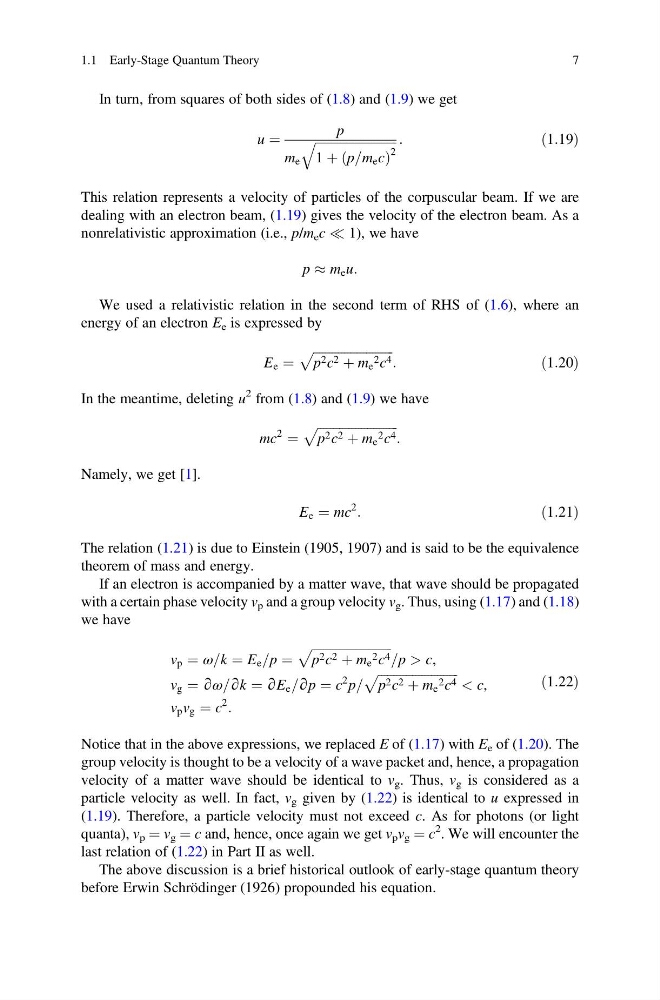
In turn, from squares of both sides of (1.8) and (1.9) we get
u ¼
p
m e
ffiffiffiffiffiffiffiffiffiffiffiffiffiffiffiffiffiffiffiffiffiffiffiffiffiffi
1 þ p=m e c
ð
Þ
2
q
:
ð1:19Þ
This relation represents a velocity of particles of the corpuscular beam. If we are
dealing with an electron beam, (1.19) gives the velocity of the electron beam. As a
nonrelativistic approximation (i.e., p/m e c ( 1), we have
p % m e u:
We used a relativistic relation in the second term of RHS of (1.6), where an
energy of an electron E e is expressed by
E e ¼
ffiffiffiffiffiffiffiffiffiffiffiffiffiffiffiffiffiffiffiffiffiffiffiffiffi ffi
p 2 c 2 þ m e
2 c 4
p
:
ð1:20Þ
In the meantime, deleting u
2 from (1.8) and (1.9) we have
mc
2
¼
ffiffiffiffiffiffiffiffiffiffiffiffiffiffiffiffiffiffiffiffiffiffiffiffiffi ffi
p 2 c 2 þ m e
2 c 4
p
:
Namely, we get [1].
E e ¼ mc
2
:
ð1:21Þ
The relation (1.21) is due to Einstein (1905, 1907) and is said to be the equivalence
theorem of mass and energy.
If an electron is accompanied by a matter wave, that wave should be propagated
with a certain phase velocity v p and a group velocity v g . Thus, using (1.17) and (1.18)
we have
v p ¼ ω=k ¼ E e =p ¼
ffiffiffiffiffiffiffiffiffiffiffiffiffiffiffiffiffiffiffiffiffiffiffiffiffi ffi
p 2 c 2 þ m e
2 c 4
p
=p > c,
v g ¼ ∂ω=∂k ¼ ∂E e =∂p ¼ c
2 p=
ffiffiffiffiffiffiffiffiffiffiffiffiffiffiffiffiffiffiffiffiffiffiffiffiffi ffi
p 2 c 2 þ m e
2 c 4
p
< c,
v p v g ¼ c
2
:
ð1:22Þ
Notice that in the above expressions, we replaced E of (1.17) with E e of (1.20). The
group velocity is thought to be a velocity of a wave packet and, hence, a propagation
velocity of a matter wave should be identical to v g . Thus, v g is considered as a
particle velocity as well. In fact, v g given by (1.22) is identical to u expressed in
(1.19). Therefore, a particle velocity must not exceed c. As for photons (or light
quanta), v p ¼ v g ¼ c and, hence, once again we get v p v g ¼ c
2 . We will encounter the
last relation of (1.22) in Part II as well.
The above discussion is a brief historical outlook of early-stage quantum theory
before Erwin Schrödinger (1926) propounded his equation.
1.1 Early-Stage Quantum Theory
7
u ¼
p
m e
ffiffiffiffiffiffiffiffiffiffiffiffiffiffiffiffiffiffiffiffiffiffiffiffiffiffi
1 þ p=m e c
ð
Þ
2
q
:
ð1:19Þ
This relation represents a velocity of particles of the corpuscular beam. If we are
dealing with an electron beam, (1.19) gives the velocity of the electron beam. As a
nonrelativistic approximation (i.e., p/m e c ( 1), we have
p % m e u:
We used a relativistic relation in the second term of RHS of (1.6), where an
energy of an electron E e is expressed by
E e ¼
ffiffiffiffiffiffiffiffiffiffiffiffiffiffiffiffiffiffiffiffiffiffiffiffiffi ffi
p 2 c 2 þ m e
2 c 4
p
:
ð1:20Þ
In the meantime, deleting u
2 from (1.8) and (1.9) we have
mc
2
¼
ffiffiffiffiffiffiffiffiffiffiffiffiffiffiffiffiffiffiffiffiffiffiffiffiffi ffi
p 2 c 2 þ m e
2 c 4
p
:
Namely, we get [1].
E e ¼ mc
2
:
ð1:21Þ
The relation (1.21) is due to Einstein (1905, 1907) and is said to be the equivalence
theorem of mass and energy.
If an electron is accompanied by a matter wave, that wave should be propagated
with a certain phase velocity v p and a group velocity v g . Thus, using (1.17) and (1.18)
we have
v p ¼ ω=k ¼ E e =p ¼
ffiffiffiffiffiffiffiffiffiffiffiffiffiffiffiffiffiffiffiffiffiffiffiffiffi ffi
p 2 c 2 þ m e
2 c 4
p
=p > c,
v g ¼ ∂ω=∂k ¼ ∂E e =∂p ¼ c
2 p=
ffiffiffiffiffiffiffiffiffiffiffiffiffiffiffiffiffiffiffiffiffiffiffiffiffi ffi
p 2 c 2 þ m e
2 c 4
p
< c,
v p v g ¼ c
2
:
ð1:22Þ
Notice that in the above expressions, we replaced E of (1.17) with E e of (1.20). The
group velocity is thought to be a velocity of a wave packet and, hence, a propagation
velocity of a matter wave should be identical to v g . Thus, v g is considered as a
particle velocity as well. In fact, v g given by (1.22) is identical to u expressed in
(1.19). Therefore, a particle velocity must not exceed c. As for photons (or light
quanta), v p ¼ v g ¼ c and, hence, once again we get v p v g ¼ c
2 . We will encounter the
last relation of (1.22) in Part II as well.
The above discussion is a brief historical outlook of early-stage quantum theory
before Erwin Schrödinger (1926) propounded his equation.
1.1 Early-Stage Quantum Theory
7