

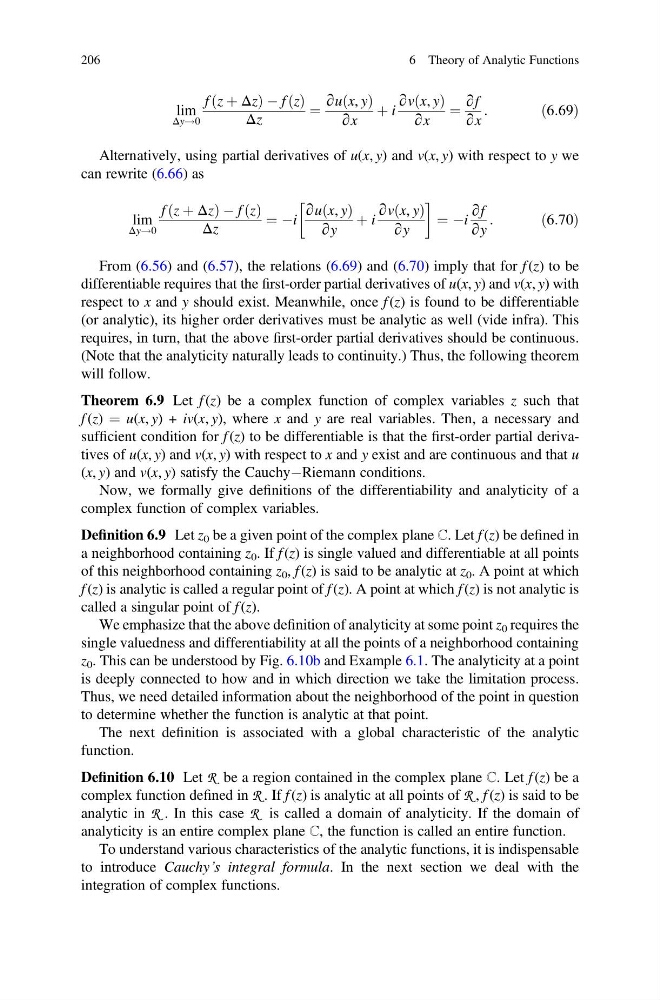
lim
Δy!0
f z þ Δz
ð
ÞÀf z
ð Þ
Δz
¼
∂u x, y
ð Þ
∂x
þ i
∂v x, y
ð Þ
∂x
¼
∂f
∂x
:
ð6:69Þ
Alternatively, using partial derivatives of u(x, y) and v(x, y) with respect to y we
can rewrite (6.66) as
lim
Δy!0
f z þ Δz
ð
ÞÀf z
ð Þ
Δz
¼ Ài
∂u x, y
ð Þ
∂y
þ i
∂v x, y
ð Þ
∂y
!
¼ Ài
∂f
∂y
:
ð6:70Þ
From (6.56) and (6.57), the relations (6.69) and (6.70) imply that for f (z) to be
differentiable requires that the first-order partial derivatives of u(x, y) and v(x, y) with
respect to x and y should exist. Meanwhile, once f (z) is found to be differentiable
(or analytic), its higher order derivatives must be analytic as well (vide infra). This
requires, in turn, that the above first-order partial derivatives should be continuous.
(Note that the analyticity naturally leads to continuity.) Thus, the following theorem
will follow.
Theorem 6.9 Let f (z) be a complex function of complex variables z such that
f (z) ¼ u(x, y) + iv(x, y), where x and y are real variables. Then, a necessary and
sufficient condition for f (z) to be differentiable is that the first-order partial derivatives of u(x, y) and v(x, y) with respect to x and y exist and are continuous and that u
(x, y) and v(x, y) satisfy the CauchyÀRiemann conditions.
Now, we formally give definitions of the differentiability and analyticity of a
complex function of complex variables.
Definition 6.9 Let z 0 be a given point of the complex plane ℂ. Let f (z) be defined in
a neighborhood containing z 0 . If f (z) is single valued and differentiable at all points
of this neighborhood containing z 0 , f (z) is said to be analytic at z 0 . A point at which
f (z) is analytic is called a regular point of f (z). A point at which f (z) is not analytic is
called a singular point of f (z).
We emphasize that the above definition of analyticity at some point z 0 requires the
single valuedness and differentiability at all the points of a neighborhood containing
z 0 . This can be understood by Fig. 6.10b and Example 6.1. The analyticity at a point
is deeply connected to how and in which direction we take the limitation process.
Thus, we need detailed information about the neighborhood of the point in question
to determine whether the function is analytic at that point.
The next definition is associated with a global characteristic of the analytic
function.
Definition 6.10 Let R be a region contained in the complex plane ℂ. Let f (z) be a
complex function defined in R . If f (z) is analytic at all points of R , f (z) is said to be
analytic in R . In this case R is called a domain of analyticity. If the domain of
analyticity is an entire complex plane ℂ, the function is called an entire function.
To understand various characteristics of the analytic functions, it is indispensable
to introduce Cauchy’s integral formula. In the next section we deal with the
integration of complex functions.
206
6 Theory of Analytic Functions
Δy!0
f z þ Δz
ð
ÞÀf z
ð Þ
Δz
¼
∂u x, y
ð Þ
∂x
þ i
∂v x, y
ð Þ
∂x
¼
∂f
∂x
:
ð6:69Þ
Alternatively, using partial derivatives of u(x, y) and v(x, y) with respect to y we
can rewrite (6.66) as
lim
Δy!0
f z þ Δz
ð
ÞÀf z
ð Þ
Δz
¼ Ài
∂u x, y
ð Þ
∂y
þ i
∂v x, y
ð Þ
∂y
!
¼ Ài
∂f
∂y
:
ð6:70Þ
From (6.56) and (6.57), the relations (6.69) and (6.70) imply that for f (z) to be
differentiable requires that the first-order partial derivatives of u(x, y) and v(x, y) with
respect to x and y should exist. Meanwhile, once f (z) is found to be differentiable
(or analytic), its higher order derivatives must be analytic as well (vide infra). This
requires, in turn, that the above first-order partial derivatives should be continuous.
(Note that the analyticity naturally leads to continuity.) Thus, the following theorem
will follow.
Theorem 6.9 Let f (z) be a complex function of complex variables z such that
f (z) ¼ u(x, y) + iv(x, y), where x and y are real variables. Then, a necessary and
sufficient condition for f (z) to be differentiable is that the first-order partial derivatives of u(x, y) and v(x, y) with respect to x and y exist and are continuous and that u
(x, y) and v(x, y) satisfy the CauchyÀRiemann conditions.
Now, we formally give definitions of the differentiability and analyticity of a
complex function of complex variables.
Definition 6.9 Let z 0 be a given point of the complex plane ℂ. Let f (z) be defined in
a neighborhood containing z 0 . If f (z) is single valued and differentiable at all points
of this neighborhood containing z 0 , f (z) is said to be analytic at z 0 . A point at which
f (z) is analytic is called a regular point of f (z). A point at which f (z) is not analytic is
called a singular point of f (z).
We emphasize that the above definition of analyticity at some point z 0 requires the
single valuedness and differentiability at all the points of a neighborhood containing
z 0 . This can be understood by Fig. 6.10b and Example 6.1. The analyticity at a point
is deeply connected to how and in which direction we take the limitation process.
Thus, we need detailed information about the neighborhood of the point in question
to determine whether the function is analytic at that point.
The next definition is associated with a global characteristic of the analytic
function.
Definition 6.10 Let R be a region contained in the complex plane ℂ. Let f (z) be a
complex function defined in R . If f (z) is analytic at all points of R , f (z) is said to be
analytic in R . In this case R is called a domain of analyticity. If the domain of
analyticity is an entire complex plane ℂ, the function is called an entire function.
To understand various characteristics of the analytic functions, it is indispensable
to introduce Cauchy’s integral formula. In the next section we deal with the
integration of complex functions.
206
6 Theory of Analytic Functions