

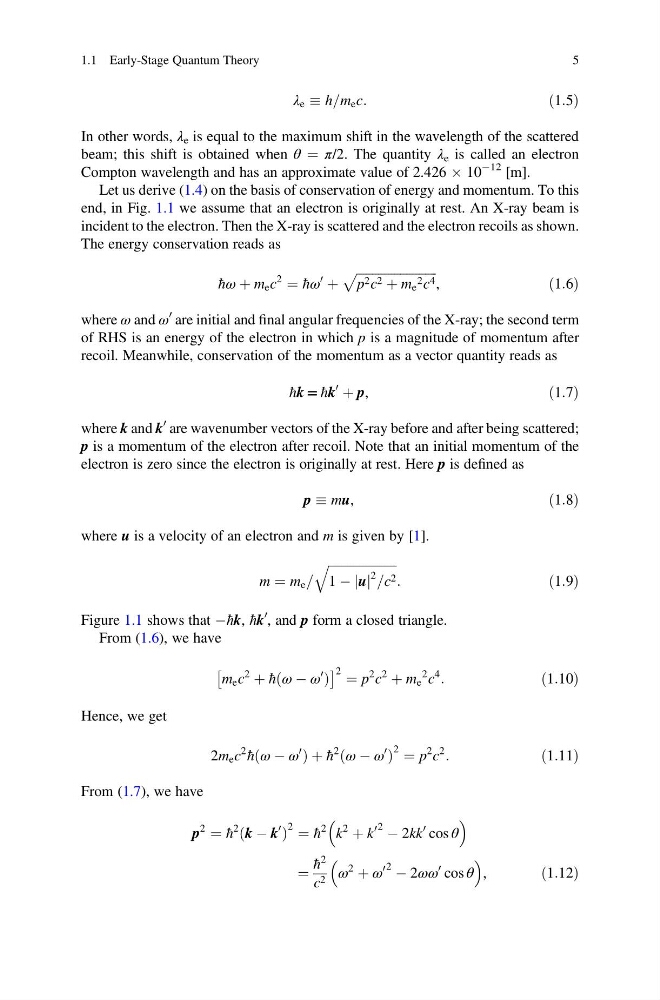
λ e h=m e c:
ð1:5Þ
In other words, λ e is equal to the maximum shift in the wavelength of the scattered
beam; this shift is obtained when θ ¼ π/2. The quantity λ e is called an electron
Compton wavelength and has an approximate value of 2.426 Â 10
À12 [m].
Let us derive (1.4) on the basis of conservation of energy and momentum. To this
end, in Fig. 1.1 we assume that an electron is originally at rest. An X-ray beam is
incident to the electron. Then the X-ray is scattered and the electron recoils as shown.
The energy conservation reads as
ħω þ m e c
2
¼ ħω
0
þ
ffiffiffiffiffiffiffiffiffiffiffiffiffiffiffiffiffiffiffiffiffiffiffiffiffi ffi
p 2 c 2 þ m e
2 c 4
p
,
ð1:6Þ
where ω and ω
0 are initial and final angular frequencies of the X-ray; the second term
of RHS is an energy of the electron in which p is a magnitude of momentum after
recoil. Meanwhile, conservation of the momentum as a vector quantity reads as
ħk = ħk
0
þ p,
ð1:7Þ
where k and k
0 are wavenumber vectors of the X-ray before and after being scattered;
p is a momentum of the electron after recoil. Note that an initial momentum of the
electron is zero since the electron is originally at rest. Here p is defined as
p mu,
ð1:8Þ
where u is a velocity of an electron and m is given by [1].
m ¼ m e =
ffiffiffiffiffiffiffiffiffiffiffiffiffiffiffiffiffiffiffiffiffiffi
1 À u
j j
2 =c 2
q
:
ð1:9Þ
Figure 1.1 shows that Àħk, ħk
0
, and p form a closed triangle.
From (1.6), we have
m e c
2
þ ħ ω À ω
0
ð
Þ
Â
à 2 ¼ p
2 c
2
þ m e
2 c
4
:
ð1:10Þ
Hence, we get
2m e c
2
ħ ω À ω
0
ð
Þþħ
2
ω À ω
0
ð
Þ
2 ¼ p
2 c
2
:
ð1:11Þ
From (1.7), we have
p
2
¼ ħ
2
k À k
0
ð
Þ
2 ¼ ħ
2 k
2
þ k
0 2 À 2kk
0 cos θ
¼
ħ
2
c 2 ω
2
þ ω
0 2 À 2ωω
0 cos θ
,
ð1:12Þ
1.1 Early-Stage Quantum Theory
5
ð1:5Þ
In other words, λ e is equal to the maximum shift in the wavelength of the scattered
beam; this shift is obtained when θ ¼ π/2. The quantity λ e is called an electron
Compton wavelength and has an approximate value of 2.426 Â 10
À12 [m].
Let us derive (1.4) on the basis of conservation of energy and momentum. To this
end, in Fig. 1.1 we assume that an electron is originally at rest. An X-ray beam is
incident to the electron. Then the X-ray is scattered and the electron recoils as shown.
The energy conservation reads as
ħω þ m e c
2
¼ ħω
0
þ
ffiffiffiffiffiffiffiffiffiffiffiffiffiffiffiffiffiffiffiffiffiffiffiffiffi ffi
p 2 c 2 þ m e
2 c 4
p
,
ð1:6Þ
where ω and ω
0 are initial and final angular frequencies of the X-ray; the second term
of RHS is an energy of the electron in which p is a magnitude of momentum after
recoil. Meanwhile, conservation of the momentum as a vector quantity reads as
ħk = ħk
0
þ p,
ð1:7Þ
where k and k
0 are wavenumber vectors of the X-ray before and after being scattered;
p is a momentum of the electron after recoil. Note that an initial momentum of the
electron is zero since the electron is originally at rest. Here p is defined as
p mu,
ð1:8Þ
where u is a velocity of an electron and m is given by [1].
m ¼ m e =
ffiffiffiffiffiffiffiffiffiffiffiffiffiffiffiffiffiffiffiffiffiffi
1 À u
j j
2 =c 2
q
:
ð1:9Þ
Figure 1.1 shows that Àħk, ħk
0
, and p form a closed triangle.
From (1.6), we have
m e c
2
þ ħ ω À ω
0
ð
Þ
Â
à 2 ¼ p
2 c
2
þ m e
2 c
4
:
ð1:10Þ
Hence, we get
2m e c
2
ħ ω À ω
0
ð
Þþħ
2
ω À ω
0
ð
Þ
2 ¼ p
2 c
2
:
ð1:11Þ
From (1.7), we have
p
2
¼ ħ
2
k À k
0
ð
Þ
2 ¼ ħ
2 k
2
þ k
0 2 À 2kk
0 cos θ
¼
ħ
2
c 2 ω
2
þ ω
0 2 À 2ωω
0 cos θ
,
ð1:12Þ
1.1 Early-Stage Quantum Theory
5